
Explore bodyweight exercise options in Mississauga with a practical guide to coaching, setup, clear instructions, and choosing versions you understand.
Bodyweight exercise sounds simple because it does not always require a rack of equipment. The actual experience can be less straightforward. A movement demonstrated effortlessly in a video may be difficult to understand, while a different version becomes manageable once the setup changes. Adapting bodyweight exercises in Mississauga begins with recognizing that choosing a version is part of training, not an admission that you have failed the original exercise.
The aim is to find an assigned task you can understand and discuss with a coach. That may involve a different support, position, range, or sequence. Which adjustment makes sense depends on the exercise and the person, so this article focuses on the questions and planning that make modifications useful. It does not prescribe one variation for everyone.
Stop treating the hardest-looking version as the default
Exercise demonstrations often show one finished version with little context about how it was learned. Viewers can easily assume that the demonstration defines the minimum standard. In a coached program, the starting version should be selected for the task at hand rather than for its visual impact.
Ask what the coach wants you to learn. The answer might concern a setup, a movement sequence, or maintaining attention to a particular cue. Once that purpose is clear, a modification becomes a practical teaching decision. You can judge whether it helps you practise the intended task instead of judging whether it looks impressive.
This perspective is especially useful in group settings. Different participants may use different versions without following different overall themes. Their choices reflect circumstances you may not know. Your own instruction deserves attention even when someone nearby performs a version that appears more demanding.
Describe the problem before selecting the adjustment
If an exercise is not working for you, explain what happens. “I cannot do it” may describe your frustration, but it does not tell the coach whether the issue is balance, setup, remembering the sequence, or something else. A more specific account gives the conversation a useful starting point.
You might say that you lose track of the instruction after the first repetition, do not know where to place your hands, or feel uncomfortable getting into the starting position. Those are different problems. They may call for different explanations or exercise choices.
If something feels painful or wrong, stop and tell the coach. Do not treat an online list of easier variations as a way to work around an unexplained problem. Relevant concerns and any professional guidance should be part of the discussion before choosing how to continue.
Understand what the support is doing
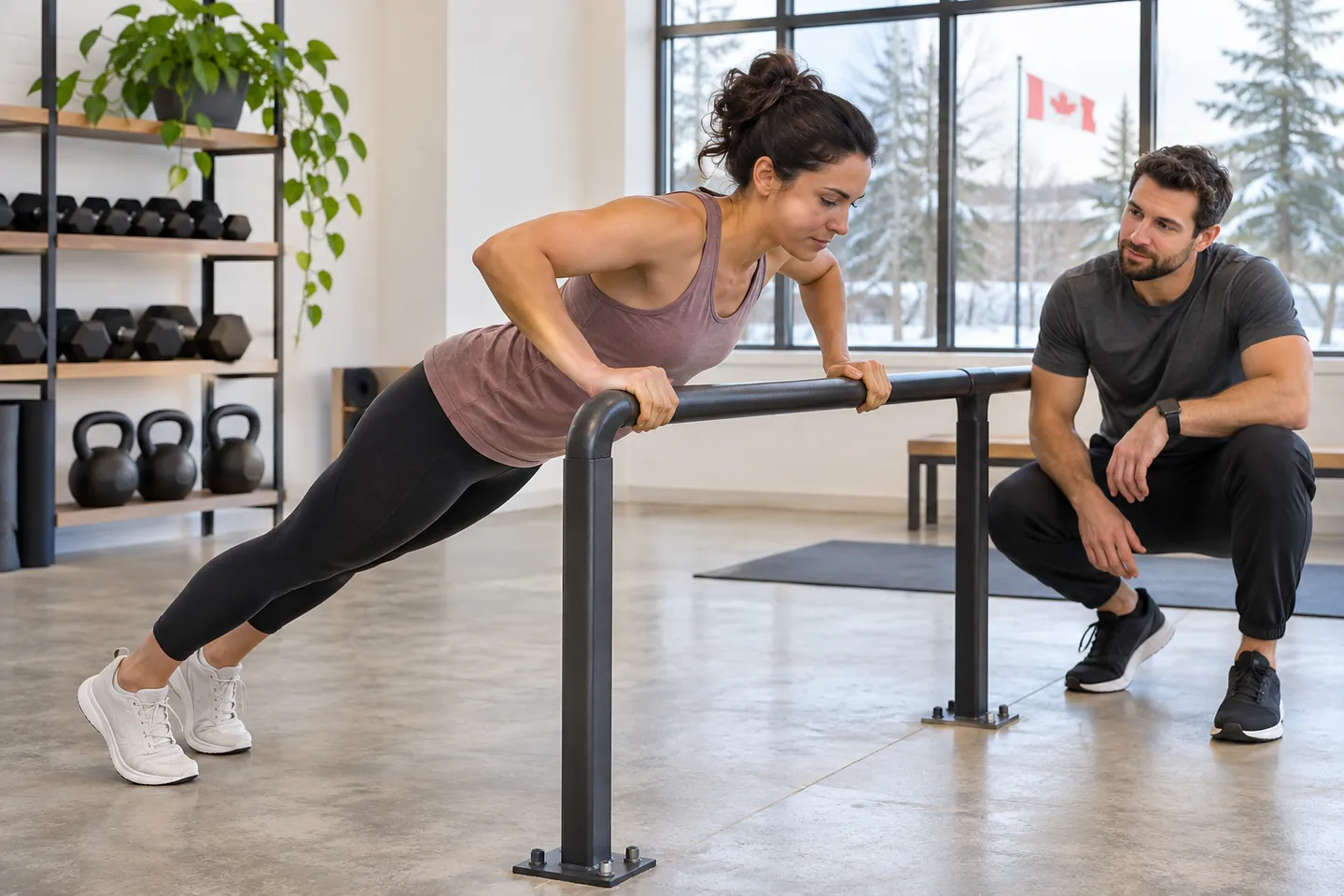
A bench, rail, wall, or other support may appear in a bodyweight variation. Ask why it is there and how you are meant to use it. Is it a place for your hands, a reference point, or an aid to the setup? Knowing its role helps you reproduce the exercise more accurately.
Use equipment selected or approved for the task. A household object that looks similar to a gym support may not behave the same way. Before adapting an exercise at home, discuss the actual space and equipment available rather than assuming any chair or table is an appropriate substitute.
The position of the support can also matter to the assigned version. Record the relevant details instead of remembering only that you used “something raised.” If you cannot recreate the arrangement, ask for help before treating a different setup as equivalent.
Make the instruction short enough to remember
A modification is most useful when it makes the task clearer. If the adjusted version comes with a long chain of instructions you cannot retain, ask the coach to identify the priority. You may need to practise the starting arrangement before adding the full movement.
Repeat the instruction in your own words and show the setup back to the coach. This reveals misunderstandings early. It also helps you learn the difference between what you observed and what you assumed while watching.
After trying the version, describe what became easier to understand and what remained confusing. This gives the coach feedback on the teaching, not just the exercise. A modification may solve one difficulty while revealing another detail that needs explanation.
Keep a clear distinction between different versions
When several alternatives are demonstrated, they can blend together in memory. Give each one a recognizable description in your notes. Include the support, position, and cue that distinguish it from the others.
Ask which version belongs in your current plan. Demonstrating an option does not necessarily mean you should rotate through every option independently. The coach may be comparing possibilities or showing where the exercise could develop later.
If you attend a class, clarify your version before the group begins moving quickly between tasks. It is easier to ask while the instruction is being given than to improvise after everyone has started. Arriving with a known option can also make subsequent sessions feel more straightforward.
Discuss pace and pauses as instructions
A bodyweight movement can feel quite different depending on how it is performed. If the program specifies a pace or a pause, ask what that means in practical terms. Do not assume the objective is to finish the repetitions as quickly as possible.
Likewise, understand when rest is intended. Some sessions use timed intervals; others use sets with a different structure. Ask how your modified version fits that format, especially if you need additional time to set up or change position.
Avoid adding extra repetitions simply because your variation looks less dramatic than another person’s. Follow the assigned work and report how it felt. The coach can use that information to decide whether the challenge or version should change.
Give home practice a realistic environment
If you plan to practise outside the gym, describe the space you actually have. Mention the floor surface, available room, and equipment you can reliably use. The coach can then discuss whether the assigned exercise translates to that environment.
Check the area before beginning. Move unrelated objects, make sure you understand where the exercise will take place, and keep the plan accessible. The practical setup should not require you to interrupt every set to rearrange the room.
If the environment changes, revisit the plan. A version taught using a fixed gym support may not have an obvious home equivalent. Asking for a suitable alternative is more useful than improvising with furniture simply to preserve the exercise name.
Know what would justify changing the version
Ask your coach how progress will be reviewed. You may be looking for greater familiarity, a clearer setup, or a change in the challenge within the current version. Progress does not always require abandoning the modification at the earliest opportunity.
When a change is proposed, understand what is new. The support may be different, the movement sequence may change, or the amount of work may be adjusted. Learning one change at a time can make the transition easier to describe and evaluate.
You can express a preference without deciding the program alone. If you enjoy a particular version or find another confusing, explain why. The coach can consider that information alongside the purpose of the exercise and your broader plan.
Record the experience without ranking yourself
A useful note describes what happened: the version used, the work completed, and a cue or question to remember. It does not need to label the session as good or bad. Factual notes give you something specific to bring back to coaching.
For example, you might record that a particular support made the setup clearer or that you needed another demonstration when switching sides. Those observations can help the next lesson begin in the right place. A vague statement that the exercise was difficult does less to guide the discussion.
Over time, the record may show that you prepare the exercise with less help and understand the instructions more quickly. Those are meaningful changes in how independently you can train. They deserve recognition alongside any change in the version itself.
Ask for a plan that fits your whole week
If you train with a friend, explain that you may be following different versions of the same exercise. Agree that neither person needs to copy the other to share the session. You can still start together, encourage attendance, and discuss the experience afterward while respecting the instructions each of you has received. This keeps company helpful without making matching movements the condition for training together.
Bodyweight exercises can appear in coached sessions, classes, and independent routines. Tell your coach where else you practise them so that the discussion includes the whole week. Repeating a movement because it appears in several unrelated plans is different from following one coordinated arrangement.
Keep the routine manageable enough to remember. A small set of clearly assigned movements may be more useful than a long collection of variations gathered from videos. You can add detail as your understanding develops instead of carrying an entire exercise library into every session.
Konga’s personal training service is a place to discuss guided exercise learning. Contact the team with your experience, goals, and questions about current options. A useful modification makes the next attempt clearer and gives you a version you can practise with appropriate instruction. That is the purpose of adapting the exercise in the first place.
Filed under
Keep exploring
More training insights await.