
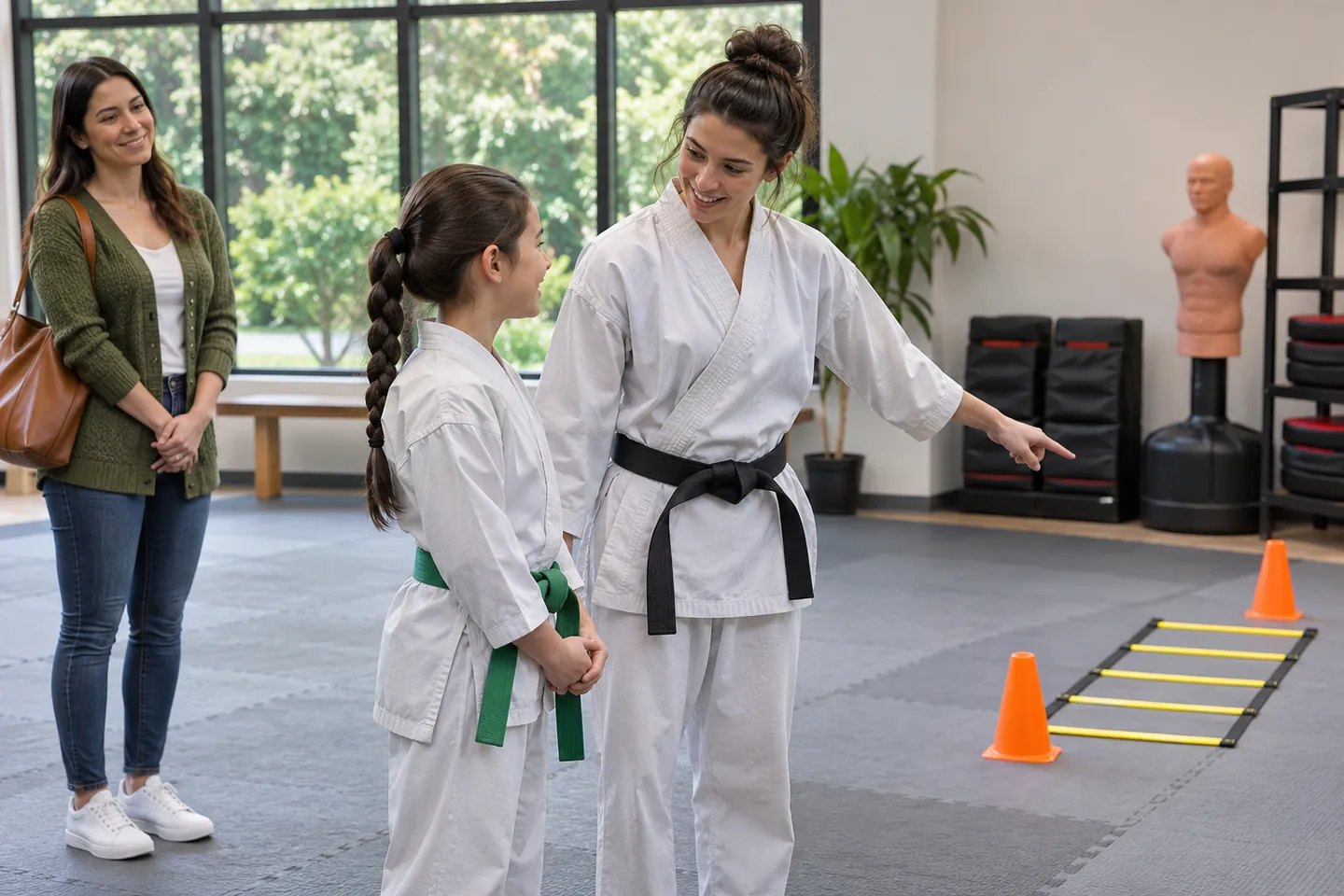
Set useful martial arts goals for children in Mississauga by focusing on the current class, observable habits, child input, and realistic coach-led next steps.
Parents often want to know what their child should be achieving in martial arts. The question is reasonable, but it becomes difficult when the answer is reduced to a universal timetable. Children enter with different experiences, interests, communication styles, and familiarity with group activities. A goal that is useful for one child may be irrelevant or too complicated for another in the same age group.
Setting age-appropriate martial arts goals in Mississauga starts with the actual child and the actual class. Ask the coach what the current activities are intended to teach, then choose a manageable behaviour or skill to notice. The goal should help the child understand the next step. It should not become a second curriculum imposed from the parent seating area.
Begin with the class placement
Confirm that the program has placed your child in an appropriate group for its current structure. Ask how age, experience, and readiness are considered. Do not assume that an age number alone establishes every expectation, or that the group a sibling attended in a previous year still works the same way.
The coach can explain what the class is practicing and what beginners are expected to manage. This context matters before you set a home goal. If the session is introducing basic routines, a parent target involving advanced combinations may be disconnected from the lesson. Alignment makes encouragement clearer and reduces competing instructions.
Share relevant information that helps the coach understand your child. Describe practical patterns, such as needing a demonstration repeated or finding transitions difficult. Avoid broad labels that suggest a fixed limitation. Specific observations make it easier to identify a useful starting point and a realistic next action.
Translate broad hopes into visible actions
Words such as confidence, focus, and discipline can mean different things to different families. A child may struggle to act on them because they are so broad. Translate the hope into a behaviour that fits the class. For example, asking the coach for help is more concrete than “be confident.”
Other useful examples might include waiting for the start signal, returning equipment to the assigned place, or trying the coach’s correction once before deciding the task is impossible. These are examples to discuss with the instructor, not a required checklist for every child. The right goal depends on what is currently being taught.
Keep the action small enough to recognize. A goal such as “listen perfectly for the whole class” leaves little room for ordinary learning. A more focused aim might involve stopping a side conversation when the coach begins a demonstration. Specificity makes feedback easier and avoids treating a single lapse as failure of the entire session.
Let the child contribute to the choice
Ask what your child wants to become more comfortable doing. They may mention remembering a sequence, working with a partner, or knowing where equipment belongs. Their answer can reveal a concern that adults have not noticed. A goal connected to that concern may feel more relevant than one selected entirely from the sideline.
Offer a small number of coach-approved possibilities if the child does not know how to answer. Too many options can make the conversation feel like another assignment. Explain each choice in ordinary language, then let the child express a preference. Participation in the decision does not mean they must design the training plan alone.
For older children and teenagers, allow more direct conversation with the instructor where appropriate. They can begin practicing how to ask for feedback and explain a learning difficulty. Parents remain involved, but the student should gradually have a voice in the activity they are attending. The arrangement should suit the child and the program.
Keep goals different from guarantees
A goal identifies something to work toward; it does not promise a result by a fixed date. Avoid turning the coach’s suggestion into a contract that the child must fulfill after a certain number of classes. Learning can be uneven, and a new activity may reveal that the goal needs to be adjusted.
Do not promise that martial arts will automatically solve every issue at school or home. A class can provide opportunities to practice habits, but transfer to other settings is not guaranteed. Concerns that require educational, medical, or other professional support should receive that support rather than being assigned entirely to a recreational program.
The useful question after a session is what the child tried and what they learned about the task. A goal can be valuable even when it shows that more explanation is needed. That information helps the coach choose the next step and helps the family avoid interpreting difficulty as unwillingness.
Use effort descriptions that have substance
“Try harder” is often too vague to help. A child may already feel they are trying and not know what should change. Describe the action the coach recommended: watch the full demonstration, ask for another example, or reset before repeating the movement. The instruction should come from the class context rather than a parent’s technical guess.
When acknowledging effort, name what you saw. “You tried the slower version after the coach showed it” gives the child a clear connection between an action and learning. Broad praise can be pleasant, but specific observations make it easier to understand what was useful and repeat it later.
Avoid praising only visible confidence or flawless execution. Quiet concentration, a respectful request for help, and a calm restart can also deserve recognition. This keeps the goal accessible to children with different temperaments and prevents performance style from becoming the only measure of progress.
Set a review point without constant checking
Agree on when to discuss the goal again with the coach. The timing should suit the program and the nature of the task. There is no universal interval that works for every child or skill. A clear review point can prevent the goal from becoming a question asked repeatedly after every small action.
Between reviews, keep parent commentary limited. Calling reminders from the sideline may interfere with the coach’s instruction and make the child feel continuously evaluated. Let the class provide the practice setting. Use appropriate communication channels if you need to share an observation or ask whether the goal still fits.
At the review, ask what has become easier, what remains confusing, and whether the next step should change. The answer may be to continue, simplify, or choose a different focus. Adjustment is part of the process. A goal that no longer serves the lesson should not remain in place merely because it was written down.
Avoid comparisons across children
Siblings or classmates may progress differently even when they attend the same program. One child may learn a movement quickly but find partner changes difficult. Another may cooperate comfortably while needing more repetitions of a sequence. A single ranking cannot represent those different learning tasks fairly.
Keep each child’s goals separate. Do not ask one sibling to prove that another should be able to perform the same action. The coach can explain the expectations for each student within the program. At home, discuss the child’s own effort and questions rather than using another person as a deadline.
Be careful with public charts or rewards that invite comparison. If your family uses a record, make sure it supports the intended behaviour without turning the class into a competition for parental approval. Ask whether a simple conversation would serve the purpose just as well. Not every useful goal needs a visible scoreboard.
Keep home support noncontact and appropriate
Parents can support preparation, listening routines, and equipment care without recreating the class. If a technical goal needs practice outside the gym, ask the coach for a suitable noncontact task. Follow the instruction provided and keep it within the child’s ability and available space.
Do not organize striking practice with siblings or friends. Children should understand that martial arts techniques are used only within the instructed activity and its boundaries. Konga’s kids program emphasizes not practicing on family members. A goal about learning a technique does not change that expectation.
Home support may be as simple as helping the child remember one question for the next lesson or preparing the bag together. These actions keep the learning connected to the coach. They also avoid turning family time into an additional training session that the child did not agree to and the instructor did not design.
Recognize when the goal should be replaced
If a goal creates repeated confusion or conflict, revisit it. Perhaps it was too broad, poorly explained, or no longer relevant to the class. Ask the coach for perspective and listen to the child’s account. The solution may be a smaller step rather than a stronger demand.
A useful goal should make the next action clearer. It should leave room for mistakes, questions, and changes in the lesson. Families exploring kids martial arts at Konga can use the free trial page to discuss the current program and appropriate expectations. Start with the child in front of you, the class they are joining, and one practical thing worth learning next.
Filed under
Keep exploring
More training insights await.