
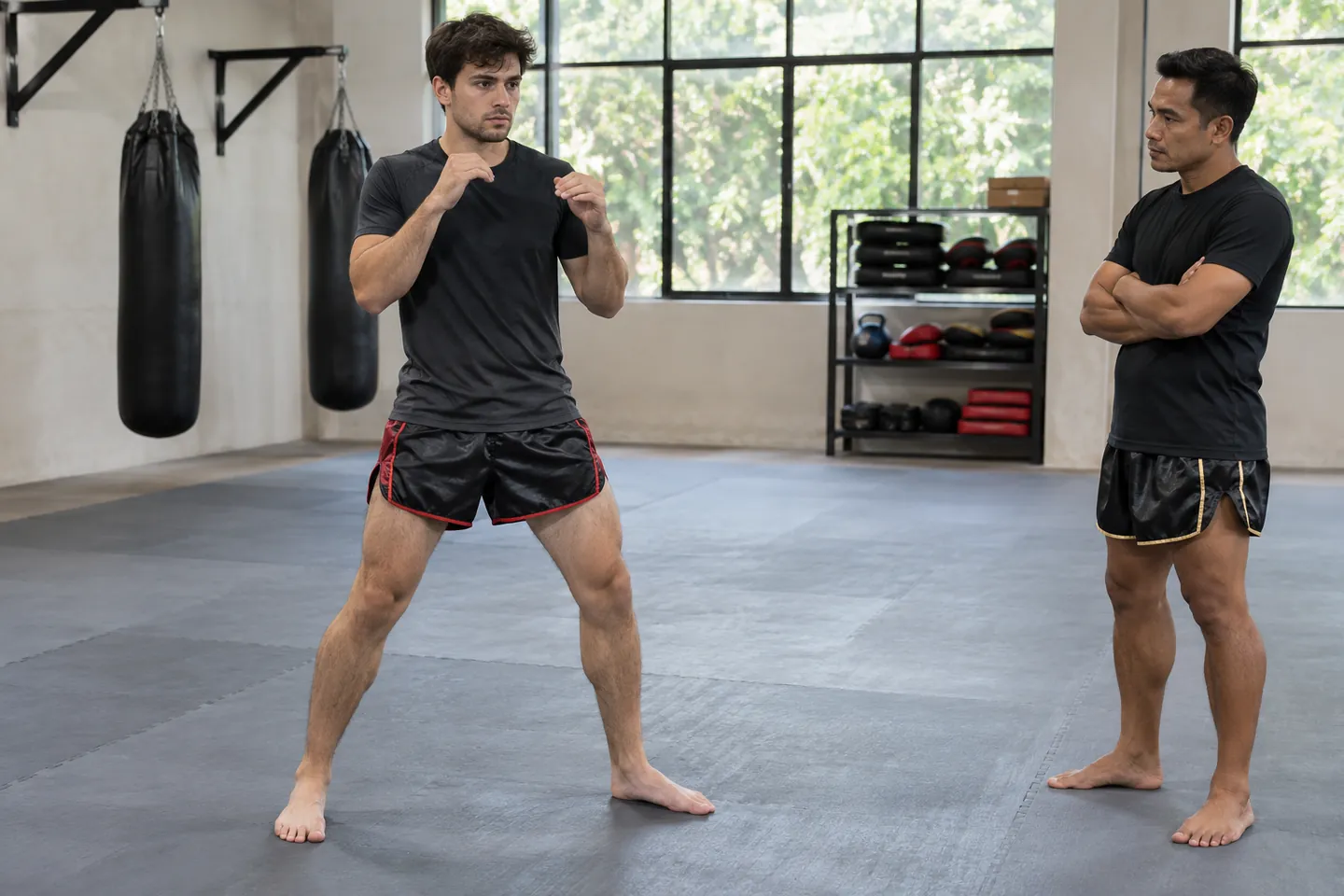
Explore balance in Muay Thai in Mississauga with practical ways to notice unstable finishes, ask for coaching, simplify drills, and track useful progress.
Balance becomes noticeable when it disappears. A beginner finishes a kick and needs two extra steps. A short combination ends with the feet somewhere unexpected. A change of direction feels harder than the strike that preceded it. These moments can be frustrating, but they also provide useful information for a coach watching the lesson.
For adults learning Muay Thai in Mississauga, balance is best approached through the actual movements being taught. It is not simply a contest to see who can stand on one leg longest, and it does not require a collection of unusual home exercises. Start by noticing when the position becomes uncertain, then let the coach adjust the task so that the cause can be explored.
Describe the moment, not your identity
Saying “I have terrible balance” can feel like an explanation, but it closes the conversation too early. You may be stable during some exercises and uncertain during one particular transition. Describe that transition. “I need an extra step after the rear-side movement” tells the coach much more than a broad judgement about your body.
The description does not need technical precision. You can say that you feel as though you are reaching, turning too far, or hurrying to catch up. The coach can compare that feeling with what they see. Together, those perspectives can identify a useful adjustment without treating your first interpretation as a diagnosis.
This language also changes how you experience the lesson. A specific movement can be practiced and modified. A fixed label makes every wobble feel like confirmation of a permanent weakness. Keep your observations tied to the current task and leave room for the next attempt to provide different information.
Look at the starting position
An uncertain finish sometimes begins before the main movement. Ask the coach to check your starting stance and distance from the equipment. If you begin in a position that makes the task difficult, trying harder during the strike may not solve the problem. The setup deserves as much attention as the visible action.
Avoid adopting an exaggerated position simply because it feels more secure while standing still. You also need to move from it. The coach can help you find the stance appropriate to the exercise and your present ability. A position that looks impressive in a mirror may not serve the task being practiced.
Once the setup is clear, repeat it deliberately. Beginners often establish a useful position once, then drift away from it over several repetitions. A brief reset lets you check whether the same starting conditions are still present. This makes the coach’s feedback easier to interpret because fewer variables are changing at once.
Give the finish a clear destination
Ask what you should be able to do immediately after the assigned movement. The answer may be to return to a stance, pause, or continue into another specified action. Knowing the destination helps you recognize whether the repetition is complete. Without it, you may treat any landing as acceptable as long as the strike reached the target.
If the coach asks for a pause, use it as a check rather than empty time. Notice whether you can stop without an unexpected shuffle. If you cannot, communicate that and try the suggested adjustment. The purpose is not to freeze rigidly; it is to understand the finish required by the drill.
Be patient with this quieter part of practice. The last instant of a movement may receive less attention than the impact, yet it shapes the next action. A controlled return can make an entire sequence easier to follow. It is worth learning even when no one across the room can see the improvement.
Reduce complexity before increasing effort
When balance becomes uncertain during a long combination, ask whether the coach can isolate the troublesome section. A single movement may reveal an issue that is difficult to see in a rapid sequence. This is not a punishment for making a mistake. It is a way to make the lesson specific enough to understand.
The coach may reduce range, pace, or the number of actions. Follow the chosen adjustment rather than changing several things yourself. If everything changes at once, you may not know which difference helped. A deliberate progression gives you and the coach clearer information about what the movement needs.
Do not assume that adding force will make the technique work. A beginner can confuse commitment with control and try to drive through an uncertain position. Use the effort requested for the drill. The immediate objective is a repeatable movement, not a dramatic impact that leaves the finish unresolved.
Pay attention to the surface and space
Before practice, know where your group is meant to work and whether any equipment is nearby. Keep bottles, bags, and loose items outside the training area according to the gym’s rules. A clear floor does not teach technique by itself, but it removes avoidable distractions and obstacles from the task.
Follow the gym’s footwear and mat guidance. Do not assume that a movement practiced in one setting will feel identical on every surface. If the floor or your equipment feels unsuitable, tell the coach before continuing. You should not need to compensate silently for something that can be checked or corrected.
At home, resist turning household objects into balance equipment. A chair, cushion, or unstable platform may not be appropriate for the exercise you imagined. If you want extra practice, ask for a simple task suited to your actual space. Clear, ordinary surroundings are often more useful than an improvised challenge.
Let a partner remain predictable
During padwork, an unexpected target change can make a beginner chase the equipment. Partners should follow the position and movement assigned by the coach. If the holder needs to adjust, stop first and explain. Consistency helps the striker learn the intended movement instead of responding to a different setup every repetition.
As the striker, do not add an unannounced step or extra action when you lose position. Pause and reset. The pad holder should not have to guess whether you are finishing the assigned drill or beginning something new. Clear endings give both people time to re-establish the arrangement before another attempt.
If you feel the pair’s spacing is repeatedly wrong, involve the coach. Avoid a long exchange of competing technical guesses. The instructor can observe the relationship between the two roles and adjust the drill. A partner is there to cooperate with the learning task, not to diagnose every movement problem independently.
Notice changes as the session continues
A movement may feel organized early in class and less controlled later. Tell the coach if the quality changes. You may need a break, a slower version, or a simpler assignment. Continuing exactly the same way while the task becomes increasingly uncertain does not automatically produce useful practice.
Use concrete observations. “I am taking extra steps now” gives the coach something to watch. It is more helpful than deciding you must finish every repetition because the timer is still running. The coach can help distinguish the class goal from a personal rule you invented about never pausing.
If dizziness, pain, or feeling unwell is involved, stop and communicate promptly. Do not treat those experiences as ordinary technical errors. A coach can manage the immediate class situation, but medical questions may require appropriate healthcare support. The priority is understanding what is happening before resuming the activity.
Keep additional practice connected to instruction
Ask the coach whether a brief noncontact rehearsal would help between classes. Explain where you would do it and what you remember of the movement. The answer may be a simple stance reset or no extra drill at all until the next lesson. Follow that guidance instead of assembling exercises from unrelated sources.
If a home task is approved, keep it attentive and modest. Stop when you are no longer sure of the instruction. A few clear attempts can support familiarity; repeated guessing can make a confused pattern harder to explain later. Write down the point of uncertainty and bring it back to class.
There is also value in preparing for consistent attendance. Packing equipment, planning the route, and allowing enough time to arrive calmly create better conditions for learning. You do not need to add a demanding home routine before you have established a class routine that fits ordinary life in Mississauga.
Recognize useful progress
Balance progress may show up as fewer unplanned steps, an easier reset, or better awareness of when the starting position has drifted. You might also become more comfortable asking the coach to watch a particular transition. These are practical improvements even if the movement still feels unfamiliar in a longer combination.
Compare similar tasks across sessions rather than comparing yourself with the most experienced student in the room. Someone else’s movement reflects practice and context you may not know. Your question is whether the current instruction is becoming clearer and more repeatable. That keeps the review connected to your own learning.
The Muay Thai program at Konga offers an opportunity to work on these fundamentals with instruction. If you are new, use the free trial page to discuss a suitable first session. Bring specific observations instead of fixed labels. A coach can do much more with “I lose the finish here” than with “I will never be balanced.”
Filed under
Keep exploring
More training insights await.