
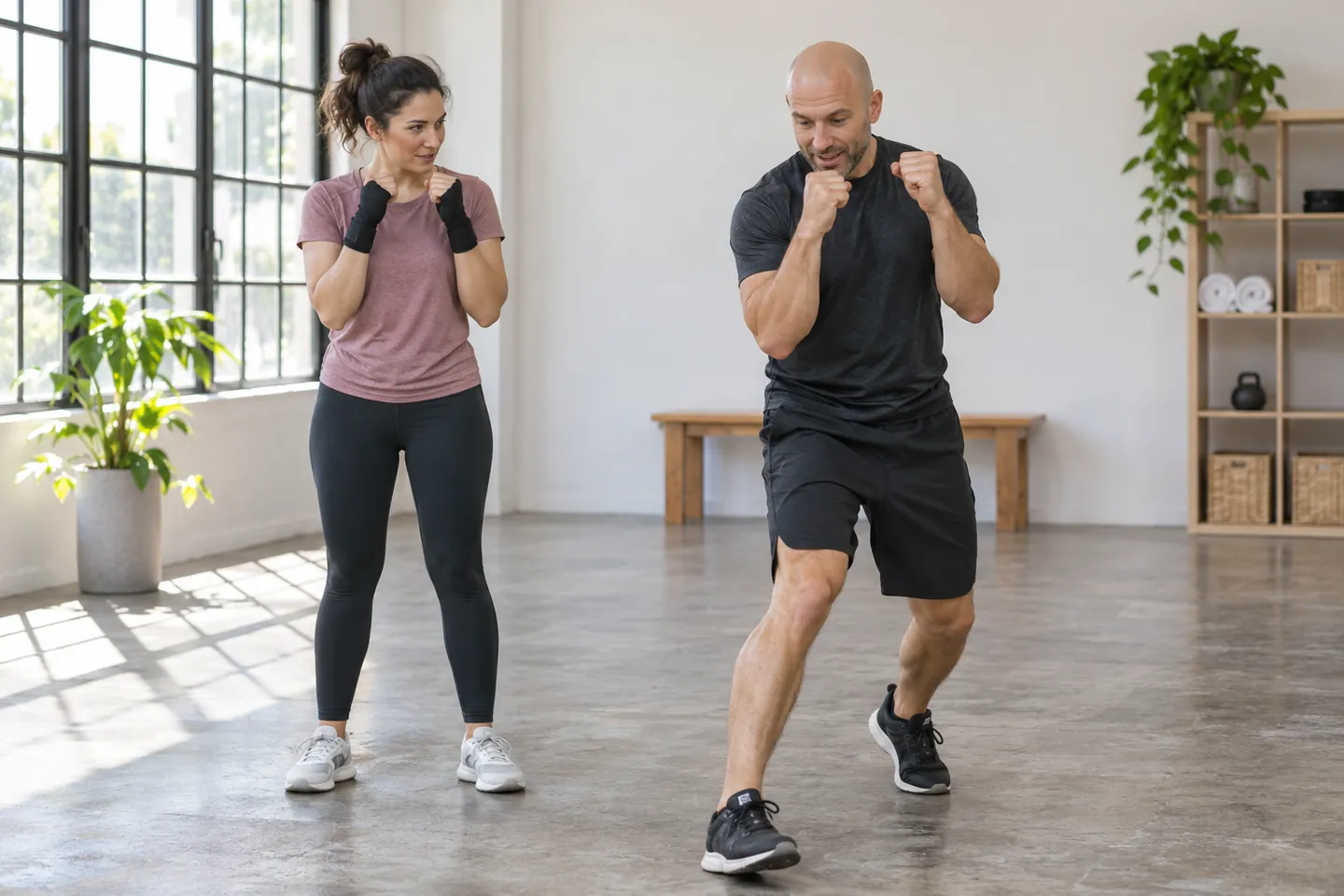
Build your approach to boxing coordination in Mississauga with simple coached tasks, clear cues, thoughtful practice, and realistic ways to notice progress.
Your coach asks for a small step and a straight punch. Separately, both movements seem manageable. Together, they feel like instructions sent to two people who have never met. One hand moves early, a foot arrives late, and you finish wondering how such a short action became so complicated. That experience does not establish anything permanent about your coordination. It identifies a task you have not yet learned to organise.
Boxing coordination in Mississauga can be approached through practical decisions about instruction and practice. Instead of trying to become generally more coordinated overnight, choose one relationship to understand: a hand and a step, a cue and a response, or the end of one punch and the beginning of another. Small, specific tasks give both you and your coach something useful to observe.
Describe the difficulty before naming yourself
“I am uncoordinated” sounds like an explanation, but it does not tell a coach what happened. A more helpful description identifies a moment: “When I step forward, I forget to return my hand,” or “I know the sequence until you add the direction change.” Those observations turn a broad judgement into a teachable problem.
You do not need technical vocabulary to describe it. Explain what you were trying to do and where you lost track. The coach can then watch the relevant part instead of guessing which instruction was unclear. You may discover that the difficulty involves memory, terminology, timing, or a movement you have not understood separately.
Treat that discovery as useful information. The aim is not to prove that the task should already feel easy. It is to identify the next version you can practise with attention. A well-described problem often leads to a much simpler exercise than the one you were trying to force through.
Reduce the number of decisions
A beginner drill can contain more choices than it first appears to. You may need to remember a stance, select the correct hand, travel in a direction, judge distance, and respond to a timer. If all those decisions are new, ask the coach which ones can be made predictable while you learn the main movement.
For example, a fixed starting position and a known sequence remove some uncertainty. You can then concentrate on how the hand and foot connect. Once that relationship is clearer, the coach may vary the starting cue or add a target. The task becomes more complex by deliberate steps rather than by accident.
Reducing decisions is not the same as avoiding challenge. It is choosing the challenge you are actually ready to study. A smaller exercise can demand considerable attention when you perform it carefully and receive feedback about the specific connection you are learning.
Learn the parts well enough to recognise them
Before joining two actions, check that you understand each one separately. Ask the coach to demonstrate the step alone or review the punch without movement. You do not need perfect technique, but you should know what each instruction refers to and how the action is meant to finish.
If one part remains unclear, spend time there. Repeating the combined task may otherwise reinforce confusion about that single element. Tell the coach which demonstration helps most: a side view, a slower version, or an explanation using simpler words.
Then return to the combined movement. The purpose of separating the parts is to make their connection easier to learn, not to avoid the connection indefinitely. The coach can help you bridge from isolated actions to a complete repetition at a manageable pace.
Use a consistent beginning and ending
Coordination practice becomes easier to compare when each repetition starts from the same arrangement. Find the stance and hand position your coach has taught, then begin the assigned action. If the starting position changes every time, it is harder to know why one attempt feels different from another.
Give the repetition a clear ending too. Return to the instructed stance, pause, and recognise where your hands and feet are. That ending creates the beginning of the next attempt. It also gives the coach a moment to observe whether the movement left you organised or required an unplanned recovery step.
The pause can become shorter as the task becomes familiar. Initially, however, it provides a useful boundary. You know when one attempt has finished, can consider a correction, and can begin again without carrying confusion directly into the next repetition.
Keep the cue short enough to remember
A long explanation may help you understand the movement before practice, but it is difficult to hold every sentence in mind while moving. Ask your coach for one short cue that captures the current priority. It might concern the order of the actions, the return, or the place where you should finish.
Repeat the cue in your own words if needed. This gives the coach a chance to confirm that you understood it. If the phrase creates the wrong movement, say so rather than continuing to repeat words that are not helping.
Avoid adding several cues from different sources during the same drill. A video, a friend, and your coach may describe related movements in different ways. For the current lesson, use the instruction that belongs to the task you are doing. Bring other advice as a question if you want it clarified.
Slow down without freezing every part
A slower pace can make the order of actions easier to notice. It gives you time to recognise which part starts, which follows, and how the movement ends. Ask the coach how slowly to practise and whether a brief pause between components would help.
Be aware that concentrating can make you stiffen or hold your breath. Mention that experience if it occurs. The instructor may simplify the task or change the cue so that you can move more comfortably while still paying attention.
The goal is not to create an exaggerated slow-motion performance that no longer resembles the assigned action. It is to choose a pace where the connection remains understandable. Your coach can help you find that middle ground and decide when a more continuous movement is appropriate.
Add a target only when it helps
A bag or pad can give the movement a clear destination, but it can also draw all your attention toward making contact. If the target causes you to forget the footwork or return, ask whether a few repetitions without contact would be useful.
When the target is introduced, establish the distance deliberately. A position that is too close or too far away can create extra adjustments that confuse the coordination task. Let the coach help set the starting point and explain what to do if the bag or pad moves.
Keep the contact level appropriate to the exercise. Greater force is not a reliable solution to uncertainty about timing. A controlled attempt gives the coach a clearer view of the relationship you are trying to learn and gives you more room to respond to feedback.
Expect different tasks to feel different
Being comfortable with one combination does not mean every new sequence will feel equally familiar. A change in direction, a different starting hand, or an added cue can alter the task substantially. Treat the new version as a new learning problem rather than evidence that earlier progress has disappeared.
Likewise, a movement may feel different with a partner than it does alone. Now you are attending to another person’s timing and position. Ask for predictable cues and a clear sequence while learning. Both participants should understand their roles before the pace increases.
Describe the difference to the coach. “I can do this alone, but I rush when the pad appears” is useful information. It suggests that the next exercise should address the target or cue, not necessarily rebuild the entire movement from the beginning.
Practise briefly with a specific question
If your coach recommends practice between classes, ask for a simple task and a clear purpose. Use an appropriate space and stay with movements you have been taught. You do not need to design an elaborate coordination circuit from unrelated exercises.
A useful practice question might be whether you can finish in the same stance after a short step and punch. Perform the task at the instructed pace, notice what happens, and stop if the movement becomes unclear or uncomfortable. More repetitions are not automatically better when you no longer understand what you are repeating.
Write a brief observation afterward. Perhaps the first few attempts were clear, but you began rushing when you tried to continue without pauses. That note gives the next coached session a precise starting point and keeps independent practice connected to instruction.
Notice progress in ordinary moments
Coordination progress may appear as less mental effort rather than a dramatic change in appearance. You may find the starting stance without looking down, remember a sequence after one explanation, or recover your place after a missed cue. These changes make participation easier even while the technique still needs attention.
Compare the same task under similar conditions when possible. A familiar movement performed slowly and a new sequence performed quickly are not equivalent tests. Ask your coach which exercise would provide a fair way to review what has become clearer.
During boxing training, choose one connection to work on and let the lesson remain specific. You are learning how to organise an action, observe the result, and adjust with help. That process gives coordination a practical meaning: a little more understanding of how the next movement can fit together.
Filed under
Keep exploring
More training insights await.