
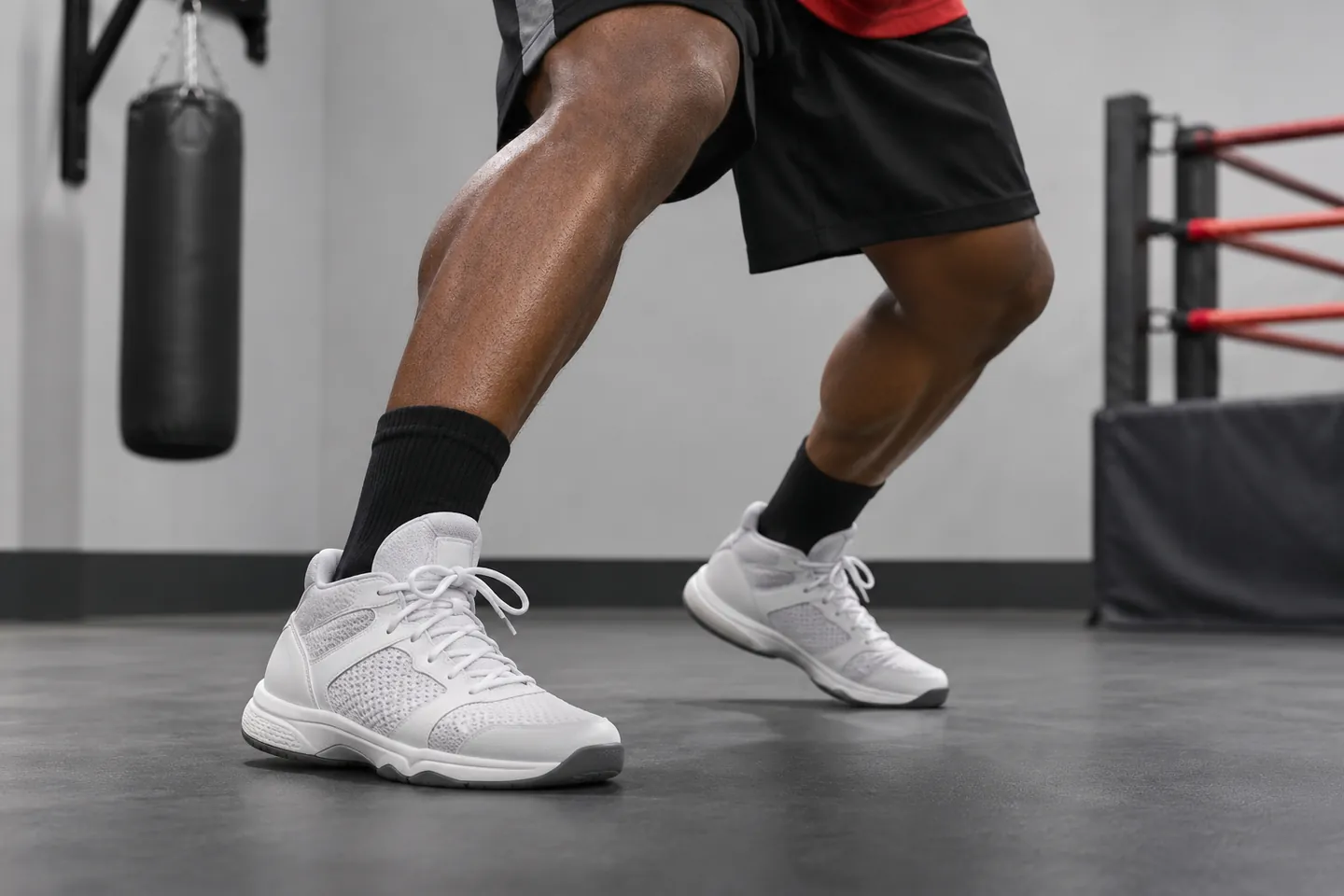
Build a thoughtful approach to boxing footwork in Mississauga, from small coached steps and clear resets to distance awareness and purposeful practice.
Footwork can be the quietest part of a boxing class and the part that makes everything else feel more complicated. Your hands may understand a punch while your feet seem to have received different instructions. You move toward a bag, arrive too close, and need another step before you can begin. Learning to notice those moments is the beginning of useful footwork practice.
Boxing footwork for adults in Mississauga does not have to start with fast ladders or elaborate patterns. It can begin with a short coached step, a deliberate stop, and a question about where you ended up. The purpose is to move into a position you can use. Speed and complexity can be discussed later, after the basic movement has a clear shape.
Give each step a reason
A beginner often moves because movement seems like something a boxer should do. The result can be constant shuffling without a clear destination. Ask what the current step is meant to accomplish. Are you approaching a target, creating room, changing your position around it, or simply learning to preserve your stance while travelling?
A clear purpose makes feedback easier to understand. If the task is to move a small distance forward and finish ready to punch, the coach can assess your final position. If the task is only to keep moving, it becomes harder to separate useful practice from unnecessary activity. You do not need a tactical explanation for every beginner drill, but you do need to understand its immediate objective.
This is especially helpful during group instruction. Two participants may appear to be doing similar movements while working on different details. Stay with the cue you were given instead of copying the fastest person nearby. The value of the exercise comes from solving the assigned problem, not from making your movement look more advanced.
Start from a position you recognise
Before stepping, establish the stance your coach has taught. Notice the spacing of your feet and where your hands rest. This is your reference point. If the beginning is different every time, it becomes difficult to tell whether the step caused the problem or whether you were already in an awkward position.
Take the time to reset between early repetitions. That pause may feel overly cautious, but it lets you compare one attempt with another. You can ask whether your feet remain organised or whether one foot has drifted to a different place. Once the basic pattern becomes clearer, the coach may connect the repetitions more smoothly.
Do not become so focused on your feet that you forget the rest of the drill. Your gaze, hands, and upper body still matter. Ask for one priority at a time if coordinating everything is difficult. A coach can temporarily simplify the task so that you understand the step before adding the full starting position back in.
Make the first movement smaller
Large steps can hide uncertainty because they create a lot of visible activity. A shorter movement makes it easier to notice which foot begins, how the other follows, and what happens when you stop. You are giving yourself fewer changes to organise at once.
Follow the sequence demonstrated by your coach for the direction you are travelling. If you cannot remember it, ask for another demonstration rather than guessing repeatedly. Watch the feet once, then the entire body. Sometimes a movement seems confusing because you have only watched the hands or because the instructor is facing you in a mirrored orientation.
Try to finish each short step in a stance you recognise. If your feet end up touching, spread extremely far apart, or require an extra shuffle before you can continue, slow down and ask what to change. The objective is not to reach a line on the floor at any cost. It is to arrive in a usable position.
Learn the stop as part of the step
Stopping deserves its own attention. Many beginners can start moving readily but drift past the intended position. A controlled stop gives you time to check where you are and prepares you to follow the next instruction. It also makes the drill easier for a coach to observe.
During a simple exercise, think of the movement as a beginning, a short journey, and an arrival. At the arrival, pause long enough to notice whether you can move again without rebuilding your stance. If the answer is no, reduce the distance or ask the coach to help identify the part that is changing.
You can use a floor reference if the gym permits it, but do not let a mark become more important than your position. A piece of tape can suggest where a movement starts or ends; it cannot tell you whether your feet are arranged appropriately. References should support the instruction rather than replace it.
Separate direction changes at first
Moving forward and backward may feel manageable until the coach asks you to go sideways. Treat each direction as a separate learning task before combining them. Practise a short movement, stop, reset, and repeat according to the instruction. There is no requirement to turn the first footwork lesson into a continuous circuit.
Once individual directions are clearer, connect two of them. For example, the coach may ask you to move forward, pause, then move back to a starting area. The return helps reveal whether you preserved your stance or gradually changed it. Keep the sequence small enough that you can remember its purpose.
Changing direction quickly is a later question if you are still uncertain about which foot begins. Tell the coach exactly where you lose track. “I understand the forward step but cross my feet when I go sideways” is more useful than “My footwork is terrible.” A precise description creates a specific teaching opportunity.
Add the target without chasing it
A heavy bag introduces a new temptation: following every swing as though the bag has set the agenda. Before combining movement and punches, ask where to begin and how to respond when the bag moves. The coach may prefer that you wait, reset, or use a simpler task while learning distance.
You do not need to hit the bag continuously. Step into the assigned position, make the instructed action at an appropriate pace, and return. If you arrive too close or too far away, treat the next repetition as a chance to adjust the starting distance. Reaching with your upper body is not the only way to solve a distance problem.
Remember that equipment has shared space around it. Keep track of nearby participants, neighbouring bags, and the route other people use to move through the room. Good footwork practice includes knowing where you are in the actual gym, not only where you are relative to one target.
Introduce turns through coaching
Turns and pivots can look simple in a short demonstration while involving details that are hard to judge alone. Ask the coach to teach the version appropriate to your current drill. Watch where the movement begins, how far it travels, and how the instructor finishes. Do not assume that a dramatic turn is a better turn.
Begin with a modest change in direction and a deliberate reset if that is the assigned progression. Keep the surface and footwear in mind, and do not force a movement that feels awkward or uncomfortable. If you are unsure whether your feet should move together or in sequence, ask before repeating it faster.
The question remains the same as with a straight step: can you finish in a position you understand and use? A turn that leaves you facing the intended direction but unable to begin the next action still needs attention. Give the coach a chance to see the complete movement, including its ending.
Practise away from the gym without inventing a new lesson
If your coach suggests home practice, keep it close to what you have already been taught. Choose a clear area with enough space and a suitable surface. Remove obstacles rather than planning to work around them. A small apartment or crowded room may be better suited to reviewing notes than rehearsing travelling movements.
Use one familiar pattern and stop before attention becomes sloppy. Independent practice is not a test of how much material you can remember from an online video. It is an opportunity to revisit a specific cue and bring better questions to the next class. If the movement becomes less clear as you repeat it, pause instead of adding more repetitions.
Record observations in ordinary language. You might notice that stepping backward feels less familiar or that you keep looking down when changing direction. Those details are useful for coaching. They are more informative than giving yourself a score without explaining what the score represents.
Keep footwork and conditioning distinct enough to learn
Fast feet can be demanding, but effort alone does not tell you whether the intended movement is improving. Ask whether a drill is mainly for learning a pattern or for a conditioning task. During technical practice, you need enough attention to preserve the cue. During a faster exercise, you still need to know the movement boundaries and appropriate adjustments.
If fatigue makes the instructions difficult to follow, communicate and simplify. A slower sequence can preserve the purpose of the lesson. Continuing at a pace where you no longer recognise the movement may make it harder to notice the specific problem you came to work on.
For boxing classes, a useful early goal is to move a short distance and arrive ready for the next instruction. That may sound modest, but it connects stance, distance, and attention in a practical way. Purposeful footwork grows from many clear arrivals, each one making the next action easier to understand.
Filed under
Keep exploring
More training insights await.