
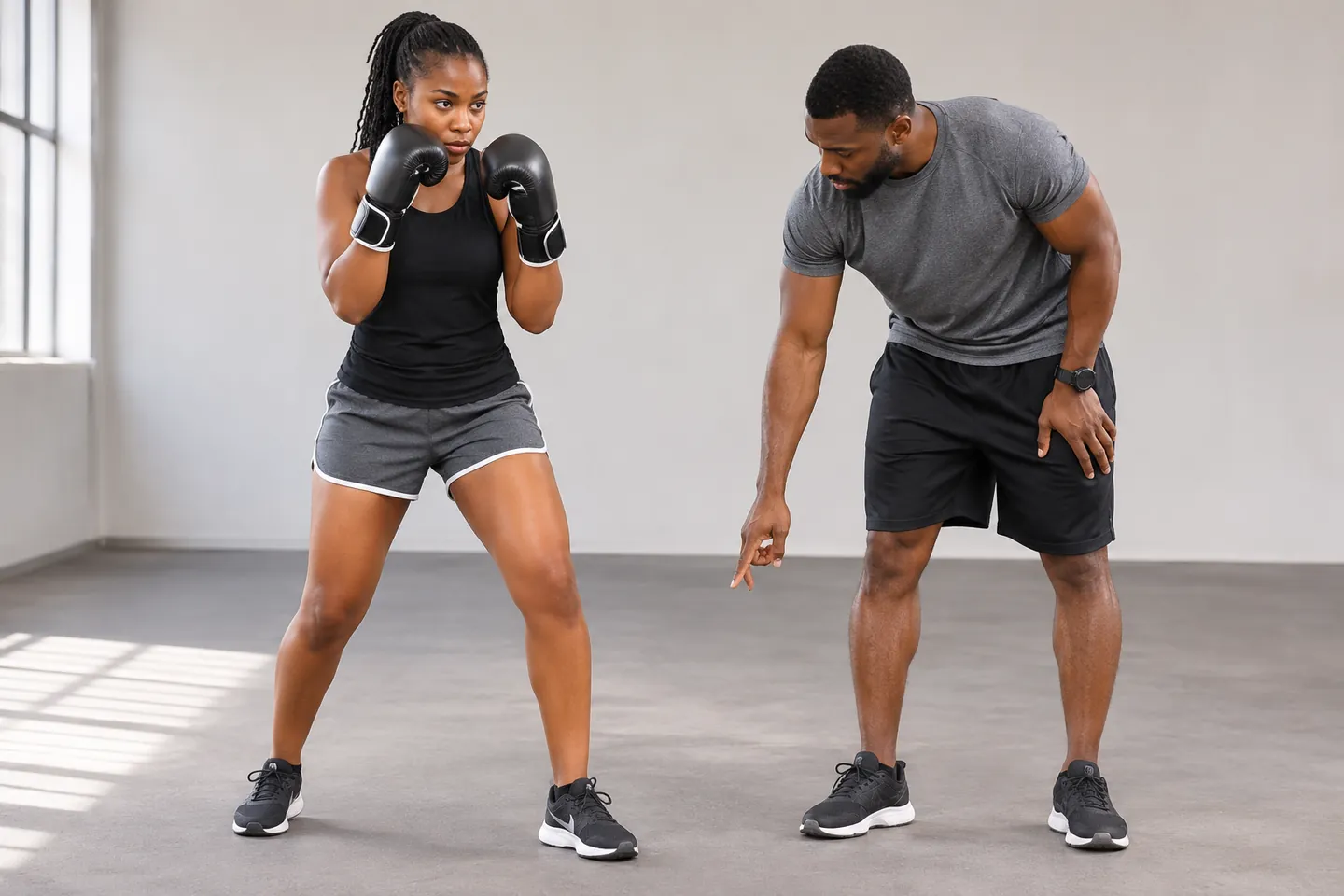
Learn how to approach boxing stance practice in Mississauga, with coaching questions, simple movement checks, and a focus on returning to a workable base.
A boxing stance can look like a pose until you try to use it. You arrange your feet, bring your hands up, and feel reasonably settled. Then you step forward or throw a punch and discover that the position has disappeared. That is why learning stance is less about copying a photograph and more about finding an arrangement you can leave, move from, and return to deliberately.
For adults studying boxing stance basics in Mississauga, the most useful starting point is a coached, repeatable position. A written guide can help you understand what to notice, but it cannot see where your weight is going or how your feet respond to movement. Use the ideas below to make practice more thoughtful and your questions more precise when you work with an instructor.
Understand what a starting stance is for
Your starting stance provides a reference. It gives your coach a common place from which to teach a punch, a step, or a reset. Without that reference, each repetition can begin from a different arrangement, making it harder to understand why one attempt feels controlled and the next feels awkward.
The position also needs to permit movement. A stance that feels solid only while you remain completely still is incomplete for boxing practice. You should be able to begin a small action and return without needing a separate recovery step every time. Early practice therefore asks a practical question: can this position support the simple task being taught?
There is no need to turn that question into a search for one perfect stance for everyone. Coaches may adjust details for the drill and the individual. Your proportions, experience, and ability to follow the movement all affect what a useful first position looks like. Learn the reasoning behind your coach’s instructions rather than collecting conflicting rules from short clips.
Choose a lead side with guidance
You will hear terms that distinguish which side is forward. Ask the coach to explain the stance they want you to begin with and how the lead and rear sides relate to it. Once the choice is made, use the same terminology consistently while learning the first movements. Clear language reduces unnecessary confusion.
Hand preference can be part of that conversation, but avoid making assumptions from a single online rule. If you are uncertain, describe how you naturally perform familiar tasks and let the coach observe basic movement. The immediate objective is to establish a workable learning setup, not to decide your permanent boxing identity in the first ten minutes.
Switching sides repeatedly can make an early lesson harder to follow. Unless the coach asks you to practise both, give yourself time to understand the chosen arrangement. You can revisit questions later with more information. A consistent beginning helps you recognise what changes when you move a foot, extend a hand, or turn your body.
Arrange your feet for the task
Your coach will help you find appropriate spacing and orientation. Notice both dimensions: how far apart your feet are from front to back and how much room exists from side to side. Two positions can look similar from the front while feeling quite different when you try to step or turn.
Avoid stretching into a very long stance simply because it appears athletic. If bringing the rear foot along requires a large effort after every small forward step, ask whether your starting distance is making the task harder. Equally, a position that feels easy to stand in may leave too little room for the movement being practised.
Use a small reset routine. Place one foot, organise the other, soften the position as instructed, and check your hands. Repeat the same sequence without rushing. Over time, the routine can become shorter, but initially it gives you a reliable way to begin again when an exercise has scattered your attention.
Keep the upper body available for movement
Beginners sometimes interpret a boxing stance as a request to brace every muscle and hold their breath. That can make even a short drill feel unnecessarily demanding. Ask your coach which parts of the position need attention and where you can release extra effort. The goal is an organised starting point that still lets you move and listen.
Hand position should also be taught in context. Bring your hands to the location the coach demonstrates, then notice whether your shoulders are creeping upward or your elbows are moving away from the intended arrangement. Do not make major adjustments based on appearance alone; ask how the hands support the activity you are about to practise.
Keep your gaze where the drill requires it. Looking down at your feet may help briefly while learning a setup, but you also need to discover the position without watching it continuously. A coach can give a verbal cue while you keep your attention forward. That creates a useful bridge between consciously arranging your feet and recognising the stance by feel.
Test the position with a very small step
Once the starting position is clear, add the smallest movement your coach requests. Travel a short distance, stop, and check whether you still recognise your arrangement. The short distance matters because it limits the number of things changing at once. You are examining the relationship between movement and stance, not trying to cover the room.
If your feet end up much closer together or farther apart, pause before adding another step. Ask which foot should begin the action and how the other follows. Repeating an unclear sequence quickly usually makes the uncertainty less visible to you, not more useful. A slow demonstration can reveal where the position changes.
Practise stopping as deliberately as starting. A controlled stop gives you a moment to observe without drifting into the next action. Can you lift your attention from your feet? Can you begin the next instruction without first rebuilding everything? These are practical checks that tell you more than whether your stance looks impressive in a mirror.
Add one punch without abandoning the base
A simple straight punch can reveal habits that remain hidden while standing still. You may lean toward the target, move a foot unintentionally, or finish with your weight arranged differently from how you began. Treat these observations as information for the coach rather than reasons to become more rigid.
Start slowly and at an appropriate distance. Ask the instructor to help you determine where to stand relative to the bag or pad. If the target is too far away for the assigned task, you may reach simply to make contact. If it is too close, you may feel crowded. Positioning is part of the drill, not a separate inconvenience to solve through force.
After the punch, pause in the returning stance. Notice the feet, hands, and your ability to move again. A useful repetition includes the return. If you only pay attention to the moment of contact, you miss the part that prepares you for the next action. This is why a coach may initially value a quiet, complete repetition over a hard impact.
Use mirrors and video carefully
A mirror can help you recognise a basic arrangement, but it is only one source of information. Watching yourself constantly can also change where you direct your attention. Follow the coach’s guidance about when to use it and when to look toward the intended task. You want to learn the movement, not become dependent on seeing your reflection.
Video can be useful when recording is permitted and other participants’ privacy is respected. Keep the clip short and choose a clear question, such as whether your feet remain spaced after a small step. Ask the coach to interpret what matters. A frozen frame may look unusual without explaining what happened before or after it.
Avoid comparing your beginner stance to a highlight of an experienced boxer in a different situation. A moving athlete may use positions for reasons that are not apparent from a photograph. Your current task is to learn a reliable reference for the drills you are doing, not to reproduce every position that appears in boxing media.
Make practice specific enough to remember
Instead of writing “work on stance” in a training note, record a concrete cue from the session. You might note that you need to reset your feet after a forward step or bring your hands back before beginning the next repetition. A cue tied to an observable action gives your next practice a clear purpose.
Keep independent practice simple and follow any limits your coach gives you. A few unhurried resets in an uncluttered space may be more appropriate than trying to reconstruct an entire class at home. Make sure there is room around you, use suitable footwear, and leave complicated or uncertain movements for supervised instruction.
If an action causes pain or an unusual problem, stop and raise it with an appropriate professional rather than trying to solve it by forcing a textbook position. General stance advice cannot account for every individual circumstance. Useful coaching includes recognising when a movement or setup needs to be reconsidered.
Look for a stance you can use repeatedly
Progress may first appear as fewer interruptions. You find your starting position more quickly. A small step no longer leaves you wondering which foot belongs where. You can listen to the next instruction while maintaining the arrangement you have already learned. These changes are meaningful even if your stance still needs regular correction.
For local boxing instruction, bring a simple question to your next session: “What should I check when I return to my stance?” The answer can anchor your practice across punches, steps, and basic combinations. A useful stance is not a pose you hold for approval. It is a familiar place from which you can begin learning the next movement.
Filed under
Keep exploring
More training insights await.