
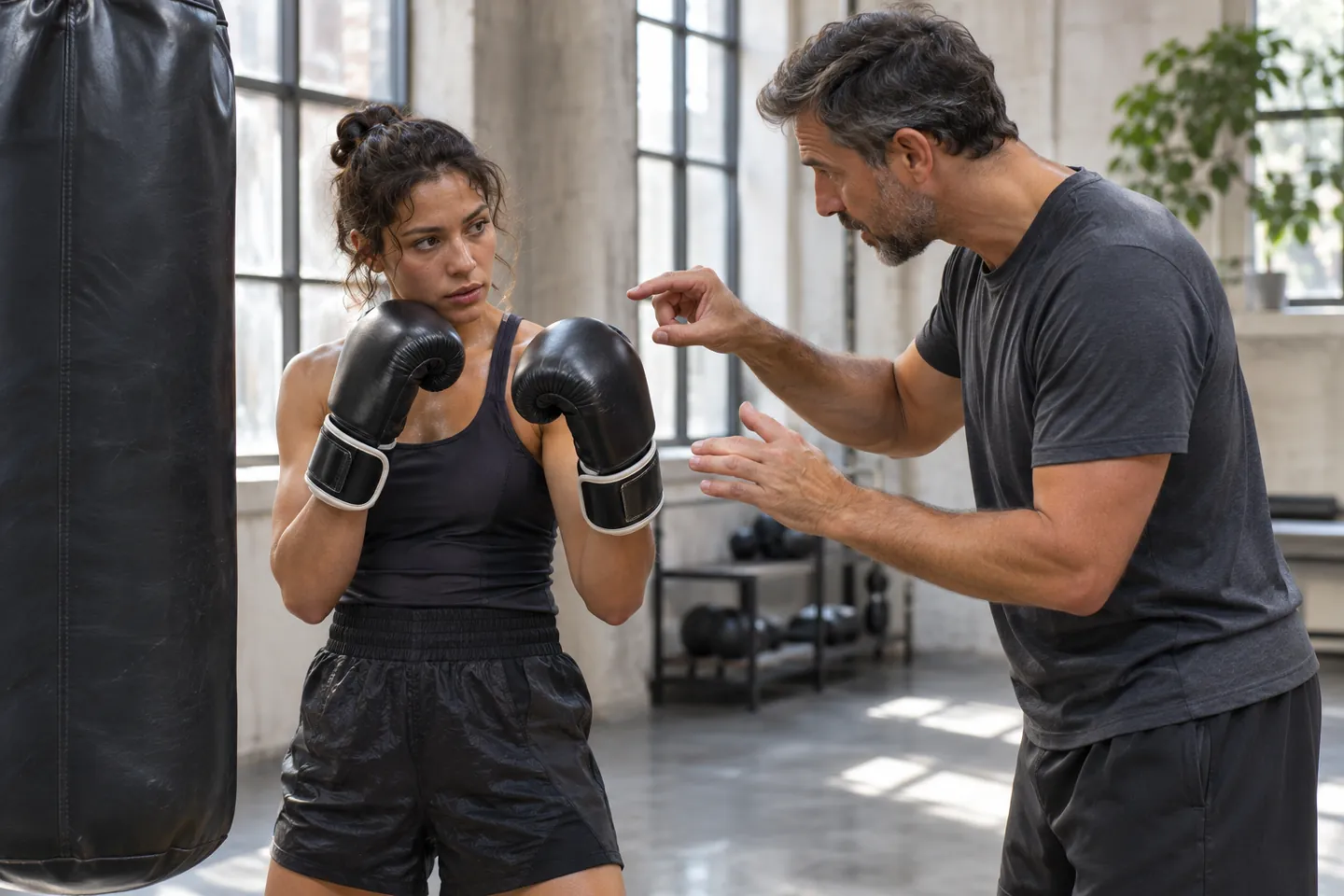
Work through a boxing technique plateau in Mississauga by defining the problem, reviewing coaching cues, simplifying practice, and choosing a useful next step.
At first, almost every boxing class introduces something new. You learn the names of punches, find the starting stance, and begin to recognise a short combination. Later, progress can feel less obvious. The same correction appears again, the movement still feels awkward, and you wonder whether you have reached a limit. Before calling that experience a plateau, it helps to identify what has actually stopped changing.
Boxing technique plateaus in Mississauga are best discussed through specific observations with a coach. A stuck feeling may reflect an unclear cue, a task that has become more demanding, or expectations that no longer match the stage of learning. You do not need to diagnose the cause alone. You need a question precise enough to guide the next practice.
Describe the task that feels stuck
Start with one movement or sequence. “My boxing is not improving” is too broad to examine directly. “I keep losing my stance after the jab and cross” gives the coach a clear task to observe. Include when the problem appears and whether it happens every time.
Separate what you feel from what you can describe. A movement may feel awkward even while the coach sees a useful change. Conversely, familiarity can make a repeated habit feel comfortable without resolving the issue. Both perspectives are worth discussing.
If you keep training notes, review the recent entries. Look for the same specific observation rather than repeated general frustration. The notes can help you identify whether the problem has remained unchanged or whether your description of it has become more detailed.
Check whether the task has changed
A familiar combination may now be performed faster, with footwork, or in response to a partner’s cue. Those additions change the learning problem. Difficulty with the new version does not necessarily mean the simpler version has stopped improving.
Ask the coach to compare the tasks. Can you still perform the earlier version clearly? What new demand is creating uncertainty? This distinction helps avoid rebuilding everything when the useful focus may be one added transition.
Use similar conditions when reviewing progress. A slow solo repetition and a fast padwork sequence are not equivalent tests. Choose a version that lets the coach see the specific skill you want to assess before deciding what the comparison means.
Revisit the meaning of the correction
Sometimes a cue is repeated because the learner and coach understand it differently. Ask the instructor to demonstrate exactly what they want to change. Repeat the instruction in your own words so they can check your interpretation.
If the phrase does not help you move differently, say so. A different explanation or exercise may make the same idea clearer. You are not challenging the coach by explaining that the current wording leaves you uncertain.
Include the context of the correction. A cue given for one drill may not be a universal rule for every movement. Ask when it applies and what the intended result should look like. Understanding the purpose helps you avoid applying the cue too broadly or mechanically.
Simplify the exercise enough to observe it
A long sequence can hide the exact moment that needs attention. Ask whether you can isolate the troublesome transition or return to a shorter combination. The simpler task should still preserve the issue you are trying to understand.
Slow the pace if appropriate and use a deliberate reset. This gives the coach time to observe and gives you a clear boundary between attempts. You can make one adjustment, repeat the action, and discuss whether the intended change appeared.
Simplifying is a teaching decision, not a punishment for failing to progress. A small task can be demanding when you perform it with attention. Once the connection becomes clearer, the coach can help you reintroduce the parts that were temporarily removed.
Choose one change to test
When several details need work, ask which one should take priority. Trying to change foot placement, hand path, rhythm, distance, and breathing in the same repetition can make it difficult to identify what helped.
Treat the next attempt as a small experiment. Use the agreed cue, perform the movement at a manageable pace, and receive feedback. If the result is different, ask whether it moved in the intended direction. If not, clarify before making another unrelated adjustment.
Give the correction enough practice to become understandable, but do not repeat it indefinitely without review. The coach should help determine whether the task is producing useful information or whether another explanation is needed.
Examine distance and setup
A movement can feel persistently awkward because its starting conditions are unclear. On a bag or pads, ask the coach to check where you stand and how the target is presented. A distance problem may lead you to reach or crowd the movement repeatedly.
Keep the setup consistent for a few attempts so that you can compare them meaningfully. If the bag moves or the holder changes position, follow the coach’s reset instructions. Otherwise, you may be trying to correct technique while the situation keeps changing.
This does not mean practice must always be static. It means the current review needs enough consistency to identify the issue. More variable tasks can be introduced deliberately after the basic relationship is clearer.
Notice when effort changes the movement
You may perform the assigned action clearly at a moderate pace and lose it when trying to hit harder or move faster. Tell the coach exactly where the change occurs. That observation can guide a progression more effectively than simply deciding you need more effort.
Ask what level of challenge preserves the purpose of the drill. A technical round should give you enough attention to follow the cue. If the task becomes a blur, reducing pace or complexity may make the next correction easier to understand.
Do not use exhaustion as proof that the plateau has been addressed. A demanding session can still leave the technical question unresolved. Evaluate the practice by whether it clarified the movement and produced a useful next step.
Use video only for a defined question
If recording is permitted and privacy is respected, a short clip may help the coach show what happens during the movement. Decide what you want to examine before filming. A few clear repetitions can be more useful than a long recording of the whole session.
Ask the coach to interpret the relevant detail. A frozen frame can look unusual without explaining the movement around it, and a polished moment does not establish that every repetition is consistent. Video supports the conversation; it does not replace instruction.
Avoid comparing your clip directly with an experienced athlete in a different task. Their movement may reflect circumstances you are not practising. Keep the reference close to the coach’s demonstration and the specific exercise under review.
Review independent practice honestly
If you practise between classes, tell the coach what you have actually been doing. Include any variations you added from videos or other sources. A mismatch between home practice and the class cue may contribute to confusion.
Ask which version is appropriate to rehearse alone and which should remain supervised. Use a suitable clear space and stay within the instructions. Independent repetition is most useful when you understand the task well enough to notice the intended detail.
If you cannot remember the cue, ask before continuing to repeat an uncertain version. A short pause in independent practice may be more useful than accumulating repetitions you later need to reinterpret. Bring the uncertainty back as a concrete question.
Give progress more than one visible form
A technical improvement may first appear as recognising the error sooner, asking a clearer question, or needing fewer reminders during a simple version. Those changes do not mean the movement is complete, but they are relevant evidence of learning.
Ask the coach what they would look for over the next few sessions. A clear criterion helps you notice change without inventing a dramatic deadline. The criterion might concern the finish of a movement or consistency at a particular pace.
Avoid changing your entire routine after one frustrating class. Review a small set of comparable observations and discuss the pattern. A single difficult day is limited evidence about a longer learning process.
Leave the review with a concrete next task
At the end of the conversation, confirm what to practise, what cue to use, and when to review it. The plan does not need to be elaborate. It needs to be specific enough that both you and the coach can recognise the intended task next time.
During boxing training, bring the stuck feeling as an observation rather than a conclusion about your ability. Ask the coach to watch the movement under clear conditions and help identify the next useful adjustment.
A plateau becomes more workable when it is translated into a question you can test. You may need a simpler sequence, a different explanation, or more consistent setup. Whatever the answer, the next session can have a purpose beyond trying harder at a problem that has not yet been clearly defined.
Keep the review date flexible enough to gather useful practice rather than demanding a change after one attempt. If the same question remains unresolved, tell the coach precisely what you tried and what you noticed. That information allows the next discussion to begin with evidence instead of returning to the general feeling that nothing is happening.
Filed under
Keep exploring
More training insights await.