
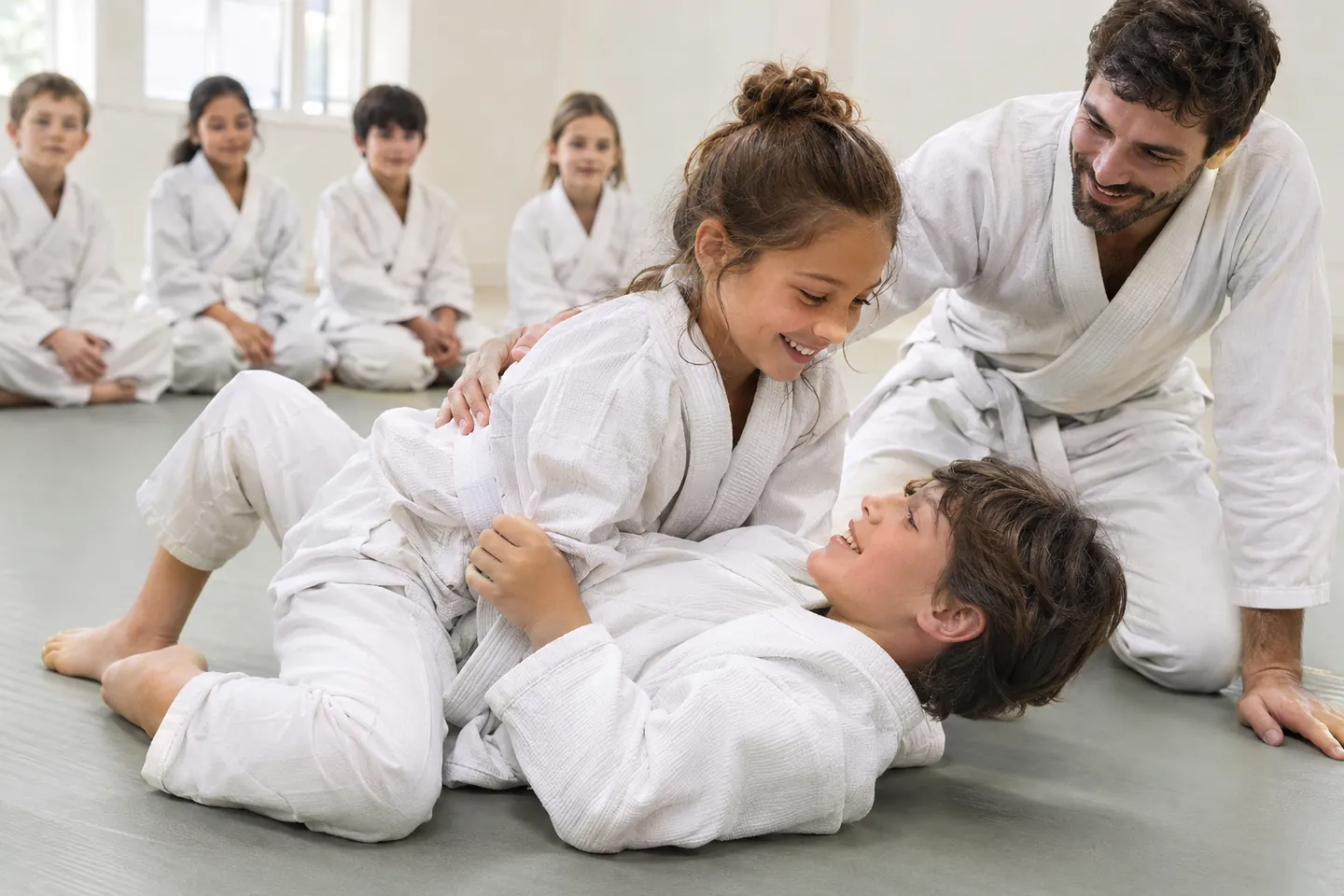
Thinking about Brazilian jiu-jitsu for your child in Mississauga? Learn what kids' classes involve, how safety is handled and how to support them at home.
Parents often arrive at Brazilian jiu-jitsu with a mix of curiosity and caution. They have heard that it builds confidence and teaches self-defence without punching or kicking, which sounds appealing. They have also seen clips of adults grappling and wondered whether wrestling on the floor is really a good idea for a seven-year-old.
Those are fair questions. Brazilian jiu-jitsu, often shortened to BJJ, is a grappling martial art focused on positions, control and technique rather than strikes. In a well-run kids’ program, it is taught in a structured, age-appropriate way that emphasises safety, respect and play. Many families in Mississauga choose it because it gives children a way to be physical and competitive while learning to control themselves and look after their training partners.
This guide is written for parents. It explains what kids’ BJJ usually involves, how coaches approach safety, what children tend to get out of it, and how you can support your child as they start.
What BJJ actually is
At its core, BJJ is about using leverage, positioning and technique to control another person. Practitioners learn to move from one position to another, escape when they are in a poor position, and hold a partner in a controlled way. In adult classes, this includes submissions such as joint locks and chokes. In kids’ classes, the emphasis is usually different.
Children’s programs typically focus on movement skills, positional control, escapes and games. Coaches may introduce simplified techniques as children get older and more experienced, but with strict rules and close supervision. Younger children in particular spend a lot of time learning how to fall safely, move on the mat and work with a partner.
Because there is no striking, BJJ can be an option for parents who want their child in martial arts but are hesitant about punching and kicking. It is still a physical activity, and contact with a partner is part of it, but that contact is controlled and guided.
What a typical kids’ class looks like
Classes vary between gyms, but many follow a similar pattern. They often begin with a warm-up that includes running, crawling, rolling and other movement games. These activities build coordination and get children comfortable moving their bodies in unusual ways.
Next comes technique. The coach demonstrates a skill, such as how to escape from underneath a partner or how to hold a stable position. Children then practise in pairs, usually at a slow pace, while the coach moves around the room correcting and encouraging.
Many classes finish with positional games, where children try to achieve a particular goal from a specific starting position under the coach’s rules. These games are fun, competitive and a good way for children to apply what they have learned in a lively but controlled setting.
How safety is handled
Safety is the first question most parents ask, and it should be. In a good program, safety is built into everything: the mats, the rules, the supervision and the culture.
Coaches teach children how to fall and roll safely early on. They set clear rules about what is and is not allowed, and they enforce them. Partners are typically matched by size, age and experience where possible. Children are taught to “tap,” which means signalling that they want to stop, and to respect a partner’s tap immediately.
Supervision matters too. Coaches should be actively watching the room, not standing at the side. Ask how many coaches typically supervise each class and how they handle situations where a child is upset or a drill becomes too rough. A reputable gym will be glad to explain.
The life skills parents often notice
Many parents say they see changes in their child beyond the mat. While every child is different and no program can guarantee particular outcomes, some common themes come up in conversations with families.
Children learn to listen to instructions, follow rules and wait their turn. They practise working with partners of different sizes and abilities, which encourages patience and empathy. They learn to stay calm when they are in an uncomfortable position, such as being held down, and to think about how to improve their situation.
There is also the experience of steady, earned progress. BJJ is difficult, and improvement comes gradually. Children who stick with it learn that effort over time leads to results. That lesson can carry into school, music, other sports and many other parts of life.
Confidence without aggression
A common worry is that martial arts might make a child more aggressive. In practice, good BJJ programs tend to emphasise control and respect. Children learn that the goal is not to hurt anyone but to improve their own skills and help their partners improve too.
Because BJJ is about control rather than striking, children can practise at a realistic level against resisting partners in a relatively safe way. That experience often builds a quiet kind of confidence. Children learn what they are capable of without needing to prove it.
Coaches typically discuss when martial arts skills should and should not be used. Many programs teach children to avoid conflict, use their words, seek help from adults and only use physical skills to keep themselves safe as a last resort.
Good ages to start
Many gyms offer programs for children from around four or five years old, often grouped by age. Younger children’s classes tend to focus more on movement, games and basic positions, while older children learn more detailed techniques.
There is no single perfect age to start. Some children are ready to listen and follow instructions at five; others benefit from waiting a year or two. Consider your child’s attention span, their comfort with physical contact and whether they are interested in trying.
If you are unsure, a trial class is a good way to find out. Watch how your child responds to the coach, the other children and the activities. Ask the coach for their impressions afterwards. You can check the kids’ schedule to see which classes might suit your child’s age.
What your child will need
For most kids’ BJJ programs, children train in a uniform called a gi, which is a heavy cotton jacket and pants with a belt. Some gyms also run no-gi classes where children wear a rash guard and shorts. Ask the gym what is required and whether there is a loaner option for the first few classes.
Other useful items include a water bottle, flip-flops or sandals for walking off the mat, and a hair tie for long hair. Nails should be trimmed short to avoid scratches. Mouthguards may be recommended for certain activities; follow your gym’s guidance.
Hygiene is important in grappling sports. Wash the gi after every class, make sure your child showers after training, and keep them home if they have a skin condition or are unwell. These habits protect everyone on the mats.
Supporting your child from the sidelines
Your attitude as a parent has a big influence on your child’s experience. Encourage effort rather than results. Ask what they learned, what they enjoyed and what they found tricky, rather than whether they “won.”
Try not to coach from the sidelines during class. It can be confusing for children to hear different instructions from a parent and a coach, and it can distract them from the lesson. Save your questions and comments for afterwards.
Be patient with progress. Some children take to BJJ quickly; others need months before they feel comfortable. Both are normal. The important thing is that your child is learning, staying active and enjoying the experience.
Fitting training into family life
Most families in Mississauga are juggling school, work, homework, activities and commutes. BJJ is most beneficial when it is consistent, so choose a schedule that you can realistically maintain. Once or twice a week is a common starting point for children.
Consider the logistics. Will you be driving across the city in rush-hour traffic? Will the class time clash with dinner or homework? Is there another sibling who could train at the same time in a different program, such as kids’ boxing? Planning ahead makes it easier to stay consistent.
School breaks are another consideration. Some gyms run holiday programs or a summer camp, which can keep children active and engaged when school is out.
Belts, stripes and patience
Kids’ BJJ programs usually use a belt system to recognise progress. Children may earn stripes on their belts as they learn and demonstrate skills, with belt promotions happening less frequently. The exact system varies between gyms.
Belts can be motivating, but they are not the main point. Help your child understand that progress is about learning and improving, not collecting colours. Some children progress faster than others, and that is fine.
If your child feels discouraged about their belt, talk with them and with the coach. Coaches can often explain what your child needs to work on and provide encouragement.
Watching for signs it is working
Within a few months, you might notice small changes. Your child may be more confident in new situations, more willing to try difficult things or more able to stay calm when frustrated. They may talk about friends from class or ask to practise techniques at home, ideally on a soft surface and gently.
You might also notice that they are more physically capable: better balance, more coordination, more strength for their age. These changes can make other sports and activities more enjoyable too.
Equally, if your child is consistently unhappy or reluctant to attend, talk with them and the coach. Sometimes a different class time, a different program or a break is the right answer.
Giving BJJ a try
Brazilian jiu-jitsu can be a rewarding activity for children when it is taught with care, structure and a strong focus on safety. It offers physical activity, problem-solving, friendship and steady progress, all without striking.
If you would like to see whether it suits your child, explore our kids martial arts programs or book a free trial at Konga Fitness in Mississauga. Our coaches will be happy to answer your questions and help your child feel welcome from the first class.
Filed under
Keep exploring
More training insights await.