
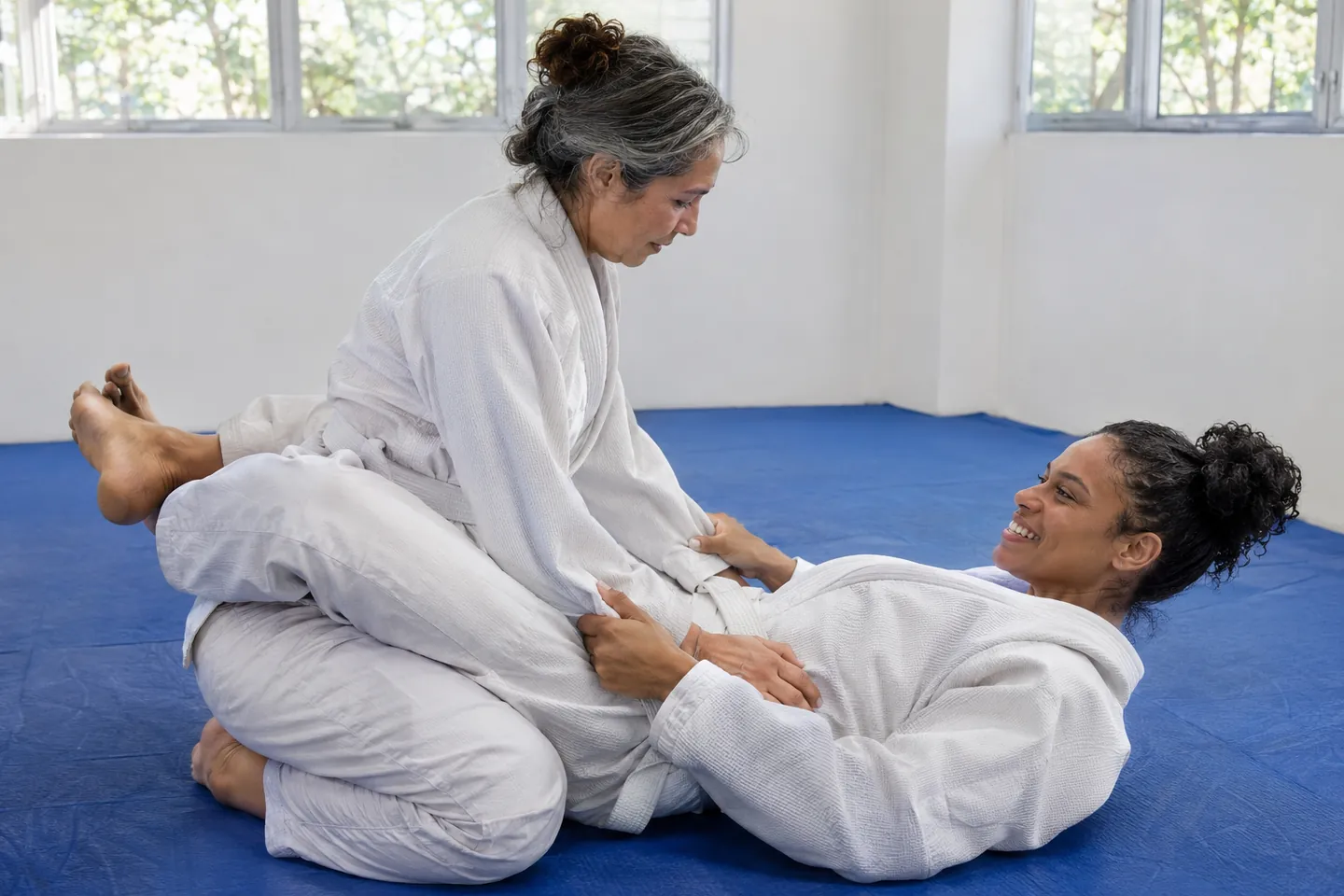
An honest look at Brazilian jiu-jitsu for women in Mississauga: first classes, choosing partners, gi or no-gi, hygiene, confidence and steady progress.
“I want to try it, but I don’t know if I’m the kind of person who does jiu-jitsu.”
Coaches hear some version of that sentence often, and it comes from women far more frequently than from men. It is an understandable worry. Brazilian jiu-jitsu is a close-contact grappling art, many rooms are still majority male, and the pictures people see online tend to show intense competition rather than a regular Tuesday evening class. From the outside, it can be hard to imagine yourself on the mat.
This article is for women in Mississauga who are curious about BJJ but unsure where they would fit. It covers what early classes actually involve, how partner selection works, practical questions about clothing and hygiene, and the slow, satisfying way confidence tends to build. There is no single type of woman who trains jiu-jitsu. The women who stick with it are simply the ones who found a room where they felt able to learn.
What jiu-jitsu actually asks of you
At its core, Brazilian jiu-jitsu is about controlling position and using leverage rather than relying purely on size or strength. Much of the art happens on the ground. Students learn how to escape from underneath, how to hold someone down safely, and how to apply submissions, which are holds that end a round when one partner taps to signal they’ve had enough.
That last point matters. Tapping is not failure. It is a normal, frequent part of training for everyone, including experienced black belts. You tap when a hold becomes uncomfortable, when you’re unsure, or when you simply want to stop. Your partner releases immediately. This shared agreement is what lets people practise effective techniques safely day after day.
What jiu-jitsu asks of a beginner is mostly patience. You will spend a lot of time in positions you don’t yet understand, and that’s expected. Early progress is less about winning rounds and more about recognizing where you are and what your options might be.
Leverage, size and the honest truth
You will often hear that jiu-jitsu allows a smaller person to defeat a larger one. There’s truth in that, but it deserves an honest framing. Technique gives a smaller, skilled person real tools. It does not make size irrelevant. When a beginner of any gender trains with a much heavier partner, the weight difference is noticeable.
That honesty is actually reassuring. You are not expected to overpower anyone, and you’re not failing if a bigger partner is hard to move. Instead, you’re learning to use frames, angles and timing so you don’t have to fight strength with strength. Over months, many women find they can escape positions that once felt impossible, not because they got stronger overnight but because they understood the mechanics better.
Good coaches also manage partner pairings with this in mind. Drilling a technique with someone closer to your size often makes it easier to learn the movement before trying it against more resistance.
Your first few classes
A beginner class typically starts with a warm-up that includes jiu-jitsu-specific movements: shrimping (a hip escape along the mat), forward and backward rolls, and getting up from the ground safely. These may feel awkward on day one. That’s normal. They are the building blocks of nearly everything you’ll learn.
Then the coach demonstrates a technique, often a position, an escape or a sweep, and students practise it with a partner. You’ll take turns, so half the time you’re doing the technique and half the time you’re helping your partner learn it by providing a realistic but cooperative reaction. Ask questions whenever something is unclear. Instructors would far rather explain a detail twice than watch someone practise the wrong thing.
Some classes end with positional sparring or rolling, which means live practice with resistance. As a newcomer, it’s fine to ask whether you can watch, roll lightly, or skip it for your first session. A responsible coach will not push you into sparring before you know how to tap and protect yourself.
Choosing partners and setting the tone
Partner selection is one of the most important skills in jiu-jitsu, and it’s rarely talked about in beginner guides. You are allowed to say who you’d like to train with, and you’re allowed to decline a roll. A brief “I’m going to sit this one out” is all that’s needed. Nobody in a healthy gym will question it.
When you do roll, you can also set the pace. Saying “Can we go light? I’m still learning” at the start helps your partner calibrate. Experienced students generally welcome that kind of communication because it makes training safer and more useful for both people.
If something ever feels inappropriate, whether it’s a partner’s intensity, comments or behaviour, tell a coach. Close contact is part of jiu-jitsu, but it happens within clear standards of respect. A well-run academy takes those standards seriously and responds to concerns.
Women’s classes and mixed classes
Some women prefer to start in a women-only setting, while others are comfortable in mixed classes from day one. Both are completely valid. A women’s class can offer a familiar entry point, a chance to meet other women who train, and a lower-pressure environment for learning the basics.
Mixed classes have their own benefits. You’ll train with a wider range of body types and skill levels, which can broaden your understanding of how techniques work. Many women train in both formats over time, using the women’s sessions for focused learning and community, and mixed classes for variety.
If you’re unsure which to choose, ask about the options when you contact the gym. You can also look at the adult schedule to see what fits around work, childcare or the evening commute along the 403.
Gi, no-gi and what to wear
Jiu-jitsu is practised in two main formats. Gi training uses a heavy cotton uniform with a jacket and pants, and many techniques involve gripping the fabric. No-gi training uses fitted athletic clothing like a rash guard and shorts or spats, and relies more on gripping the body. Some gyms offer both.
For a first class, ask what’s required. Often you can try a session in comfortable, fitted athletic clothing without loose zippers, pockets or drawstrings. If you continue with gi training, you’ll eventually need your own uniform. Women’s cut gis are available and tend to fit better in the shoulders and hips, though plenty of women wear standard cuts too.
A fitted sports top, a rash guard underneath the gi jacket and hair tied back in a way that won’t catch on anything all help. Remove jewellery before class, including earrings and rings. It’s a small habit that prevents a lot of minor injuries.
Hygiene and practical comfort
Close contact means hygiene matters for everyone. Arrive in clean training clothes, keep fingernails and toenails short, and wear sandals or shoes off the mat so you don’t track dirt onto it. Bring a water bottle and a small towel. Washing your training clothes after every session isn’t optional; it’s part of being a good partner.
Some women have practical questions about training during their period, during pregnancy or postpartum, or around specific health considerations. These are worth discussing privately with a coach and, where relevant, your doctor or another qualified healthcare provider. Adjustments are common and there’s no reason to feel awkward raising them.
It’s also worth knowing that grappling can leave you with mat burn, sore fingers or the occasional bruise, especially in the early months while you’re still learning how to move efficiently. These usually become less frequent with experience. If anything feels like more than ordinary soreness, get it checked.
Self-defence and confidence
Many women come to jiu-jitsu partly because of self-defence. It’s reasonable to expect that learning to move calmly while someone is holding you down will build composure. Training regularly helps you get used to pressure and close contact in a controlled way.
At the same time, it’s worth keeping expectations realistic. Jiu-jitsu classes are not a guarantee of safety in every situation, and sport-focused techniques don’t always map directly onto a real-world confrontation. Some gyms include self-defence principles in their curriculum. If that’s a priority for you, ask how it’s addressed.
The confidence many women describe isn’t really about fighting. It’s about discovering that you can stay calm when something is difficult, solve problems under pressure and keep showing up even when you don’t feel good at something yet. That carries over into work, family life and everything else.
Progress, belts and patience
Jiu-jitsu uses a belt system, usually starting with white and progressing through blue, purple, brown and black. Many academies also award stripes on each belt to mark progress. Advancement is slow by design. It often takes years to move between belts, and every gym has its own approach to promotions.
Try not to measure yourself by colour. A more useful marker is whether you understand more this month than last month. Can you recognize the position you’re in? Do you remember the first step of an escape? Are you breathing more calmly under pressure? These are real signs of progress, and they show up long before any stripe does.
Consistency matters more than intensity. Two classes a week sustained over many months will usually teach you more than a burst of daily training followed by burnout. Fit training around your real life, whether that’s shift work, school pickups in Meadowvale or a long drive from Port Credit.
Combining BJJ with other training
Jiu-jitsu pairs well with other forms of exercise. Some women add strength and conditioning to build general resilience, or yoga to work on mobility and breathing. Others enjoy striking classes for a different kind of challenge. None of this is required, and you can always start with jiu-jitsu alone.
If you have a past injury or ongoing concern, a session with a qualified professional through a service like physiotherapy can help you understand what’s appropriate before you train. Communicate any limitations to your coach so they can suggest suitable modifications.
Stepping onto the mat
The first class is usually the hardest one to attend. After that, the mat becomes more familiar, the faces become friendlier and the techniques start to have names you recognize. Many women who once wondered whether they were “the kind of person” who does jiu-jitsu discover the question doesn’t really matter. You become that person by turning up, learning and coming back.
If you’d like to see what our Brazilian jiu-jitsu classes look like in practice, you’re welcome to book a free trial or contact us with any questions about formats, women’s sessions or what to bring. We’re happy to help you find a starting point that feels right.
Filed under
Keep exploring
More training insights await.