
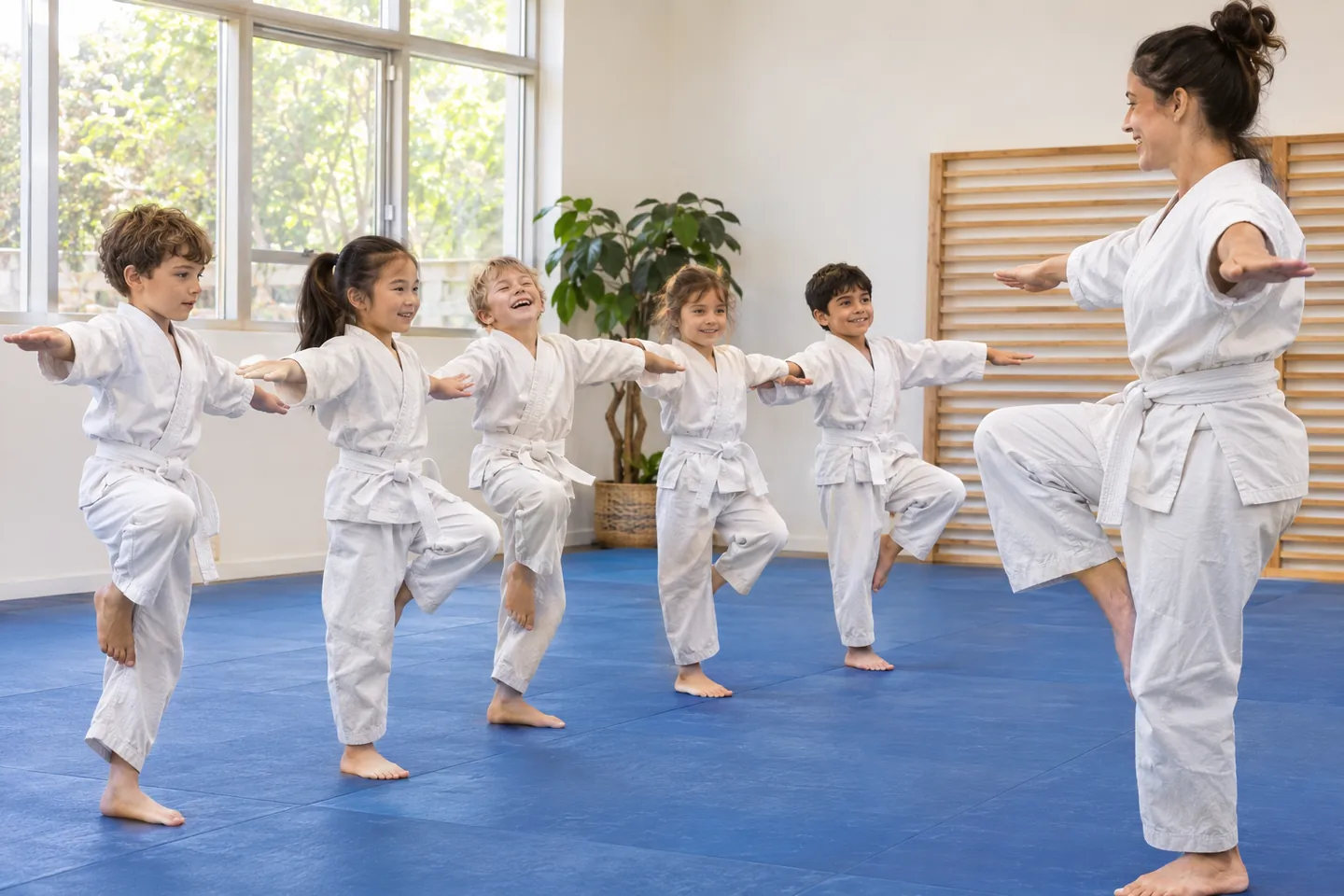
A parent's guide to how kids martial arts classes in Mississauga develop coordination through balance drills, footwork, games, repetition and patient coaching.
Parents notice coordination in small moments. A child who trips over their own feet on the way to the car. A child who cannot quite catch a ball at recess. A child who rides a bike confidently one week and falls off the next. Coordination develops at very different rates in different children, and most of the variation is completely normal. Still, many parents wonder whether there are activities that help it along.
Martial arts are one option that often comes up. Kids martial arts in Mississauga, as in most places, tend to blend structured technique with games, balance challenges and movement drills. Children practise stepping, turning, kicking, punching pads and falling safely, often in sequences that require several body parts to work together. Over time, those repetitions can contribute to a child’s general sense of how their body moves.
This post explains how that tends to work in a class setting, what parents can reasonably expect and how to support coordination at home. It is general information. If you have concerns about your child’s motor development, your family doctor or a paediatric physiotherapist or occupational therapist is the right person to consult.
What coordination really means
Coordination is a broad word. It includes the ability to move different parts of the body together in a controlled way, to balance, to time movements, to react to things around you and to judge distances. It also involves the connection between what a child sees and how they respond, such as tracking a pad and striking it accurately.
Children develop these abilities gradually through play, sport and daily life. Some aspects, like balance, may improve quickly with practice, while others, like timing complex movements, take longer. Every child has their own pattern, and comparing one child to another is rarely helpful.
Martial arts training touches many of these elements at once. A simple drill like stepping forward and throwing a punch requires balance, timing, coordination between the upper and lower body and spatial awareness. Repeating drills like this, at a pace suitable for the child’s age, gives them many opportunities to practise.
Balance comes first
Many kids martial arts classes start with balance. Children stand in stances, shift their weight, hold one-legged positions and move in controlled ways. These activities might look simple, but they form the foundation of almost every other skill.
A child who can hold a stable stance can throw a kick without toppling over. A child who can shift their weight smoothly can move forward and backward without stumbling. Balance work also builds body awareness, as children learn to notice when they are tipping and how to adjust.
Instructors often turn balance into a game. Children might hold a “flamingo” pose for a count, try to keep balance while reaching for a target or freeze in a stance when the instructor calls out. These activities keep younger children engaged while building a skill that supports everything else.
Crossing the midline
One aspect of coordination that martial arts practise often is crossing the midline, which means moving one side of the body across to the other side. Throwing a cross punch with the rear hand, turning to block on the opposite side or pivoting for a kick all involve this kind of movement.
Some young children find crossing the midline tricky at first. They may prefer to use the hand on the same side as a target or turn their whole body rather than reaching across. Gentle, repeated practice in a fun setting gives them plenty of opportunities to get comfortable with these patterns.
You might notice your child gradually becoming more fluid with these movements over weeks and months. Instructors usually introduce them in simple forms first and add complexity as children become ready.
Footwork and moving through space
Footwork is a big part of most martial arts. Children learn to step forward, backward and sideways while staying balanced. They learn to pivot, change direction and move around a training area without bumping into others.
These skills contribute to spatial awareness, which is the ability to understand where your body is in relation to people and objects around you. In a busy class, children learn to move within their own space, keep a safe distance from partners and respond to changes in the room.
Footwork drills are often designed as games: moving around cones, following lines on the mat or mirroring a partner’s steps. These activities feel like play but provide meaningful practice for coordination and body control.
Hand-eye coordination and targets
Pad work and target drills give children practice in hand-eye and foot-eye coordination. An instructor holds a pad, the child watches it and strikes it with a hand or foot. As skills develop, the pad might move, change height or appear at different times, requiring the child to track and respond.
This kind of practice is controlled and safe. Contact is with pads held by trained instructors or, for older children, by carefully supervised partners. Children are taught to strike with appropriate force and control rather than as hard as they can.
Over time, many children become more accurate and confident with these drills. Parents sometimes notice this confidence carrying over into other activities, like catching or kicking a ball, though every child is different.
Learning to fall safely
Many martial arts teach children how to fall safely. Breakfalls, rolls and controlled landings help children learn to protect their head and distribute impact when they lose balance. These skills are valuable on the mats and in daily life, whether on the playground, on a bike or on an icy Mississauga sidewalk in January.
Learning to fall also builds coordination and body awareness. Children need to tuck their chin, position their arms and time their movements correctly. Instructors usually teach these skills gradually, starting from low positions on soft mats before progressing.
Children who are comfortable falling often become less afraid of trying new physical challenges. That willingness to try can be just as important as the skill itself.
Sequences and memory
As children progress, they often learn short sequences of movements, such as a combination of strikes or a pattern of steps and blocks. Remembering and performing these sequences involves both physical coordination and memory.
This combination can be challenging, and that is part of its value. Children learn to break a sequence into parts, practise each part and then put them together. They also learn to focus, listen to instructions and watch demonstrations carefully.
Instructors usually adjust the length and complexity of sequences based on age and experience. A five-year-old might learn a two-step pattern, while an older child might work on longer combinations. Progress is gradual and should feel achievable.
Why repetition works
Coordination develops through repetition. Each time a child practises a movement, they get a little more familiar with it. Over weeks and months, movements that once felt awkward start to feel natural.
Martial arts classes are well suited to this kind of practice. Techniques are revisited regularly, often with small variations to keep things interesting. Children get many repetitions in each class without the activity becoming dull, especially when games and challenges are mixed in.
Consistent attendance helps. A child who comes regularly, even just once or twice a week, gets more repetitions over time than one who attends sporadically. Many families in Mississauga find that a regular class slot, fitted around school and other activities, makes consistency easier.
The role of a patient instructor
Good instruction makes a big difference. A skilled kids instructor breaks movements into manageable steps, demonstrates clearly, gives encouraging feedback and adjusts activities for children at different levels. They notice when a child is struggling and offer support without singling them out.
Patience is essential. Coordination develops at different rates, and some children need more time and more repetitions than others. A supportive environment where mistakes are treated as part of learning helps children stay motivated and willing to try.
If you are choosing a class for your child, watch how instructors interact with the children. Do they explain things clearly? Do they encourage effort? Do they create a safe, positive atmosphere? These qualities matter as much as the specific martial art being taught.
Supporting coordination at home
You can support your child’s coordination outside of class through everyday play. Activities like hopscotch, skipping rope, throwing and catching, balancing on a curb with a hand to hold or climbing at the playground all help. Simple games like Simon Says or mirroring each other’s movements can be fun and useful.
If your child wants to practise martial arts at home, encourage them to show you what they learned in class rather than inventing new techniques. Keep practice light and safe, with plenty of space and no hitting people or pets. A pillow can be a fine target for a gentle punch.
Above all, keep it fun. Children are more likely to keep practising when they enjoy it. Praise effort and improvement rather than perfection, and avoid comparing your child to siblings or classmates.
When to seek extra support
While coordination varies widely, some children have difficulties that benefit from professional assessment. If your child consistently struggles with motor skills compared with peers, has trouble with daily tasks like dressing or writing, or seems to fall or bump into things much more than expected, talk to your family doctor. They may refer you to a specialist such as a physiotherapist or occupational therapist.
Martial arts can still be a positive activity for children with coordination difficulties. Let the instructor know about any concerns so they can adapt activities and provide appropriate support.
Getting started
Coordination grows through practice, play and patient guidance. Kids martial arts offer all three in a structured, encouraging setting where children can move, learn and build confidence at their own pace.
If you are looking for a place for your child to start, our kids martial arts classes in Mississauga welcome beginners and focus on fundamentals, safety and fun. You can also explore kids boxing for children who enjoy pad work and footwork. Check the kids schedule to find a class that fits your family’s week.
Filed under
Keep exploring
More training insights await.