
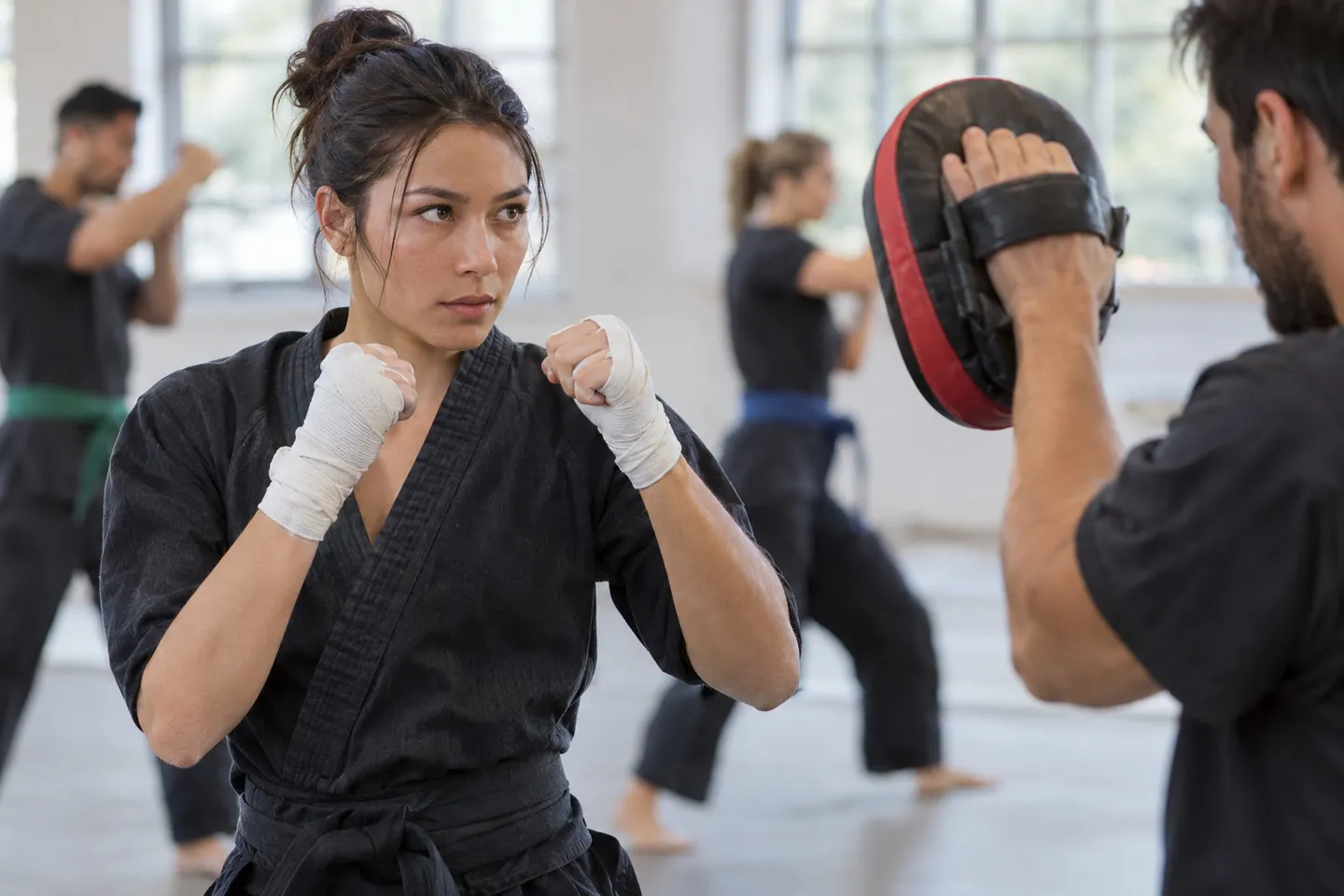
How martial arts classes in Mississauga train attention: drilling, partner work, breathing under pressure, and habits that help focus carry into work and home life.
Ask someone who has trained for a year what changed, and fitness is often not the first thing they mention. They talk about the hour where their phone stayed in a locker, the drill that demanded every bit of their attention, and the odd calm they felt driving home afterward. Focus, it turns out, is one of the quieter outcomes of regular practice.
That is worth thinking about carefully, because attention has become a scarce resource for many adults in Mississauga. Work pulls in several directions at once, commutes eat into the evening, and notifications fill every gap. Martial arts training will not fix all of that, and it is not a substitute for professional support when concentration problems are serious. But the structure of a good class does ask you to practise attention in a direct, physical way.
This post looks at how that happens, what parts of training do the heavy lifting, and how to make the most of it if focus is one of the reasons you are considering classes in Mississauga.
Attention is a skill you can practise
People often talk about focus as a trait: some people have it, others do not. A more useful view is that attention behaves a lot like a skill. It improves with repeated, deliberate practice under conditions that make wandering costly, and it gets weaker when it is never exercised.
Most daily environments do not train attention very well. They reward switching quickly between tasks, scanning headlines, and responding to whatever is loudest. That is a skill of its own, but it is different from sustained concentration on one thing for an extended period.
A martial arts class flips those conditions. For an hour, there is usually one main task in front of you, a coach giving specific instructions, and a partner who needs you to pay attention. You cannot check your email during a pad round. That simple constraint is part of what makes the practice valuable.
The warm-up as a transition
The first few minutes of class do more than raise body temperature. They act as a bridge between the rest of your day and the session itself. Many people arrive with their mind still on a meeting, a traffic jam on Hurontario, or what to make for dinner.
A structured warm-up gives those thoughts somewhere to go. Following a sequence of movements, matching the pace of the group, and listening for the coach’s next instruction gradually pulls your attention into the room. By the time technical work starts, you are usually more present than you were when you walked in.
You can help this process along. Arrive a few minutes early when possible, put your phone away before you step onto the mat or floor, and treat the warm-up as part of the session rather than something to rush through. Small rituals, like wrapping your hands slowly or tying your belt deliberately, can also signal to your mind that it is time to train.
Drilling teaches narrow, deep focus
Technical drilling is where concentration is most obviously trained. Learning to throw a clean jab, to check a kick, or to pass someone’s guard requires attention to small details: where your weight is, what your back hand is doing, when to breathe. A coach might ask you to focus on just one of those details for an entire round.
That kind of narrow focus is harder than it sounds. Your mind will drift toward other parts of the technique, toward your partner, or toward how tired you feel. Each time you notice the drift and bring yourself back to the cue, you are practising attention. The repetitions add up in the same way that repetitions of a physical movement do.
It helps to choose one point of focus deliberately. If a coach gives several cues, pick the one that seems most important for you today and keep returning to it. You will usually improve more than if you try to fix everything at once, and the practice of holding a single priority is useful well beyond the gym.
Partner work demands awareness of another person
Drilling alone on a bag or in the air is one thing. Working with a partner adds a different kind of attention. Now you are tracking another person’s position, timing and intentions, while still managing your own technique and safety.
In striking classes, that might mean holding pads well for a partner, responding to their combinations at the right moment, and keeping your guard up while you do it. In Brazilian jiu-jitsu, it might mean feeling small shifts in pressure and adjusting before a position slips away. Both require you to stay alert without becoming tense.
This is often where people discover how much their attention wanders. A lapse while holding pads is noticed immediately. That feedback is useful rather than embarrassing. It makes the cost of distraction concrete, and over time most people find their ability to stay engaged with a partner becomes much steadier.
Breathing and composure under pressure
Focus is easy when nothing is at stake. It is much harder when you are tired, uncomfortable, or under pressure. Martial arts training puts you in those situations in a controlled way, and that is where some of the most meaningful changes happen.
During a hard round, the natural response is to tense up, hold your breath, and let your thinking narrow to panic. Coaches spend a great deal of time teaching students to do the opposite: breathe steadily, keep the shoulders relaxed, and continue making sensible decisions. That is not something you learn from a lecture. You learn it by experiencing pressure repeatedly and practising a calmer response.
For many adults, this has an obvious parallel outside the gym. A stressful conversation at work or a hectic morning with the kids can trigger the same tightening. People who train often say they notice the reaction sooner and recover from it more quickly. That is not a guarantee, and everyone’s experience is different, but the skill of breathing through discomfort is a practical one.
Structure and repetition reduce mental clutter
One reason classes help with focus is that they remove a lot of small decisions. You do not need to plan the workout, choose the exercises, or decide when to rest. The coach handles the structure, and you handle the effort and attention.
That reduction in decision-making can feel like a relief, especially at the end of a busy day. Many people in Mississauga spend their working hours making choices and solving problems. An hour where the main task is to follow instruction and execute well can be restorative in its own way.
Repetition also matters. Coming to class on the same evenings each week builds a rhythm. The route becomes familiar, the warm-up becomes predictable, and the mental energy that once went into figuring out the logistics can be redirected to learning. Checking the adult schedule and picking two or three regular sessions is a good starting point.
Short-term memory and learning sequences
Martial arts often involve combinations and sequences: a jab, cross and hook; a sweep followed by a pass; a block followed by a counter. Remembering and performing these sequences under time pressure exercises working memory in a way that is different from memorizing information at a desk.
At first, combinations can feel overwhelming. You hear the coach call out four strikes and forget the third one by the time you start. That is normal. With practice, you begin to group movements into chunks, and longer sequences become manageable.
You can support this learning by repeating combinations quietly to yourself during rest periods, visualizing them before you start a round, or asking a coach to break a sequence into smaller pieces. The goal is not to become perfect, but to stay engaged with the process of learning rather than drifting through the motions.
What focus looks like for different people
Focus does not develop in the same way for everyone. Some people arrive with strong concentration and find the challenge is maintaining it when tired. Others find it difficult to stay on one task for more than a few moments and benefit from the frequent changes of drill and the active nature of the class.
Age, sleep, stress, health and life circumstances all play a role. A shift worker coming to class after a long night will have a different experience from someone who has just had a relaxed weekend. A parent who has spent the day juggling school pickups and work calls may need a few extra minutes to settle in. None of this means training is not working; it means attention fluctuates, as it does for everyone.
If you are concerned about persistent difficulties with concentration, memory or mood, speak with a family doctor or another qualified professional. Training can be a helpful part of a healthy routine, but it is not a treatment for medical or psychological conditions, and it is important to get proper guidance when you need it.
Making the most of each session
Some simple habits help focus develop more reliably. Before class, decide on one intention for the session. It might be keeping your hands up, staying relaxed during partner drills, or asking one question about a technique you do not understand. A clear intention gives your attention a home base.
During class, notice when your mind drifts and bring it back without frustration. Getting annoyed at yourself for losing focus tends to create more distraction. A simple mental note, such as “back to the cue,” is usually enough.
After class, take a minute to reflect. What did you learn? When was your concentration strongest? When did it slip? Writing a few lines in a notebook or on your phone can help you track patterns over weeks and months. This reflection is a small investment that often makes the next session more productive.
Carrying the habit beyond the gym
The real test of focus is whether it helps outside class. Some people find it useful to borrow small practices from training. They might take three steady breaths before a difficult conversation, break a large task into a sequence of steps the way a combination is broken down, or set a timer for a focused work block that feels a lot like a round.
There is no need to force a connection. Often the benefits appear naturally. You might notice you are less reactive in traffic or more patient when helping a child with homework. You might find that putting your phone away for an hour no longer feels strange.
What matters is that training provides a regular, reliable space to practise attention in a physical, engaging way. Over months, that practice can become part of how you approach other challenges in your life.
Where to begin in Mississauga
If improving focus is one of your reasons for training, choose a program that interests you and that you can attend consistently. Striking classes such as boxing and Muay Thai offer fast-paced drills and pad work. Grappling offers slower, more problem-solving-oriented attention. Both can be valuable, and many people try more than one before settling.
At Konga Fitness in Mississauga, you can explore the full range of programs and talk with the team about which classes suit your goals and schedule. The simplest next step is to book a free trial and notice how your attention feels during and after the session.
Filed under
Keep exploring
More training insights await.