
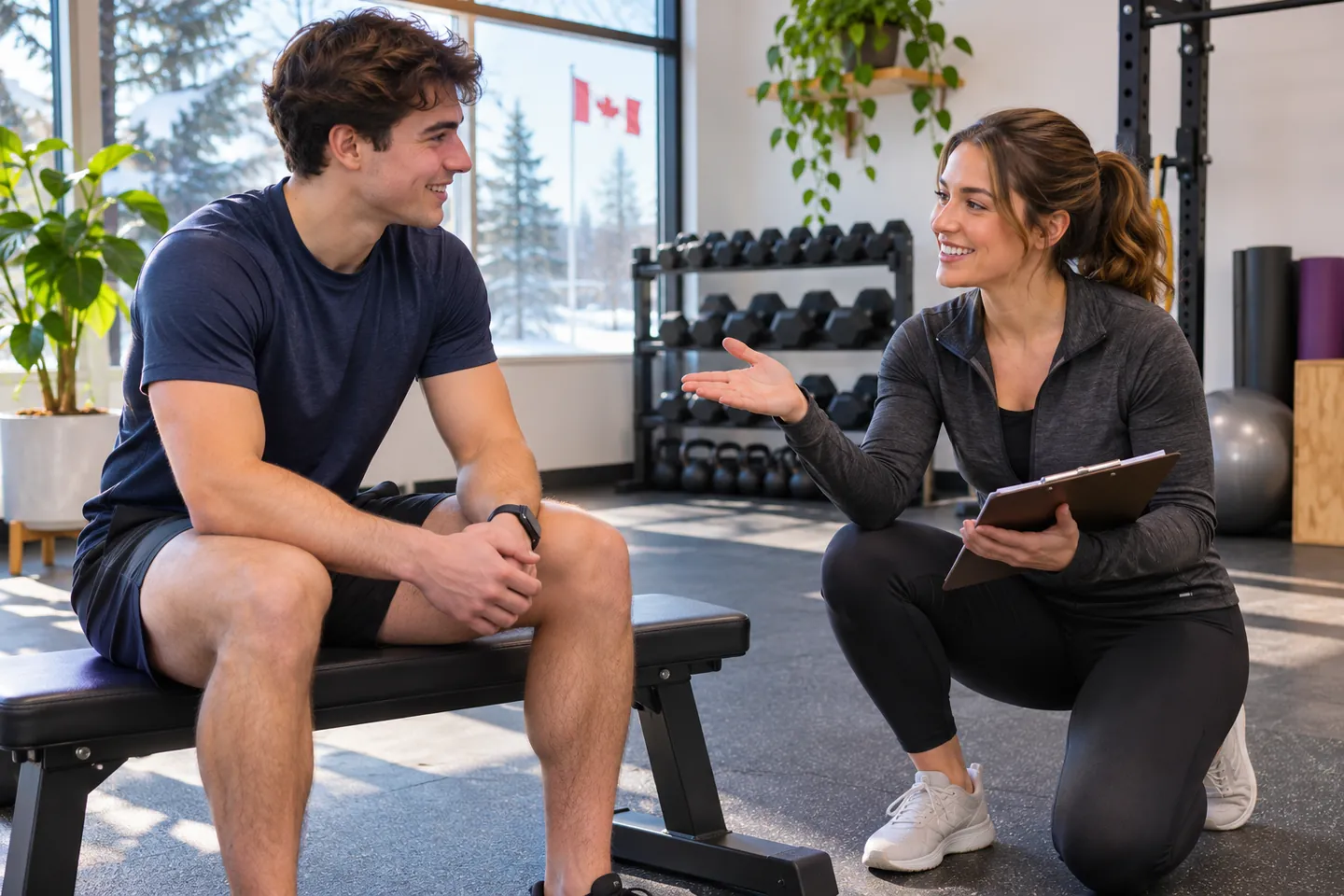
Build gym confidence in Mississauga through a clear first visit, equipment orientation, useful questions, manageable learning goals, and familiar routines.
A gym can feel unfamiliar for reasons that have little to do with the exercises. You may not know where to put your bag, how to ask whether equipment is available, or what to do when an instruction makes no sense. Building gym confidence in Mississauga begins by turning those unknowns into small questions you can answer.
You do not need to appear experienced before you belong in a training space. The first visits are an opportunity to learn the environment and the way coaching works. Confidence can develop from recognizing the entrance, understanding a setup, and knowing whom to ask for help. Those ordinary details give you something practical to work on without demanding that you feel completely comfortable immediately.
Identify the situation that makes you uncertain
Instead of saying that the entire gym is intimidating, describe the particular moment. Is it arriving alone, choosing equipment, joining a class, or asking for a demonstration? A specific situation gives you a clearer first step.
If arrival is the main concern, ask about the entrance and check-in process. If equipment is confusing, request an orientation. If the class format is unfamiliar, ask what happens at the beginning and how new participants are introduced. Different uncertainties deserve different answers.
You may have several concerns at once. Choose the one that would make the first visit easier if resolved. You do not need to understand every part of the facility before you can attend an appointment with a clear starting point.
Learn the arrival process in advance
Confirm the address, appointment time, and where you should go on arrival. Ask whether any forms or preparation should be completed beforehand. Knowing these details can reduce the amount of new information you need to manage at the door.
Plan the full journey from your actual starting location. In Mississauga, the route from work may differ considerably from the route from home. Include parking or the walk from transit and allow time for changing if needed.
If you arrive unsure, identify the appropriate staff member and ask. You are not expected to infer every local procedure from observation. A simple question about check-in or storage is a normal part of entering a new environment.
Request an orientation that answers your questions
An orientation is most useful when it includes the areas you will actually use. Ask to see where belongings go, how to find the relevant training space, and which person can help with equipment or booking questions.
Avoid trying to memorize the entire facility at once. Focus on the route for your current appointment. You can become familiar with other areas as your activities expand. A small, usable map in your mind is more helpful than a large tour you cannot remember.
If you are shown equipment, ask whether it is part of your assigned plan or simply an introduction. Knowing the difference prevents you from assuming that every demonstration is something you should immediately practise independently.
Use plain questions without apologizing for learning
You can ask for another demonstration, request a simpler explanation, or say that you do not recognize an exercise name. These are useful questions, not interruptions that need a long apology. The coach needs to know what you understand.
Specific wording can help. “Can you show the setup again?” is clearer than “I am bad at this.” “Which cue should I focus on first?” gives the coach a direct teaching question. The aim is to turn uncertainty into information that can guide the next attempt.
If the explanation still does not make sense, say so. A different demonstration angle or phrase may help. Learning is not a test of whether you can understand the coach’s first choice of words without clarification.
Give the first visits a small learning goal
Choose something you can observe by the end of the session. You might want to understand the check-in process, remember the setup for one exercise, or learn how the class transitions between activities. These goals create a clear purpose beyond simply surviving the visit.
Tell the coach what you want to understand. They can help make the lesson specific and realistic. A small goal also gives you a useful question afterward: what became clearer, and what still needs explanation?
Do not demand that the first appointment solve every uncertainty. Becoming familiar with a place often involves repeated ordinary visits. A clear small improvement is a better guide than deciding whether you felt perfectly confident throughout the entire session.
Learn equipment etiquette directly
Uncertainty about sharing space can be as distracting as uncertainty about exercises. Ask the facility how to handle occupied equipment, where to return items, and whether there are particular expectations about stations or attachments.
You can also ask for a simple way to check whether someone is using an item. Knowing the local expectations makes the interaction easier. Avoid assuming that everyone else automatically understands rules that were never explained to you.
If a situation is unclear, seek staff guidance. You do not need to resolve a confusing equipment issue by copying another member or abandoning the entire session. A practical question can turn an awkward moment into another familiar part of the environment.
Keep comparison in context
You cannot see another person’s training history by watching a few repetitions. They may have practised the movement for years, be following a different plan, or have a different reason for attending. Their session is not a useful test of whether you should feel comfortable with yours.
Return attention to your assigned task. Are you setting it up as instructed? Do you understand the cue? What question would help the next attempt? These are things you can use directly.
If comparison keeps distracting you, mention it to the coach. You might benefit from a clearer session focus or a different place to begin within the facility. The goal is not to pretend other people are invisible, but to keep their work from replacing the instructions that matter to you.
Decide whether company would help
A friend can make the first arrival feel more familiar, provided the arrangement supports your own learning. You might travel together or attend the same class while following different instructions. Agree on what kind of support you want.
Do not make the friend’s presence the only possible route to attending. Ask how you will manage a visit when their schedule changes. Knowing the arrival process and the person to contact can help you preserve independence while still enjoying company.
Individual coaching may also provide a clear setting for questions. If you prefer a quieter introduction, discuss that preference when asking about options. The useful format is the one that gives you enough guidance to participate, not the one you think a confident person is supposed to choose.
Keep a record of what is becoming familiar
After the session, write a few lines about what you learned. You might note where equipment belongs, a cue that helped, or a question to revisit. This preserves useful information before the details blur together.
Review older notes occasionally. You may notice that an issue that once required several questions is now routine. That evidence can be easy to miss when attention naturally shifts to the next unfamiliar task.
Keep the language factual. “Needed another explanation of the cable setup” gives you a next step. “Embarrassing session” may describe a feeling but does not tell you what to ask about. You can acknowledge discomfort while still recording information that helps the next visit.
Evaluate the environment as well as yourself
Confidence is not solely your responsibility to manufacture. The clarity of instruction, the response to questions, and the atmosphere all affect the experience. Notice whether the setting gives you room to learn respectfully.
If something repeatedly makes participation difficult, raise it specifically. You might need more explanation before transitions or a clearer way to request an alternative. A constructive response can help you decide whether the arrangement is capable of adapting to your needs.
It is also reasonable to choose another format when the fit remains poor. A different appointment time, class structure, or coaching arrangement may suit you better. The decision should follow actual experience rather than an assumption that discomfort always means you should simply try harder.
Prepare a clear next visit
Before leaving, identify the next appointment and the practical steps needed to attend. Ask what you should remember and whether anything will change. A familiar beginning makes the next visit easier to picture.
Konga’s personal training service and group classes offer different starting points. Contact the team to discuss current options and explain what would help you feel prepared. A request for clear arrival instructions or beginner-oriented explanation is useful information.
Gym confidence can grow from a collection of ordinary skills: arriving, asking, setting up, practising, and returning. You do not need to wait until uncertainty disappears before beginning. You need a setting where questions receive clear answers and a manageable next task that helps the space become more familiar over time.
Filed under
Keep exploring
More training insights await.