
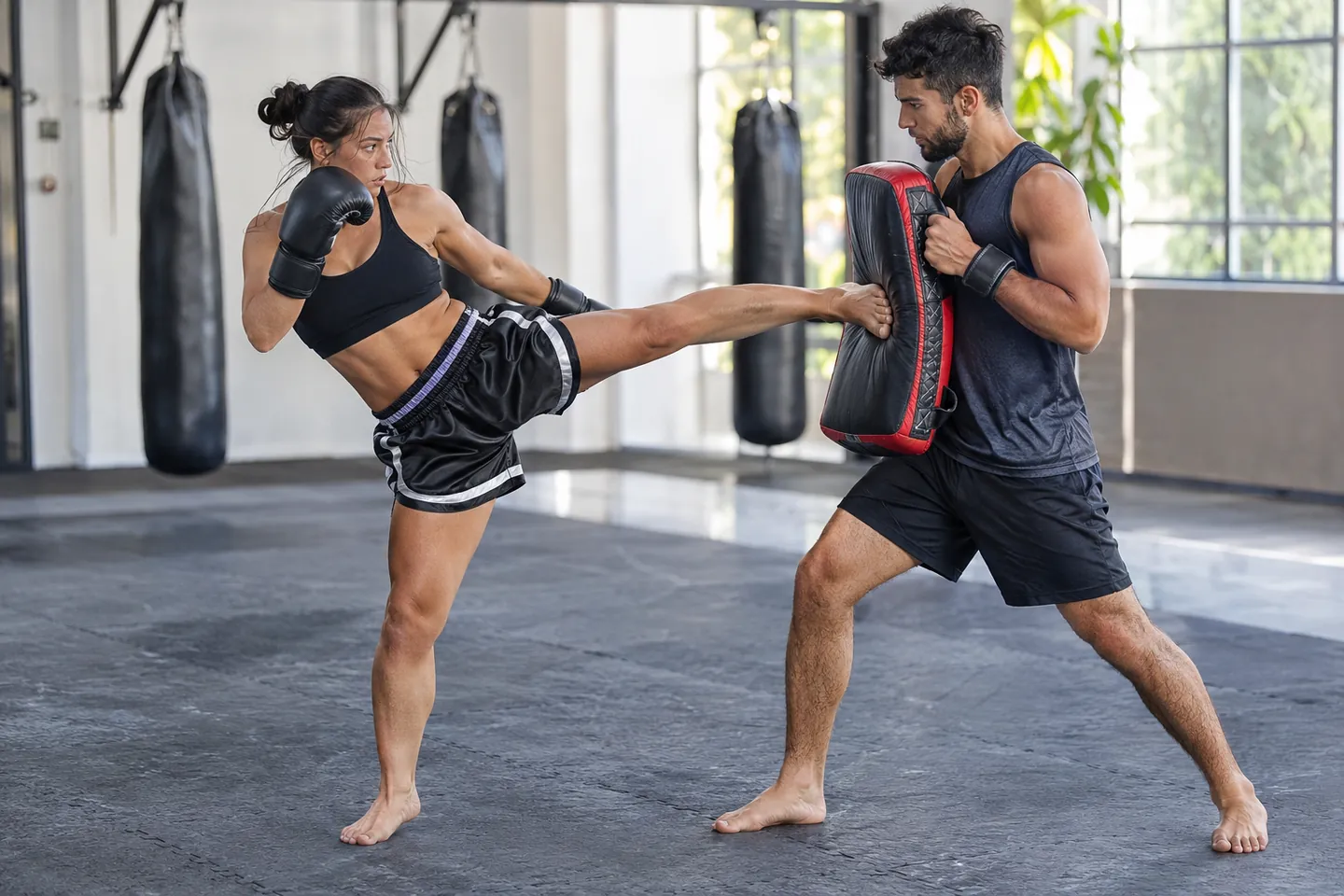
A practical guide to building kickboxing combinations in Mississauga, from linking two strikes to adding kicks, balance, rhythm and partner pad work.
A single kick, practised on its own, is a fairly tidy problem. You learn where to stand, how to pivot, where the shin or foot should land and how to get back to your stance. The moment you try to throw that kick after two punches, the problem changes shape. Your weight is somewhere new, your hips are at a different angle and the target may have moved. That is the real work of kickboxing, and it is where many beginners first feel stuck.
Building kickboxing combinations in Mississauga classes is less about memorising long strings of strikes and more about understanding how one movement sets up the next. A good combination flows because each piece leaves you in a position from which the following piece is natural. When that relationship is clear, even a three-strike sequence feels smooth. When it is not, a two-strike sequence can feel like a fight with your own body.
What follows is a way of thinking about combinations from the ground up: starting with pairs, adding a third piece, mixing hands and legs, and eventually practising them with a partner and a little movement. Your coach will have their own system and terminology, so treat these ideas as a companion to class, not a replacement for it.
Start with pairs, not sentences
It is tempting to copy the five- and six-strike sequences you see experienced members throwing. Resist that for now. The building block of every combination is a pair: one strike followed by another. If you can make a handful of pairs feel clean, longer combinations become a matter of joining pairs together.
A familiar starting pair is the jab followed by the cross. The jab comes from the lead hand and sets distance; the cross comes from the rear hand and uses the rotation of the hips. Notice what the jab does to your body. It extends the lead side slightly forward and keeps your weight fairly centred, which leaves the rear side loaded and ready. The cross then uses that loaded position. The two strikes fit because the first one prepares the second.
Try other pairs your coach has shown you and pay attention to the same relationship. Does the first strike leave you balanced for the second, or do you need to adjust your feet in between? If you need an adjustment, that is useful information. Either the pair needs a small step, or it is not a natural pairing at your current stage.
Think in terms of weight transfer
Almost every kickboxing combination can be described as a series of weight shifts. A cross moves weight toward the lead leg. A lead hook pulls it back toward the centre or rear. A rear round kick requires your weight to be over the lead leg so the rear leg can swing freely. When strikes follow the direction your weight is already travelling, combinations feel easy. When they fight it, they feel clunky.
This is why a cross followed by a lead hook is such a common pairing. The cross shifts your weight forward and rotates the hips; the hook unwinds that rotation in the opposite direction. Equally, a lead hook can set up a rear kick, because the hook turns the body and leaves the rear hip ready to come through. You do not need to memorise every possible relationship. You just need to start noticing where your weight is at the end of each strike.
A helpful exercise is to throw a strike slowly and freeze at the end. Ask yourself which foot is carrying more of your weight and which hip is loaded. Then ask which strike would naturally follow from that position. Over time this becomes intuitive, and you begin to see why your coach builds the combinations they do.
Adding the third piece
Once a pair feels comfortable, add one more strike. The most reliable way to do this is to extend a pair you already know well rather than inventing something new. Jab, cross becomes jab, cross, lead hook. Or jab, cross becomes jab, cross, lead low kick.
The third piece is often where balance becomes an issue. Each strike shifts your weight, and by the third you may be leaning further than you realise. Slow down and check your stance after the combination ends. Are your feet still roughly where they started? Is your guard back in place? If not, the combination may need a small footwork adjustment, or you may simply need more repetitions at a slower speed before trying to speed up.
Many coaches suggest counting the strikes out loud at first, or naming them as you throw. It sounds simple, but it keeps your attention on the sequence rather than letting your mind drift to how hard you are hitting. When you can throw the three-strike combination smoothly without counting, you have internalised it.
Mixing hands and legs
The defining feature of kickboxing is the combination of punches and kicks, and this is where the weight-transfer idea really earns its keep. Kicks require more balance and more time than punches, so the strikes before a kick should set it up rather than leave you scrambling.
A common pattern is to use punches to close distance and create an opening, then finish with a kick. Jab, cross, lead hook, rear round kick is one classic example. The punches bring your attention and your partner’s guard upward, and the kick arrives at a different level. Another pattern goes the other way: a kick to start, followed by punches as you land. This asks more of your balance because you need to plant your kicking foot in a useful place.
Pay close attention to where your kicking foot lands. If it drops back to its starting position, you are set up to reset or throw again from range. If it lands forward, you have changed stance or moved closer, and the next strike needs to account for that. Your coach can show you which landing they want for each combination. Neither option is wrong, but mixing them up without intent can leave you off balance.
Keeping the guard alive
One of the most common faults in combination work is the disappearing guard. While you are concentrating on the strikes, the non-punching hand drifts away from your face, or both hands drop during a kick. In pad work this might seem harmless, but it builds a habit that becomes a problem when someone is striking back.
A simple fix is to give your non-striking hand a job. When you jab, the rear hand stays at your cheek. When you throw a round kick, the same-side arm might swing down to help with rotation while the other hand stays high to protect your head. Ask your coach exactly how they want your arms positioned during each kick, since styles vary.
Check yourself at the end of every combination. Before you relax or step away, return your hands to guard and hold for a beat. This “finishing in guard” habit takes very little effort, but it makes a meaningful difference over months of training.
Finding a rhythm
Combinations are not all thrown at the same tempo. Some flow in a steady beat; others have a pause, a feint or a quick double strike. Learning to vary rhythm makes your combinations harder to read and, just as importantly, helps you stay relaxed. Constant maximum speed is tiring and tends to make technique sloppy.
Try throwing the same combination at three different tempos: slow and deliberate, moderate and smooth, and quick but controlled. Notice which version feels most balanced. Usually the moderate tempo is where technique and timing meet, and that is a good place to spend most of your practice. Speed can be layered on later.
You can also experiment with small pauses. A jab, then a beat, then a cross and kick changes the feel of the sequence entirely. Your coach may introduce these variations as you progress. Treat them as a way to understand timing rather than as a trick to memorise.
Breathing through the sequence
Many beginners hold their breath through an entire combination, which makes them tired surprisingly fast. A common approach is to exhale sharply with each strike, often with a short hiss or puff of air. This keeps the core engaged and prevents your breath from getting trapped.
If you find yourself breathless after just a few combinations, listen to your own breathing during the next round. Are you exhaling on each strike, or just on the last one? Are you breathing at all between combinations? Small adjustments here can make a long round of pad work feel much more manageable, especially in the warmer months when the studio feels heavy.
Working with a pad holder
Pad work turns a combination into a conversation. The holder decides the target, the distance and sometimes the timing, and you respond. This is where combinations start to feel like kickboxing rather than choreography.
Good pad work depends on both people. As the striker, keep your power appropriate for your partner’s experience and the pads being used. Strike the target, not the holder’s arm or body. As the holder, present the pads clearly, meet each strike with a little resistance and keep your own guard sensible. If you are new to holding thai pads for kicks, ask your coach to show you how to brace and position them. Holding pads badly can strain your shoulders and makes it harder for your partner to learn.
Communication helps. A simple “ready?” before each combination and a quick word of feedback after keeps the rhythm going. Many partnerships in our Mississauga classes develop their own shorthand over time, which makes the rounds both productive and enjoyable.
Adding footwork and angles
Once a combination feels smooth on the spot, add movement. Step in with the first strike, or step off at an angle after the last one. This reflects how combinations are actually used: to enter range, score, and leave safely.
Exiting is particularly important. A combination that ends with you standing directly in front of your partner leaves you open to a counter. Your coach may teach you to pivot, step back or circle out after you finish. Practise the exit as part of the combination, not as an afterthought. It is far easier to build that habit now than to add it later.
Footwork also exposes balance problems. If a combination works when you stand still but falls apart when you add a step, return to the slower version and look for where your weight is going. Often the issue is a step that is too large or a kick thrown before the feet have settled.
Practising outside class
If you want to rehearse combinations at home, shadowboxing in a clear space is the simplest option. Throw each combination slowly, watching your form in a mirror or a darkened window. Focus on the transitions between strikes and on finishing in guard. Avoid adding speed or power beyond what you practise in class without guidance.
A short note after each session can be surprisingly useful. Write down the combinations you worked on, any cues your coach gave and anything that felt awkward. Bring these notes to your next class and ask about the parts that confused you. Over several weeks you will build a personal library of combinations you genuinely understand rather than a long list you half remember.
Common sticking points
A few problems come up again and again. The first is rushing: trying to throw a combination at full speed before it is clean at a slower pace. The second is over-rotating on a kick, which leaves you facing away from your partner when you land. The third is reaching for a target that is too far away, which pulls you off balance.
Each of these has a straightforward fix. Slow down. Ask your coach to check your pivot and landing. Let the pad holder adjust the distance. None of these problems mean you are bad at kickboxing. They mean you are learning, and every experienced kickboxer you see in the room has worked through the same ones.
Building your library over time
Combinations are cumulative. The pairs you learn in your first month become the building blocks of the sequences you throw a year later. Patience at this stage pays off because it gives you a reliable foundation of movements that fit together.
If you are ready to work on combinations with experienced coaches and a supportive group, our kickboxing classes in Mississauga focus on clean technique, smart pad work and steady progress. You might also enjoy the striking-heavy approach of Muay Thai, which adds elbows, knees and clinch work to the mix. When you are ready, book a free trial and start building your first combinations with someone watching closely.
Filed under
Keep exploring
More training insights await.