
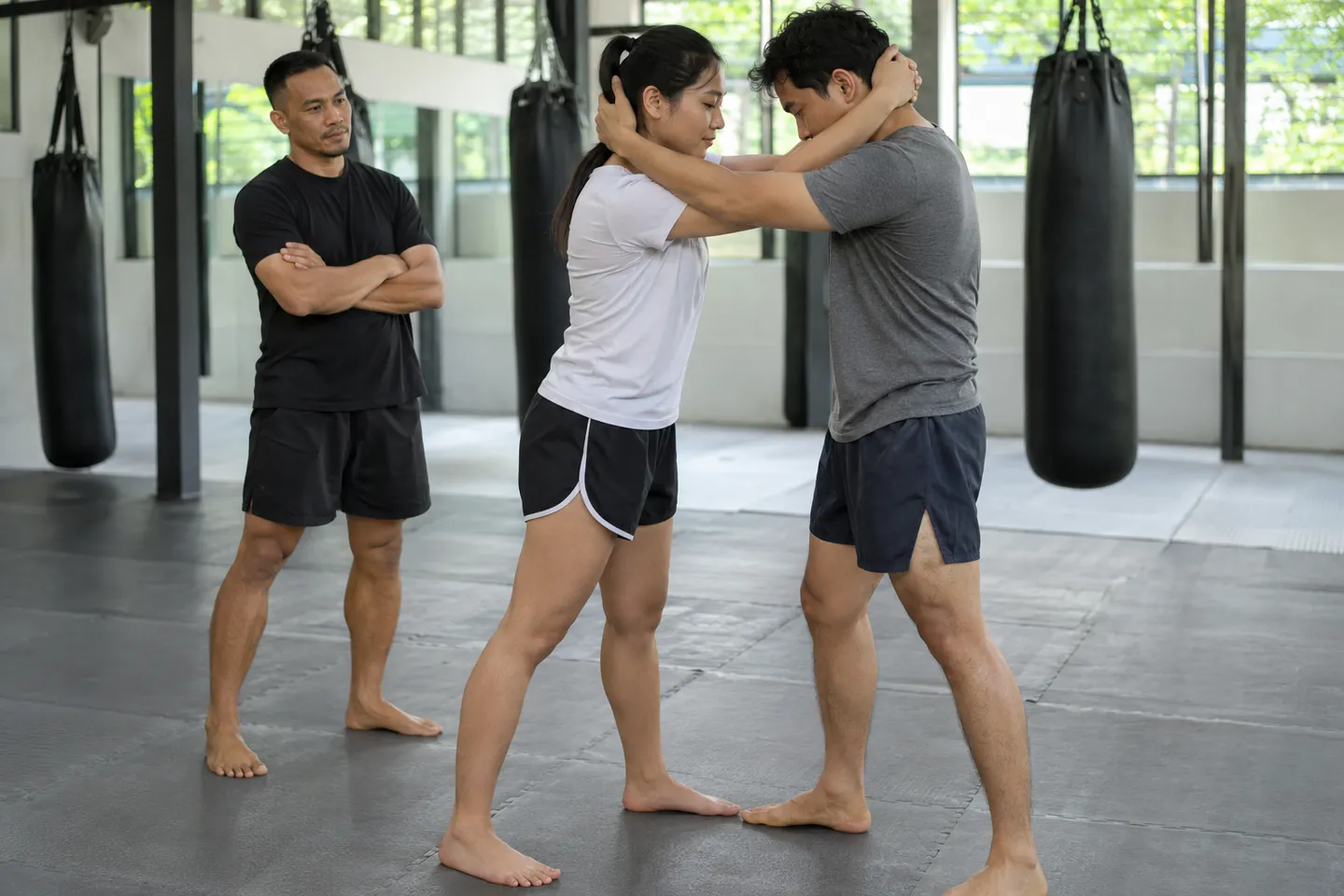
A grounded introduction to the Muay Thai clinch for beginners in Mississauga, covering posture, hand position, balance, knees, and safe partner practice.
The first time most people step into a Muay Thai clinch, it is a strange experience. Up to that point, striking has involved distance: you punch, kick, and move around a partner or pad holder. Then the coach pairs you up, tells you to tie up, and suddenly you are standing chest to chest with someone, hands around their neck, trying to figure out where your feet are supposed to go.
It is common to feel clumsy and a little self-conscious. Nearly everyone does. The clinch is a skill set of its own, with its own positions and priorities, and it rewards patient practice more than strength or aggression.
This article covers the basics a beginner might encounter when learning the clinch in Muay Thai classes in Mississauga. It explains why the clinch matters, the main positions you will hear about, and how to practise safely with partners while you build familiarity. Your coach’s instruction always comes first, since gyms teach the details in different ways.
Why Muay Thai includes a clinch at all
Muay Thai is sometimes called the art of eight limbs, because it uses fists, elbows, knees, and shins. The clinch is the range where knees and elbows become especially relevant, and where a fighter can control an opponent’s posture, balance, and movement.
In competitive Muay Thai, the clinch is a scoring and controlling range in its own right, not simply a place to rest. Fighters work for dominant hand positions, off-balance their opponents, and look for openings to land knees. In beginner classes, of course, the emphasis is on learning positions and movement rather than striking hard.
Understanding the clinch also makes you a more complete striker. Even if you never compete, learning what happens at close range makes you more comfortable when a partner closes distance in sparring or drilling.
Posture comes before everything
If there is one theme that runs through clinch instruction, it is posture. A beginner who leans forward with their head down is easy to pull around. A beginner who stands tall, with hips close and spine fairly upright, is much harder to control.
Coaches often ask students to keep their heads up and their hips in, rather than bending at the waist. This is partly about balance and partly about preventing a partner from pulling your head down into position for knees. When your posture breaks, many of your options disappear.
It can help to think of posture as something you return to constantly rather than something you set once. During the clinch, partners shift and push, and you will need to readjust. Noticing when your head has dropped and bringing it back up is a skill in itself.
Hand and arm position
There are several common hand positions in the Muay Thai clinch. You may hear terms like double collar tie, where both hands are behind an opponent’s head, single collar tie with one hand behind the head and the other controlling an arm, or arm control positions where you hold the biceps or wrists.
For beginners, the most important idea is often the inside position. Having your arms inside your partner’s arms, closer to their head and neck, usually gives you more control than having them outside. Much of the early clinch work is about learning to win and keep that inside position.
When placing hands behind the head, many coaches teach stacking one hand on top of the other rather than interlocking fingers. The reason relates to control and safety, and your coach will explain their preferred method. Follow their guidance rather than improvising.
Forearms and elbows as frames
Your forearms and elbows are not just connecting your hands to your body. In the clinch, they can be used to frame against your partner’s collarbone or chest, create space, and stop them from closing in completely.
When your partner is pulling your head, your elbows and forearms can help keep their arms from settling where they want. When you are trying to control your partner, squeezing your elbows inward can tighten your grip and limit their movement. These details take time to feel.
Many beginners rely on their hands alone, gripping hard and pulling with their arms. This tends to be tiring and not very effective. Learning to use the whole arm, along with body position, generally gives better results with less effort.
Balance and footwork in the clinch
Footwork in the clinch is different from footwork at kicking range. You are close enough to step into your partner’s space, turn them, and pull them off balance. You are also close enough to be turned and off-balanced yourself.
A stable base matters. Coaches typically encourage a stance that is not too wide or narrow and that lets you pivot and step without crossing your feet. Weight distribution changes constantly as you and your partner move, and staying light enough to adjust is part of the skill.
Turning a partner, often described as off-balancing or spinning, involves moving your feet and using your arms together. Beginners usually learn this slowly, as a cooperative drill, before any resistance is added. If you feel yourself falling or losing control, it is fine to release the clinch and reset.
Introducing knees safely
Knees are a major part of Muay Thai clinch work, but they are also where the potential for injury increases. In beginner classes, knees are usually introduced slowly, often into pads or shields held by a partner, rather than into a partner’s body.
When knees are practised in a clinch drill, the intensity is typically very light, and the focus is on positioning, timing, and balance rather than impact. Your coach will set clear rules about targets and power. Following those rules protects both you and your partner.
If you are not sure what level of contact is expected, ask before starting. Different drills call for different intensities, and assuming the wrong one is a common cause of discomfort and frustration between partners.
Choosing and working with partners
The clinch is a close, physical activity, and your partner’s approach matters. Ideally, you will practise with people who are cooperative, communicative, and roughly similar in size and experience, at least at first.
Good clinch partners give each other feedback. They let each other know if something is too tight, too hard, or uncomfortable. They also agree on the drill’s intensity and stick to it. A partner who suddenly ramps up resistance or strikes harder than agreed makes learning harder for everyone.
If you are paired with someone much larger or more experienced, it is perfectly reasonable to ask them to keep things light. Most experienced practitioners will happily adjust. If they do not, let the coach know.
Hygiene and practical courtesy
Because the clinch involves close contact, basic hygiene becomes particularly important. Clean training clothes, trimmed fingernails and toenails, and a quick check for any skin issues before class are all simple courtesies.
If you have a cut, rash, or anything that might be contagious, it is considerate to skip clinch work until it has been checked and cleared by a healthcare provider. Many gyms have policies about this for good reason.
Removing jewellery, watches, and anything with sharp edges before clinch drills is also standard. Small objects can scratch or catch during close contact.
Conditioning for the clinch
Clinch work is tiring in a way that differs from pad work. Your neck, shoulders, grip, and core are working constantly, and your legs are adjusting balance the whole time. Beginners often feel worn out after a few short rounds.
That fatigue improves with regular practice. Strength and conditioning work focusing on the neck, upper back, grip, and trunk can also help, provided it is introduced sensibly. A coach can suggest exercises suited to your level.
Neck training in particular should be approached carefully, starting gently and progressing gradually. If you have any history of neck problems, speak with a qualified healthcare professional before adding specific neck exercises.
Common beginner mistakes
Several patterns show up repeatedly in new students:
- Bending forward at the waist and letting the head drop
- Gripping with the hands only, without using forearms and elbows
- Standing too far away, which allows the partner to pull you in
- Holding the breath and tensing every muscle at once
- Going harder than the drill requires
None of these are surprising. They are what most people do before they have learned a better way. Recognising them is a step toward changing them, and your coach will usually point them out as they happen.
How the clinch fits into overall Muay Thai training
The clinch is one part of a larger picture. In a typical Muay Thai class, it may appear for a portion of the session, alongside pad work, bag work, technique drills, and conditioning. Some classes focus more heavily on clinching, especially as students progress.
For beginners, short and regular exposure is usually more useful than long, exhausting sessions. A few rounds of cooperative drilling every week builds familiarity steadily. Over time, you will start to feel comfortable in close range, which improves your overall confidence as a striker.
Some people also find that grappling arts like jiu-jitsu or wrestling-based training help them understand balance and body position in new ways, which can carry over to clinch work. Others prefer to stay focused on Muay Thai alone. Both approaches are valid.
Getting started with clinch work
Learning the clinch is a gradual process. It is normal to feel awkward and overwhelmed at first. With good coaching, cooperative partners, and patience, the position becomes familiar, and you start to notice details you could not see before.
If you are interested in exploring Muay Thai in Mississauga, our Muay Thai classes introduce clinch fundamentals within a supportive, beginner-friendly environment. You can also explore related training through kickboxing or MMA, or simply book a free trial to see how a class runs before deciding.
Filed under
Keep exploring
More training insights await.