
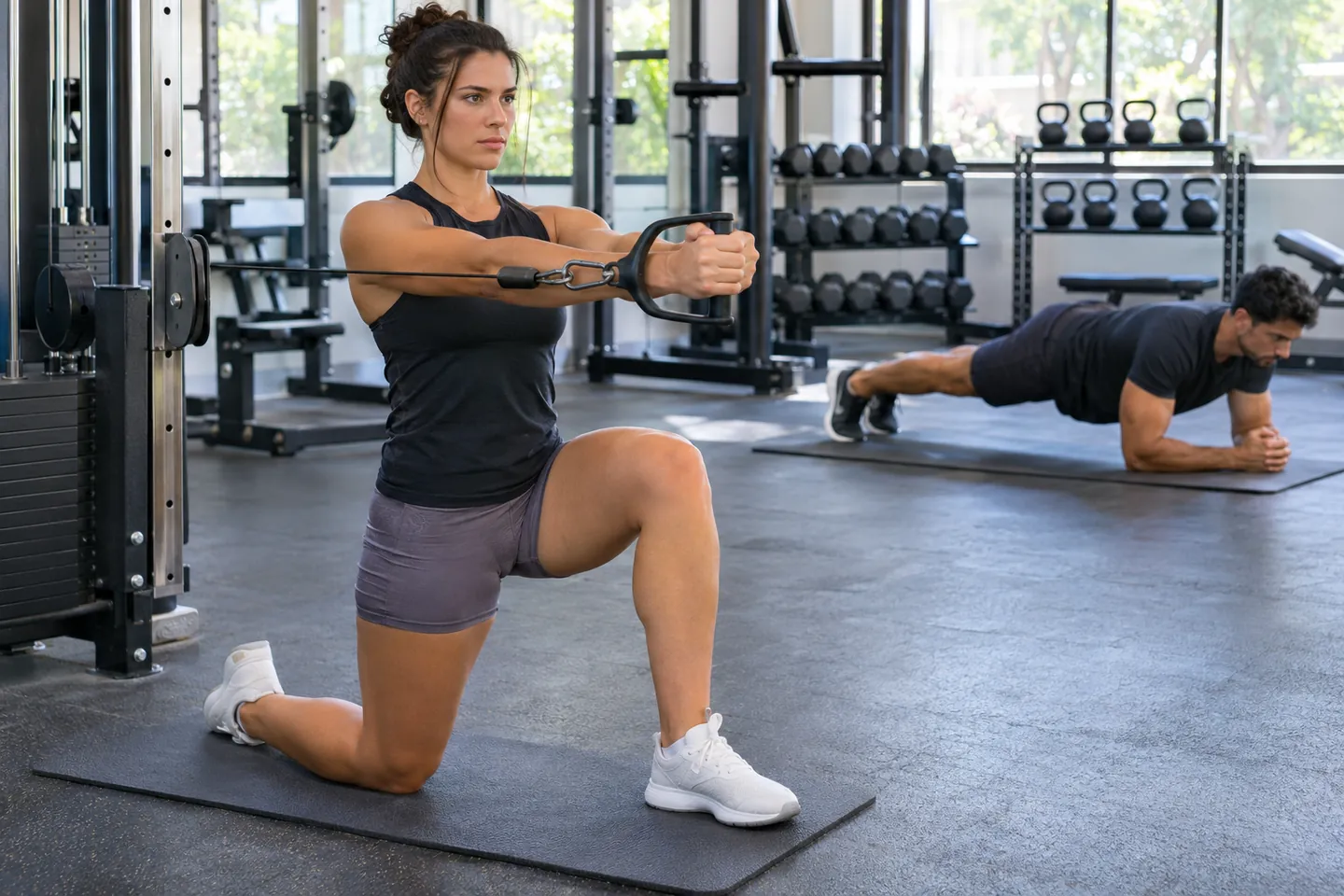
Explore core training beyond crunches in Mississauga, with planks, carries, anti-rotation drills, and breathing that help your trunk hold steady in real movement.
Crunches have a long history in fitness culture. For decades, they were the default answer to almost any question about the midsection: want a stronger core, do more crunches; want to look leaner, do more crunches. Gym floors and living rooms across the country were full of people curling up and down in sets of fifty.
Crunches are not useless, and there is no need to treat them as forbidden. But they train a fairly narrow slice of what the trunk actually does. In most sport and daily life, your core’s main job is not to bend you forward repeatedly. It is to hold your torso steady while your arms and legs produce force, to resist being twisted or pulled out of position, and to transfer energy between the upper and lower body.
For people training in Mississauga, whether that means lifting, martial arts, or just staying capable for work and family life, building a core that does those jobs well can make other training feel more solid. This post looks at what that kind of core work involves and how to start.
What “core” really refers to
The word core gets used loosely. In general fitness conversation, it usually refers to the muscles around the trunk: the abdominal muscles at the front and sides, the muscles along the spine, the deep muscles around the lower back and pelvis, the hips, and the diaphragm and pelvic floor that form the top and bottom of the abdominal cavity.
These muscles work together. They create stiffness and control around the spine and pelvis so that your limbs have a stable base to move from. When you throw a punch, pick up groceries, or push a stroller up a curb, your trunk is quietly managing forces so that the movement goes where you want it to.
Thinking of the core as a system rather than a single muscle helps explain why one exercise is not enough. Training only the front of the abdomen through repeated bending leaves a lot of that system underused.
Four jobs worth training
One practical way to organise core training is around the things the trunk needs to resist or control. Strength coaches often describe them roughly like this:
- Resisting extension: stopping the lower back from arching excessively, as in a plank or a rollout.
- Resisting rotation: keeping the torso square when a force tries to twist it, as in a cable press or a single-arm row.
- Resisting side bending: staying upright when a load pulls you sideways, as in a single-arm carry.
- Controlling flexion and hip movement: bracing during lifts and moving the hips without losing position, as in dead bugs or hip hinges.
You do not need to memorise these categories. They are simply a reminder that a well-rounded core program asks the trunk to hold steady in several directions, not just to bend forward.
Planks done with intention
The plank is probably the most familiar crunch alternative, and it earns its place. Holding a straight line from shoulders to heels asks the front of the trunk to resist the pull of gravity on the hips. The problem is that many people treat planks as an endurance contest, holding for as long as possible while their hips sag and their shoulders creep toward their ears.
A shorter plank done well usually teaches more. Set your elbows under your shoulders, squeeze your glutes lightly, brace your midsection as if preparing for a gentle poke in the stomach, and keep breathing. Twenty or thirty seconds of genuine tension may be more productive than two minutes of hanging on with poor position.
Once a standard plank feels manageable, variations such as side planks, planks with a shoulder tap, or body saws on a slippery surface add new demands. A coach can help choose progressions that suit your current level rather than jumping to the hardest versions.
Anti-rotation work
Rotational forces are everywhere. Carrying a heavy bag on one shoulder, opening a stiff door, pushing a shopping cart with one hand, and taking a hit on a pad in kickboxing all involve forces that try to twist the torso. Training the core to resist that twisting can make these situations feel more controlled.
The Pallof press is a common example. You stand or kneel side-on to a cable machine or resistance band, hold the handle at your chest, and press it straight out. The band tries to pull you toward the anchor, and your job is to keep your torso facing forward. It looks deceptively easy until you try it with a little tension.
Single-arm exercises also train anti-rotation naturally. A single-arm dumbbell row, a single-arm press, or a renegade row from a plank position all challenge the trunk to stay square while one side does the work. These are efficient because they train the core while you are training something else.
Carries: simple and underrated
Loaded carries might be the most practical core exercise there is. You pick up a weight, hold it, and walk. With weights in both hands, you train grip, posture, and general bracing. With a weight in only one hand, often called a suitcase carry, your trunk has to work hard to stop you from leaning toward the loaded side.
Carries resemble daily life closely. Bringing groceries in from the car, hauling luggage through an airport, or carrying a child on one hip all demand the same kind of control. That makes them a good choice for people who want their gym work to translate outside the gym.
Start with moderate weights and walk tall, with your shoulders level and your steps steady. If you find yourself leaning or shuffling, the weight is probably too heavy for the moment. Distance and load can increase gradually as your posture holds up.
Dead bugs, bird dogs, and slow control
Not all core work needs heavy load or long holds. Some of the most useful exercises are slow, deliberate movements that teach you to keep your trunk steady while your limbs move.
In a dead bug, you lie on your back with your arms pointed at the ceiling and knees bent above your hips. You slowly lower an opposite arm and leg toward the floor while keeping your lower back from arching off the ground. In a bird dog, you start on hands and knees and extend an opposite arm and leg without letting the torso twist or sag.
These exercises can feel almost too easy at first, but that changes quickly when you slow them down and focus on keeping everything still. They are particularly helpful for people returning to exercise after time away or for anyone who struggles to feel their trunk working in other movements.
Breathing is part of core training
It may seem odd to talk about breathing in a strength article, but the diaphragm is one of the core’s key players. How you breathe affects how well you can brace. Holding your breath constantly can make it harder to maintain tension over time, while breathing shallowly into the chest can leave the trunk less supported.
Many coaches teach a breath that expands the belly and lower ribs in all directions, followed by a controlled exhale while maintaining some tension. Practising this during planks, dead bugs, and carries helps link breathing and bracing so they work together rather than against each other.
For heavier lifting, bracing strategies may differ, and a qualified coach can explain what suits your training. If you have a medical condition affecting your blood pressure, breathing, or pelvic floor, check with a healthcare professional before using breath-holding techniques under heavy load.
How core training connects to martial arts
People who train combat sports often notice how much their trunk matters. A punch or kick that starts from the feet needs a stable midsection to carry force through to the hands or shins. In grappling, staying steady while someone pushes, pulls, or rolls you is largely a core skill.
That is one reason martial arts classes often include planks, sit-up variations, and partner drills that challenge the trunk. Combining dedicated core work with skill training can help each support the other. A stronger, more controlled core can make technique feel more connected, and technique practice gives core strength a practical purpose.
You do not need to train martial arts to benefit from this kind of core work, of course. The same principles apply to lifting, running, cycling, and the general demands of daily life.
Fitting core work into a week
Core training does not require long dedicated sessions. Many people add two or three exercises to the end of their regular workouts, or weave them into warm-ups. A few sets of a plank variation, an anti-rotation movement, and a carry can cover a lot of ground in fifteen minutes.
Two to four short sessions a week is plenty for most people. As with any training, consistency matters more than intensity. A modest routine you repeat for months will do more than an ambitious one you abandon after two weeks.
Think about variety over time too. Rotating exercises every few weeks keeps the work interesting and challenges the trunk in slightly different ways, while still giving you enough repetition to improve.
A word about back pain
Many people start core training because they have had back pain or want to avoid it. Core exercises can be part of a sensible approach to back health, but they are not a guaranteed fix, and back pain has many possible causes.
If you have persistent, severe, or unexplained back pain, see a qualified professional such as a physiotherapist or physician before starting a new program. They can assess what is going on and recommend exercises suited to you. If certain movements cause pain during training, stop and seek guidance rather than pushing through.
Gyms that offer physiotherapy alongside training can make that conversation easier, but the key point is to get individual advice rather than relying on general articles for a specific problem.
Starting your own core routine
You do not need to give up crunches entirely if you enjoy them. Just think of them as one small part of a broader picture. A balanced core routine trains the trunk to hold steady against extension, rotation, and side bending, while teaching you to breathe and brace in ways that support everything else you do.
If you would like help building that kind of routine, our strength and conditioning classes and personal training sessions in Mississauga include core work as part of well-rounded programs. You can also book a free trial and ask a coach to show you a few core exercises that suit your current fitness.
Filed under
Keep exploring
More training insights await.