
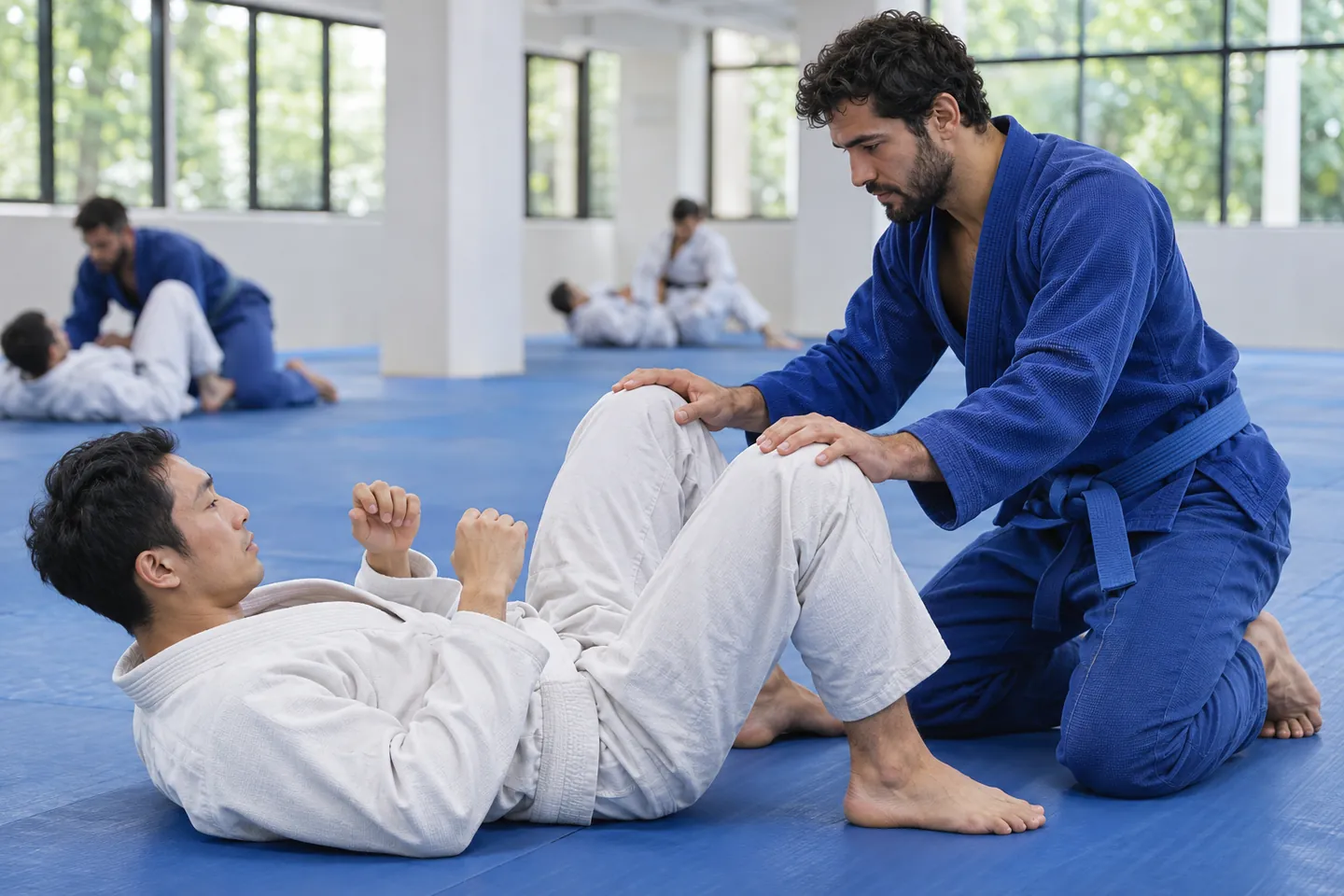
Understand how drilling and rolling fit together in Brazilian jiu-jitsu, and how Mississauga beginners can use both to learn faster and train more safely.
Walk into most Brazilian jiu-jitsu classes and you will see two very different kinds of activity. For part of the session, pairs of students repeat the same technique over and over, one partner offering little resistance while the other practises. Later, the room changes character: partners start from a position and try to achieve their goals against someone actively trying to stop them. The first is usually called drilling. The second is rolling, or sparring.
New students sometimes see these as separate worlds, with drilling as the boring prerequisite and rolling as the real thing. In practice, the two depend on each other. Drilling builds the movements you need; rolling tests them and reveals what to drill next. Understanding that relationship can make your first months of Brazilian jiu-jitsu in Mississauga far more productive and far less frustrating.
Below, we look at what each part of class is for, how to get more out of both, and how to keep the process safe and enjoyable as you learn.
What drilling is for
Drilling is repetition with a cooperative partner. The coach demonstrates a technique, perhaps a guard pass, a sweep or an escape, and then you and your partner take turns performing it. Your partner provides the right reactions and a sensible level of resistance so you can learn the sequence of movements.
The purpose is to build familiarity. Jiu-jitsu techniques involve many details: where your hands grip, where your weight sits, which way your hips turn, when to move your knee. You cannot think through all of those under pressure. Drilling helps the pattern become more natural, so that eventually you can perform it without consciously assembling every piece.
Good drilling also teaches you to see the technique from both sides. While your partner practises, you feel what it is like to receive the move. That experience helps you understand the mechanics and gives you early clues about how people might defend it.
What rolling is for
Rolling is where you try to apply what you know against resistance. Partners may start from standing, from a specific position, or from a situation the coach chooses. Each person has goals, and both are trying to achieve them. It is a cooperative activity in the sense that you are helping each other learn, but within the roll the resistance is real.
Rolling shows you what actually works for you at your current level. A technique that felt smooth in drilling may fall apart when your partner reacts unexpectedly. That is not a failure of the technique or of you. It is feedback, and it shows exactly where your understanding needs more work.
Rolling also builds qualities that drilling alone cannot: timing, the ability to read pressure, composure in uncomfortable positions, and the endurance to keep thinking while tired. Those are hard to develop any other way.
How the two feed each other
The most useful way to view drilling and rolling is as a loop. You drill a technique, try it in rolling, notice what goes wrong, bring that question back to the coach or to your next drilling session, and refine. Over many cycles, a technique moves from something you have seen to something you can use.
That loop works best when you bring curiosity to both stages. After a roll, think about one moment that confused you. Perhaps your partner kept escaping from side control, or you could never get past their legs. Before the next class, or at the start of open mat, ask a coach or more experienced student what to look at. Then drill that specific piece.
Many beginners skip this reflection and simply roll as much as possible. Rolling a lot is not wrong, but rolling without reflection tends to lead to the same mistakes repeating for months. A little thought between sessions often saves weeks of confusion.
Getting more from drilling
Quality matters more than quantity in drilling. Rushing through twenty fast repetitions with sloppy details usually teaches less than ten careful ones. Start slowly, check the key points the coach emphasised, and increase pace only once the sequence feels clear.
Communicate with your partner. If you need them to react in a certain way for the technique to make sense, ask. If they are giving too much resistance for the stage you are at, say so politely. If you are the one being drilled on, give the right reactions: not limp and lifeless, but not fighting the move either. Your aim is to help them learn.
Once the basic sequence is comfortable, a coach may introduce progressive resistance. Your partner starts to react a little more, perhaps defending one part of the move. This middle ground between drilling and rolling is extremely valuable, because it lets you test the technique without the full chaos of a live roll.
Getting more from rolling
Rolling well is a skill in itself. In the early weeks, you will probably feel overwhelmed. Everything happens quickly, you lose track of where your limbs are, and you may end up flat on your back more often than you would like. That is completely normal.
One helpful approach is to set a small goal for each roll. Rather than trying to win, focus on something specific: keeping your elbows tight while on the bottom, attempting one sweep you drilled that week, or simply breathing calmly when someone holds side control. A clear focus makes rolling less chaotic and more educational.
Choose partners thoughtfully, especially when you are new. Rolling with someone experienced who moves calmly and controls the pace can teach you a lot. Rolling with another beginner who matches your size and intensity can be fun but sometimes becomes a scramble. Both have value, but early on, calmer partners often help you learn more.
Tapping and safety
Tapping is how you signal that you want to stop, usually because a submission is applied or you feel uncomfortable. You can tap on your partner, on the mat, or verbally. Tap early and tap often. There is no shame in tapping; it is a normal part of learning, and it keeps you training next week.
When your partner taps, release immediately and smoothly. Do not crank the hold harder or make them tap twice. Trust is the foundation of rolling, and partners who respect taps quickly become popular training companions. Coaches watch for this, and gyms with good culture take it seriously.
Respect the rules set for each round. Some submissions may be off-limits for beginners, and some positional sparring rounds may limit what techniques are allowed. If you are unsure, ask the coach before you start. Our Brazilian jiu-jitsu classes introduce these expectations early so everyone knows where the boundaries are.
Managing intensity
Jiu-jitsu can be tiring, and the intensity of rolling can vary a lot. Many coaches encourage beginners to roll at a moderate pace, especially at first. Going too hard often leads to exhaustion within a minute or two, poor technique and a higher chance of injury for both partners.
You can communicate intensity before a roll. A quick “light today?” or “I’m still learning, can we keep it technical?” helps set expectations. Most partners appreciate the clarity. If someone is going harder than you are comfortable with, it is fine to tap, take a break and talk to the coach.
Pay attention to your own body. Fingers, necks, shoulders and knees can all get sore in grappling. Rest when you need it, and seek advice from a qualified professional if pain lingers. Our physiotherapy team is available to members who want an assessment.
Open mat and extra practice
Many gyms offer open mat sessions, where students can drill or roll freely without a structured class. These sessions are great for working on whatever you need: the technique from Tuesday that still feels confusing, a few extra rounds, or a quiet chat with a more experienced partner about a specific position.
If you are new, open mat can feel a little unstructured. Have a plan before you arrive. Perhaps you want ten minutes of drilling one escape, followed by a few positional rounds starting from that situation. Ask someone of similar size to help, and offer to help them in return.
Do not feel pressure to roll every round at open mat. Using some of the time to drill, rest or watch others is perfectly reasonable, especially if you have trained a lot that week.
Fitting jiu-jitsu into your week
For many students in Mississauga, jiu-jitsu fits around work, family, commuting and other commitments. A sustainable rhythm is more valuable than an intense burst followed by burnout. Two or three classes a week is common for adult beginners, though everyone’s situation is different.
If you can only train once or twice a week, focus on making those sessions count. Arrive on time so you catch the technique demonstration, pay attention during drilling, and use rolling as a chance to test one or two specific things. Taking brief notes after class can help you remember details between sessions.
Some members combine jiu-jitsu with other training, such as strength and conditioning or striking classes. That variety can be enjoyable and supports overall fitness, but watch the total load so you are not arriving at every session already exhausted.
Starting Brazilian jiu-jitsu at Konga Fitness
Drilling and rolling are two halves of the same learning process. Drilling builds the movement, rolling tests it, and the reflection between them turns experience into skill. When you value both, the early months of jiu-jitsu feel less like a confusing struggle and more like steady, visible progress.
If you would like to experience this in a supportive environment, visit our Brazilian jiu-jitsu page to learn more about the program, check the adult schedule for class times, and book a free trial at our Mississauga academy.
Filed under
Keep exploring
More training insights await.