
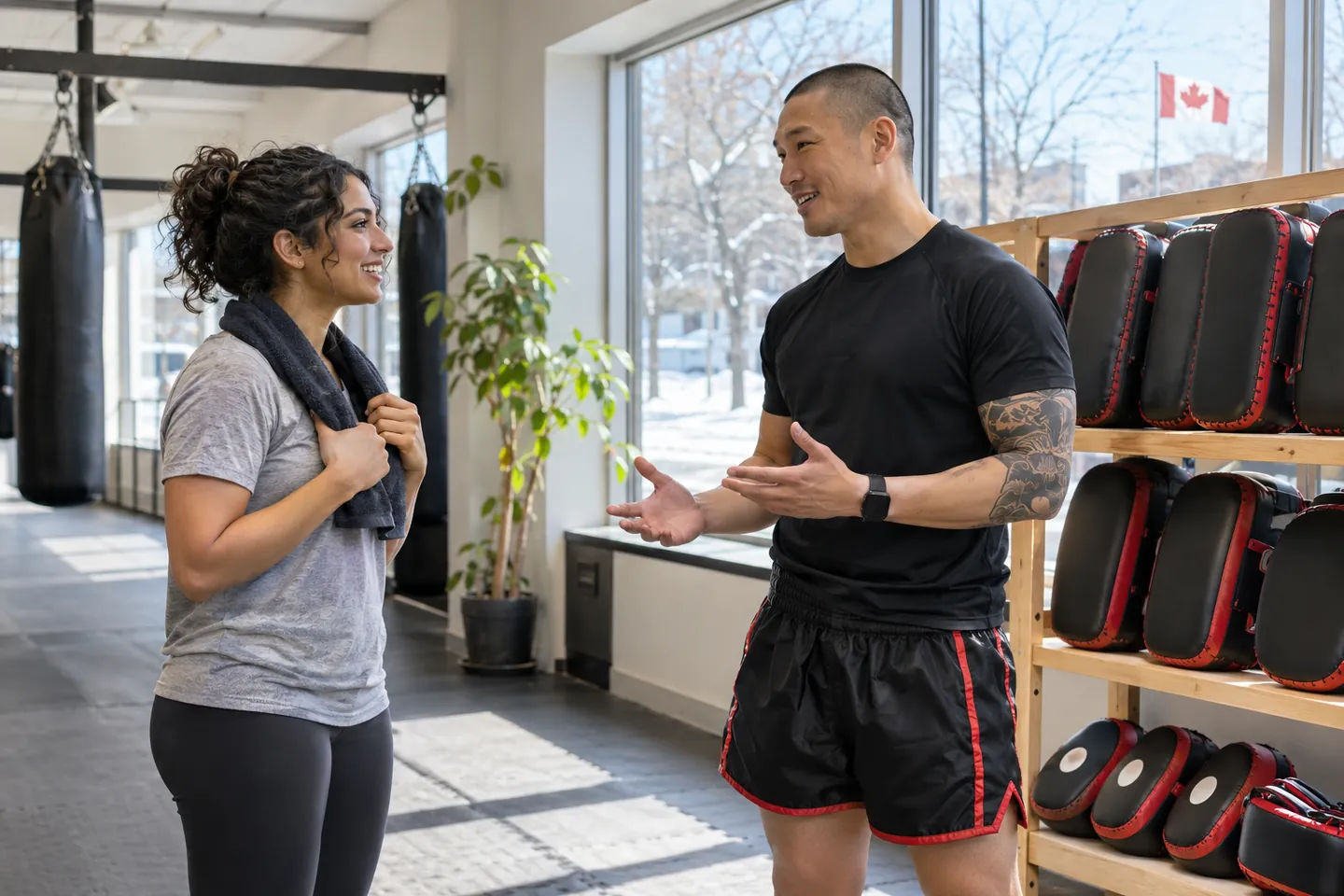
Prepare for your first Muay Thai class in Mississauga with practical guidance on arrival, equipment, partner drills, questions, and realistic expectations.
The hardest part of a first Muay Thai class often happens before any training begins. You wonder where to stand, whether everyone else already knows the combinations, and what will happen if you cannot keep up. Those questions are ordinary. A first visit is an opportunity to learn how the room works, meet the coach, and try a few unfamiliar movements with guidance. You do not need a performance ready for inspection.
For someone starting Muay Thai in Mississauga, preparation works best when it removes small uncertainties. Knowing what to bring and what to ask leaves more attention available for the lesson itself. The goal is not to become an expert before you arrive. It is to arrive ready to listen, communicate, and make a sensible decision about returning.
Contact the gym before choosing a class
A program name does not tell you everything about an individual session. Ask which class is suitable for someone with no previous experience. Explain whether you have tried boxing, another martial art, or no organized exercise at all. Each answer gives the coach useful context, but none needs to become an apology. New students are there because they have something to learn.
Confirm the current start time, arrival expectations, clothing requirements, and equipment arrangements directly with the team. A timetable found in an old social post may no longer apply. Ask specifically whether gloves or other items are available for a first visit and what must be purchased later. This prevents a rushed shopping trip for equipment that may not suit the class.
If there is a movement you cannot comfortably do, mention it before training begins. Describe the practical limitation in plain language: perhaps you need an alternative to kneeling or cannot currently raise one arm comfortably. A coach can explain class options, while personal medical decisions belong with a qualified healthcare professional who knows your circumstances.
Pack for a lesson, not a shopping campaign
Choose comfortable exercise clothing that lets you move without constantly adjusting it. Avoid hard accessories, loose jewellery, or pockets containing keys. Bring drinking water, a small towel if you use one, and a separate bag for damp clothing afterward. Follow the gym’s footwear and mat rules rather than assuming that the same arrangement applies everywhere.
It is tempting to buy every item associated with Muay Thai immediately. Waiting for coaching advice is often more practical. Equipment differs in fit, intended use, and class requirements. An attractive online photograph cannot tell you whether a glove fits your hand or whether a particular pad belongs in a beginner’s kit. Your first purchase should solve a confirmed need.
Make the journey part of the plan. Mississauga trips can involve driving, transit connections, or both. Check the actual destination and leave enough room to find the entrance without rushing. Arriving flustered does not ruin a class, but a small buffer makes it easier to ask where to put your belongings and hear the opening instructions.
Introduce yourself clearly
When you arrive, say that it is your first class and give the name used for your booking. Ask who will lead the session and where you should wait. This is more useful than standing silently beside the mats hoping someone recognizes you as new. Staff may be helping several people at once, and a simple introduction helps them direct you.
Tell the coach what you hope to get from the visit. You might be interested in learning a sport, finding an engaging exercise routine, or trying something different after work. There is no need to invent a competitive ambition. Clear goals help a coach explain which parts of the program fit your interests and which questions can be explored later.
Watch how students enter the training space, store bottles, and respond when instruction starts. Every gym has practical routines. Following them reduces confusion for everyone. If you are unsure whether to join a group or wait for a demonstration, ask. A brief question is easier to manage than guessing and accidentally beginning the wrong drill.
Expect unfamiliar movements to feel unfamiliar
During a first lesson, your stance may feel awkward and your hands may drift when you concentrate on your feet. That does not establish your potential. It means you are coordinating actions you have not yet organized into a familiar pattern. Treat the first version as information for the coach rather than a verdict on yourself.
Choose one correction at a time. If the coach asks you to reset your feet before moving again, give that task your attention for several repetitions. Trying to remember five internet tips alongside the live instruction can make a simple movement harder. The coach can see your actual position and the exercise being taught; a collection of unrelated clips cannot.
Ask for a demonstration when words do not quite land. A useful question might be, “Could you show me where my feet return after that?” It identifies a specific point of confusion. “Am I terrible at this?” invites reassurance but gives the coach little to work with. Specific questions turn uncertainty into something that can be addressed.
Understand the drill before adding effort
A first class may include different activities, but the exact format should be confirmed with the gym. Whatever the exercise, identify its purpose. Are you practicing a stance, following a short sequence, or learning to work with a pad holder? Those are different tasks. The loudest impact in the room is not necessarily the best example of your current assignment.
Start with the amount of effort the coach requests. If the instruction is controlled technique, keep it controlled even when a neighbouring student looks faster. Your partner may also be learning. Speed and force change the demands on both people, so they should not increase because one person feels excited or embarrassed.
Do not assume that enrolling in a martial arts class means you must immediately participate in contact work. Ask how contact activities are introduced, what prerequisites apply, and what choices beginners have. Clear expectations matter before any drill starts. You should understand the task and feel able to ask for clarification or stop when something is wrong.
Be an easy partner to work with
Introduce yourself to your partner and mention that you are new. Listen when the coach assigns roles. If you are holding pads, ask to be shown how to position them and what signal starts or stops the exercise. Pad holding deserves instruction of its own; it is not simply standing still while someone else trains.
Agree on the movement being practiced before beginning. If you lose the sequence, stop and reset rather than improvising an extra strike. If a pad feels unstable or you cannot see what is happening, say so immediately. Good communication protects the quality of the drill and lets both partners learn without guessing.
Thank your partner when the round ends. You do not need to apologize after every imperfect repetition. A concise “Let me reset that” is usually more constructive. Partners are sharing a learning task, and your willingness to listen, stay controlled, and communicate often matters more than whether the first combination looks smooth.
Pace the first visit with attention
Enthusiasm can make a new student work harder than intended during the opening minutes. Notice whether you can still follow instructions and control the assigned movements. If you need a break or a simpler version, tell the coach. Completing every repetition at any cost is a poor measure of how useful the session was.
Use water breaks and transitions to listen for the next task. Do not spend the whole interval rehearsing what went wrong in the previous round. One imperfect effort does not need to follow you through the class. Reset your equipment, hear the instructions, and begin the next exercise with a manageable focus.
If you feel unwell or experience pain, stop and communicate rather than treating discomfort as a character test. A group class cannot determine the cause of a symptom. The immediate practical priority is to stop the activity and get appropriate help. There will be other opportunities to train when the situation is understood.
Judge the experience with useful questions
Afterward, consider whether the class gave you clear instructions and room to ask questions. Did you understand what beginners were expected to do? Were partner activities explained? Could you communicate a concern without feeling pressured to ignore it? These observations tell you more about fit than whether you matched an experienced student’s pace.
Also consider the ordinary logistics. Can you realistically travel to the gym at the relevant time? Is there space in your week for another visit without repeatedly sacrificing other essentials? A program you can attend consistently is more useful than an impressive plan that depends on every workday ending perfectly.
Before leaving, ask what the coach recommends as your next step. That might involve attending another introductory session, clarifying equipment needs, or discussing a suitable class. You do not need to settle your entire training future in the changing area. A clear next appointment and one thing to remember are enough.
Make the second class easier
At home, write down the class time, what equipment you used, and one correction that made sense. Keep the note short enough to read before returning. Long descriptions of every mistake can turn a useful record into an unnecessary review session. You are building familiarity, not writing an exam about the evening.
Put your clothing and water bottle where you will find them before the next visit. If the journey took longer than expected, adjust the departure time. These small changes often do more for attendance than a dramatic promise to train every day. A repeatable routine makes room for skill learning to happen gradually.
You can explore Muay Thai at Konga and use the free trial page to discuss an appropriate starting point. Bring your questions, a willingness to be coached, and realistic expectations. A successful first class leaves you with a clearer understanding of the sport and a practical reason to come back.
Filed under
Keep exploring
More training insights await.