
A beginner's guide to full-body strength workouts in Mississauga: the six movement patterns, two sample sessions, sensible loading, rest, and steady progression.
Walk into a weight room for the first time and the choices can feel endless. Rows of machines, racks of dumbbells, barbells, kettlebells, cables, benches. Online advice adds to the noise with programs split across five or six days, each devoted to a single body part. For a beginner with a busy schedule, it is easy to feel that strength training is a complicated project reserved for people who already know what they are doing.
It does not need to be. For most people starting out in Mississauga, two or three full-body sessions per week are one of the most efficient ways to get stronger. Each workout trains the whole body through a handful of basic movements, which means you practise those patterns often, recover between sessions, and do not lose a whole muscle group when you miss a day.
This guide walks through the logic behind full-body training, the movement patterns that form its backbone, two sample sessions you can use as a template, and practical advice for progressing safely over your first few months.
Why full-body training suits beginners
A beginner’s body responds well to fairly modest amounts of training. You do not need large volumes of work for one muscle group to see progress. What you need is regular practice of the main movements, with enough recovery to come back a little stronger each time.
Full-body sessions offer exactly that. If you squat, hinge, push and pull two or three times per week, you get more practice at each movement than you would in a split routine where each pattern appears only once a week. More practice means faster technical improvement, and in the early months technique is a big part of getting stronger.
Full-body training is also forgiving of real life. If a late meeting or a snowstorm makes you miss Wednesday, Monday and Friday still covered everything. Compare that to a split program, where missing leg day might mean two weeks without training your legs at all. For people juggling work, family and a commute along the 401 or 403, that flexibility is valuable.
The six movement patterns
Most full-body programs are built around a small set of movement patterns. Thinking in patterns rather than individual exercises makes planning easier, because you can swap exercises within a pattern based on equipment, comfort or skill.
- Squat: bending the knees and hips to lower and stand up, as in goblet squats, box squats or leg press.
- Hinge: pushing the hips back with a relatively upright shin, as in Romanian deadlifts, kettlebell deadlifts or hip thrusts.
- Push: moving a weight away from the body, horizontally (push-ups, bench press) or vertically (overhead press).
- Pull: bringing a weight toward the body, horizontally (rows) or vertically (lat pulldowns, assisted pull-ups).
- Carry: walking while holding weight, such as farmer’s carries or suitcase carries.
- Core control: resisting unwanted movement of the trunk, as in planks, dead bugs or Pallof presses.
A balanced session includes most of these. You do not need every pattern every time, but over the course of a week, all of them should appear regularly.
Choosing beginner-friendly exercises
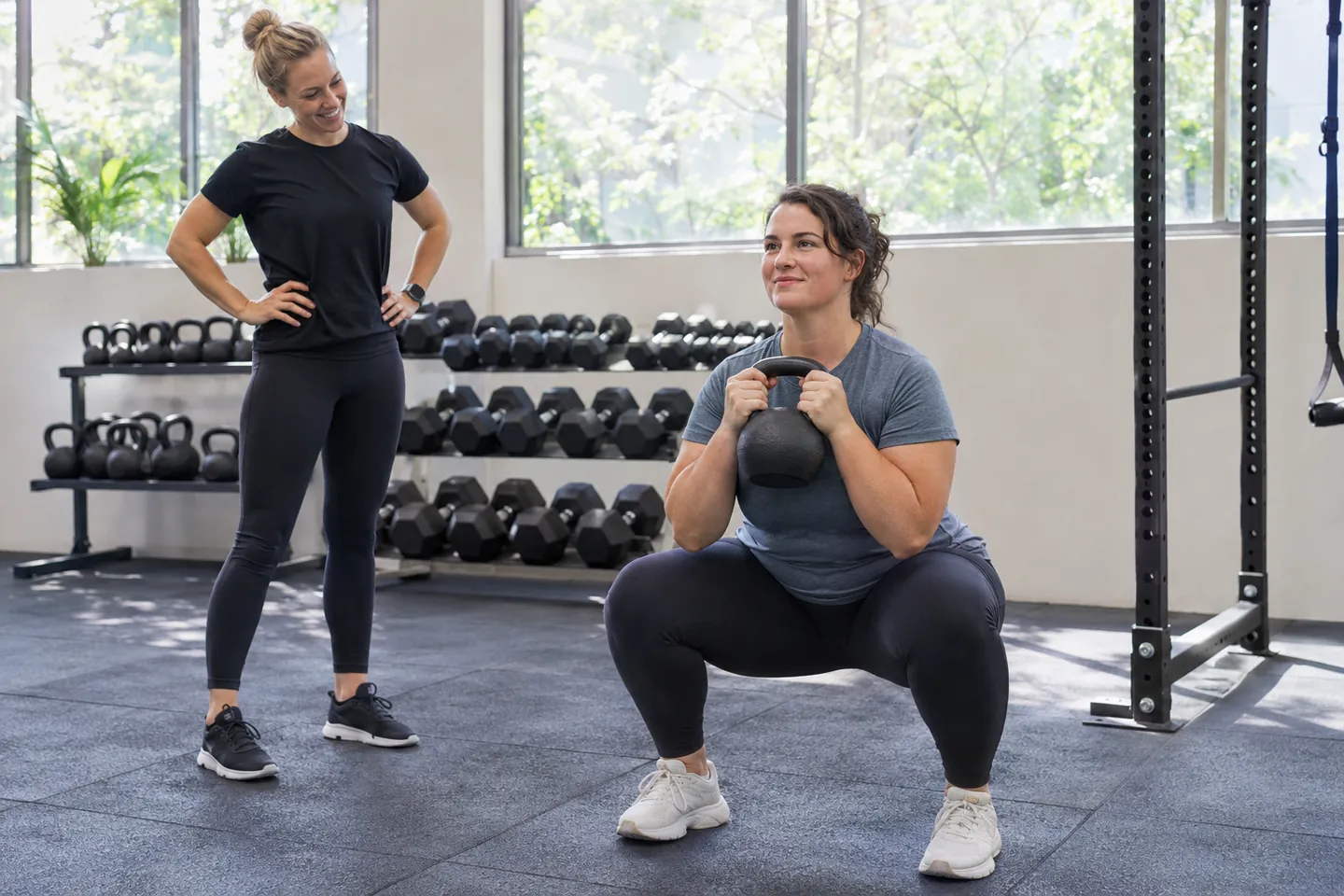
Within each pattern, start with variations that are easy to learn and easy to adjust. The goblet squat, where you hold a dumbbell or kettlebell at your chest, is a classic choice because the weight in front helps you stay upright. A box squat, where you sit back to a bench and stand up, can also help you learn depth and control.
For the hinge, a kettlebell deadlift from a raised position is often more approachable than a barbell deadlift from the floor. It teaches the movement without requiring as much mobility. Hip thrusts or glute bridges are another option that many people find comfortable.
Pushing and pulling can begin with push-ups against a bench, a dumbbell bench press, cable or dumbbell rows, and lat pulldowns. These allow you to adjust the load easily and focus on form. For core work, dead bugs and side planks are simple to learn and scale well. A coach in a personal training session can help you pick variations that suit your body and any past injuries.
Sample session A
Here is one way to organize a beginner full-body session. Treat it as a template rather than a prescription; the specific exercises and numbers can be adjusted.
Begin with five to ten minutes of general warm-up, such as easy cycling or rowing, followed by a few bodyweight squats, hip hinges and arm circles. Then work through the main exercises:
- Goblet squat: three sets of eight to ten repetitions.
- Dumbbell bench press: three sets of eight to ten repetitions.
- Kettlebell deadlift: three sets of eight to ten repetitions.
- Seated cable row: three sets of ten to twelve repetitions.
- Farmer’s carry: three trips of about thirty metres.
- Dead bug: two or three sets of six to eight slow repetitions per side.
Rest about one to two minutes between sets of the larger exercises, and a little less between sets of the smaller ones. The whole session should take roughly forty-five minutes to an hour, depending on how long you rest.
Sample session B
On the second day of the week, a slightly different set of exercises provides variety and trains the patterns from new angles. After a similar warm-up, try:
- Box squat or leg press: three sets of eight to ten repetitions.
- Half-kneeling single-arm overhead press: three sets of eight per side.
- Glute bridge or hip thrust: three sets of ten to twelve repetitions.
- Lat pulldown: three sets of ten to twelve repetitions.
- Suitcase carry: three trips per side of about twenty metres.
- Side plank: two or three holds per side of twenty to thirty seconds.
If you train three times a week, simply alternate: A, B, A one week, then B, A, B the next. This gives each pattern frequent practice while varying the exercises enough to keep things interesting.
How heavy should it feel?
One of the hardest things for beginners is choosing the right weight. Too light and the session does little; too heavy and form breaks down, which is both less effective and riskier. A practical guideline is to choose a load where you could perform two or three more good repetitions at the end of each set.
That means the last few repetitions should feel challenging, but your form should remain consistent. If your back starts to round during deadlifts, your knees cave in on squats, or you need to swing your body to finish a row, the weight is probably too heavy for now.
Many people start lighter than they need to, which is fine. It is easier to add weight than to unlearn poor habits. Over the first few weeks, you will likely find that you can increase loads quite quickly as your technique and confidence improve.
Progressing week by week
Progress in strength training comes from doing a little more over time. For beginners, that usually means adding weight or repetitions in small steps. If you complete all your sets at the top of the repetition range with good form, increase the weight slightly next session.
For example, if your goblet squat target is three sets of eight to ten repetitions and you manage ten on every set, move up to the next dumbbell or kettlebell. You may only get eight repetitions per set with the new load, and that is fine. Work back up to ten before increasing again.
Keep a simple log of what you did each session. Writing down the exercise, the weight and the repetitions takes a minute but provides clear evidence of progress. It also helps you avoid guessing which weight to use next time. Many people find this record motivating on days when they feel they are not improving.
Rest, recovery and soreness
Muscle soreness in the first couple of weeks is common, especially after exercises you have never done before. It usually peaks a day or two after the session and fades as your body adapts. Light movement, such as walking or easy cycling, often helps you feel better.
Leave at least one day between full-body sessions. Monday, Wednesday and Friday, or Tuesday and Thursday with a Saturday session, are common patterns. Recovery days do not need to be completely inactive; a walk around your neighbourhood, a stretch, or a gentle yoga class can all fit.
Sleep and regular meals support recovery as well. If you consistently feel exhausted, your joints ache, or your performance drops for several sessions in a row, it may be time to reduce the training load or speak with a professional. Ongoing pain is not something to push through, and a qualified physiotherapy practitioner can help you understand what is going on.
Common beginner mistakes
One of the most common mistakes is doing too much variety. Changing exercises every session makes it hard to learn technique or measure progress. Sticking with the same core movements for at least several weeks allows you to get better at them and see your numbers improve.
Another mistake is neglecting the pulling and hinging movements in favour of pushing exercises. Bench presses and push-ups are popular, but balanced strength requires the back and hips to be trained just as consistently. Your posture and joints will thank you for including rows, pulldowns and deadlift variations.
Finally, many beginners rush through repetitions. Moving with control, especially on the way down, gives you more benefit and helps protect your joints. A steady tempo, such as two or three seconds to lower the weight and one or two seconds to lift it, is a good habit to build early.
Fitting strength training around other activities
Many people in Mississauga combine strength training with other activities: running, cycling, martial arts or team sports. Full-body sessions can support these pursuits by improving overall strength and resilience, but they need to fit within the week.
If you train Muay Thai or Brazilian jiu-jitsu several times a week, two shorter strength sessions might be enough. Place them on days when you are not doing your hardest skill work, or after a lighter technical class. Pay attention to how your body feels and adjust as needed.
The goal is for strength training to make you feel better in your other activities, not to leave you too tired to enjoy them. If you find the balance difficult, discuss it with a coach who can help you plan your week.
Getting started with support
Learning to lift on your own is possible, but having guidance in the early stages can make a big difference. A coach can teach you how to set up each exercise, spot form issues before they become habits, and help you choose appropriate weights. That support can shorten the learning curve and make the gym feel less intimidating.
At Konga Fitness in Mississauga, the strength and conditioning classes and one-on-one personal training both offer structured ways to start full-body strength work. If you would like to see how it feels, you can book a free trial and begin building the habits that make steady, long-term progress possible.
Filed under
Keep exploring
More training insights await.