
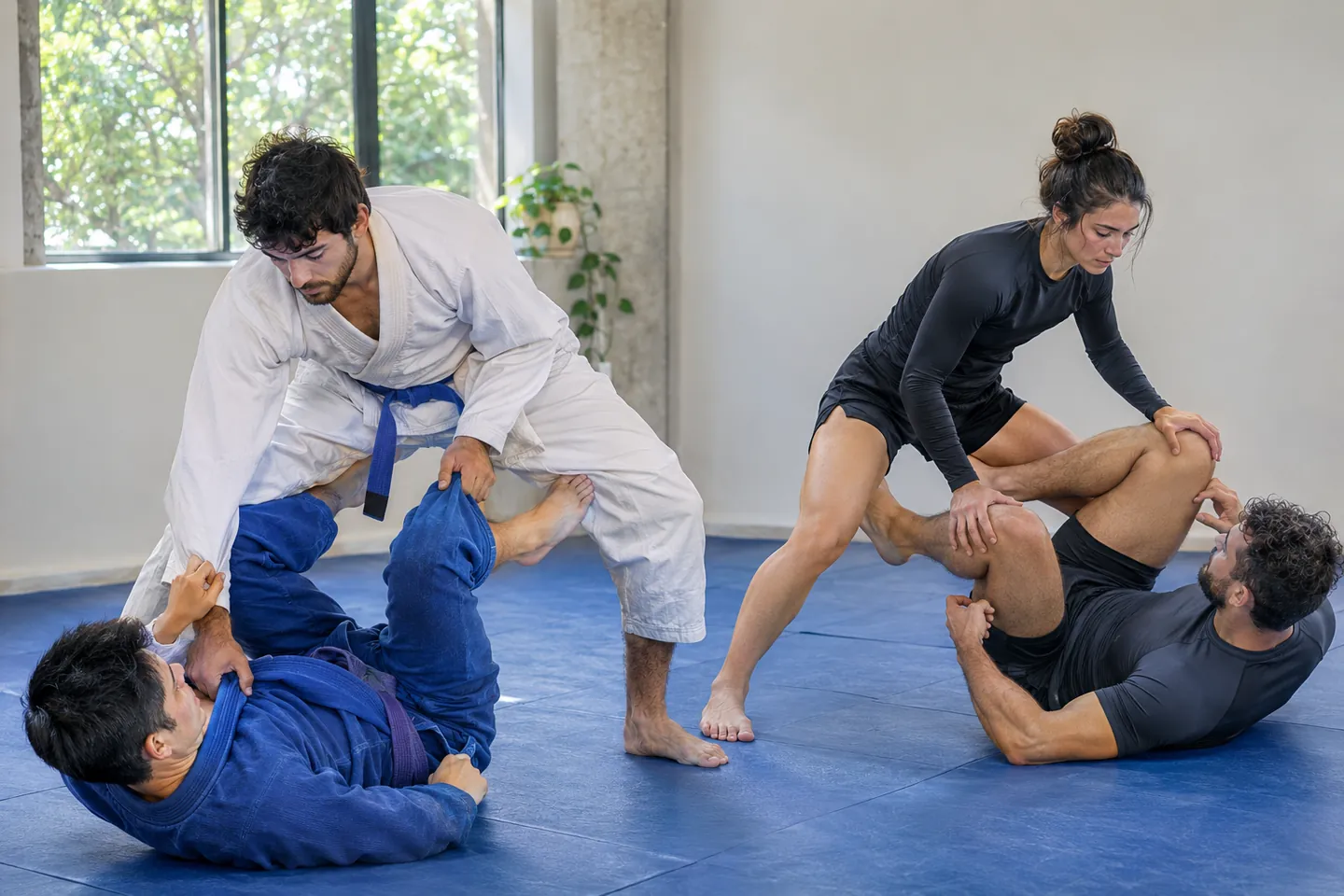
Gi or no-gi Brazilian jiu-jitsu in Mississauga? Compare grips, pace, gear and learning curve, and see why many beginners eventually decide to train both styles.
Walk into a Brazilian jiu-jitsu academy on different nights of the week and you might see two very different-looking classes. On one night, everyone is wearing a heavy cotton kimono tied with a coloured belt, gripping collars and sleeves. On another, the same people are in rash guards and shorts, moving faster, gripping wrists and heads, and sliding out of positions that would have been locked tight the night before.
These are gi and no-gi jiu-jitsu, and they are two expressions of the same art. Most beginners in Mississauga who look into BJJ quickly run into the question: which one should I do? The answer is less dramatic than online debates suggest. Both are valuable, both teach the core ideas of position and control, and many students end up training both.
This guide explains what changes between the two styles, what stays the same, and how to think about choosing as a beginner. If you are still deciding whether to try jiu-jitsu at all, it should also give you a clearer picture of what classes actually involve.
The core art is shared
Before looking at differences, it helps to understand how much the two styles have in common. In both, you learn to control an opponent through positions: guard, side control, mount, back control and the transitions between them. You learn to escape bad positions, pass the guard, sweep from underneath, and apply submissions such as chokes and joint locks.
The principles behind these skills are the same. Leverage, base, frames, hip movement and timing matter whether you are wearing a gi or not. A student who understands why a frame creates space in side control can apply that idea in either setting.
So when you choose one style to start, you are not choosing a completely separate martial art. You are choosing which set of tools and textures to learn the fundamentals with.
What the gi changes
The gi, sometimes called a kimono, is a thick jacket and pants made for grappling. Because it can be gripped, it adds a huge number of options. You can hold a collar, a sleeve, a pant leg, or a lapel, and use those grips to control your partner, set up sweeps, or apply chokes.
This tends to slow the game down. With strong grips, it is harder for an opponent to escape quickly, so positions are often held longer and exchanges become more methodical. Friction from the fabric also makes it harder to slip out of tight spots.
Many coaches feel the gi rewards precision and patience. Because your partner can grip you too, you have to be more careful about posture, grip fighting and defending your collar. Small details become very important, which can be great for learning fundamentals.
What no-gi changes
No-gi is usually trained in a rash guard and shorts or spats. Without fabric to grab, grips shift to the body: wrists, arms, the head and neck, and the legs. Common control methods include underhooks, overhooks, collar ties and body locks.
The pace is often quicker, and sweat makes everything slippery. Escaping can be easier, so positions change more frequently. That puts more emphasis on movement, scrambling, and securing control before your partner wriggles away.
No-gi also tends to place greater emphasis on certain leg-lock systems in many academies, though the rules and teaching approach vary by gym and by level. Beginners are typically introduced to these techniques gradually and under supervision, because some leg attacks need careful control to train safely.
The learning curve for beginners
Many coaches recommend that beginners spend meaningful time in the gi, because its slower pace and wealth of grips can make it easier to learn positions and defence. When a partner is holding your collar, you learn quickly how important it is to protect your neck and maintain posture.
Others argue that no-gi feels more intuitive to newcomers, because the grips resemble what you might use in wrestling or everyday scrambles. Some people also find no-gi more comfortable in warm weather or simply prefer the feel of it.
In reality, either path works. What matters more is the quality of instruction, the atmosphere in the room, and your consistency. A beginner who attends no-gi classes three times a week will progress more than one who attends gi classes occasionally.
How the two styles help each other
Students who train both often say each improves the other. Gi training develops a sharp sense of grip fighting and patience, which makes no-gi defence tighter. No-gi training sharpens movement, speed and body-based control, which makes gi game more dynamic.
Some techniques transfer directly. A well-timed hip escape or a solid knee-cut pass works in both. Others need adjustment. A collar choke has no direct equivalent without a gi, while some no-gi control positions rely on grips that are easy to strip when a jacket is involved.
Learning to adapt between styles is itself a valuable skill. It forces you to understand the principle behind a technique rather than memorising a recipe.
Gear and practical details
For gi classes, you will need a jiu-jitsu gi in the right size. Avoid judo or karate uniforms, as they differ in cut and durability. Many academies have a belt system for gi training, with belts awarded over time based on skill and experience. Ask your coach about uniform colour requirements, as some academies have preferences.
For no-gi, a well-fitting rash guard and grappling shorts or spats are standard. Avoid clothing with pockets, zippers or loose fabric that could catch fingers and toes.
In both styles, hygiene matters a great deal. Wash your gear after every session, keep nails trimmed, cover any cuts, and stay home if you have a skin issue. Good hygiene protects you and your training partners, especially during Mississauga winters when everyone is indoors and close together.
Fitness and physical demands
Both styles provide excellent full-body conditioning. Gi training tends to tax grip strength and forearms heavily, along with the back and hips. Many newcomers are surprised at how sore their hands feel after their first few gi classes.
No-gi often feels more like a cardio challenge because of the faster pace and constant scrambling. It also demands strong hips and shoulders for controlling a sweaty partner.
Supporting your jiu-jitsu with strength and conditioning work can help you handle both styles. Focus on grip, pulling strength, hip mobility and neck resilience, introduced gradually and with good coaching.
Self-defence considerations
People sometimes argue that one style is more realistic for self-defence. Gi advocates point out that people wear clothing, so learning to use and defend against grips on jackets is practical. No-gi advocates note that clothing can tear and that many confrontations involve close body contact without useful grips.
Both points have merit. Each style teaches useful skills for staying calm, controlling someone and getting up safely. If self-defence is a priority, discuss it with your coach, and consider complementing your jiu-jitsu with a striking art like kickboxing or MMA.
Competition, if it interests you
Most recreational students never compete, and that is completely fine. For those who do, gi and no-gi competitions have different rulesets and categories. Some competitors specialise in one; others enter both.
If you are curious about competing someday, talk with your coach about which style suits your strengths and how to prepare. There is no rush. Plenty of people train for years before trying a local tournament, and many never feel the need.
How to choose your first classes
If your academy offers both, try each a few times before deciding. Notice which one you enjoy more, which one feels easier to learn from, and which class times fit your schedule. Some students settle on one; others alternate naturally.
Consider practical factors. If you commute from Meadowvale or Malton and only one class time works, that may decide it for you. Over time, as your schedule allows, you can add the other style.
Ask your coach for advice. They will have seen many beginners and can suggest what might suit your body type, goals and personality.
Your first class in each style
A first gi class often feels awkward in a very specific way. The jacket is stiff, the belt keeps coming loose, and you may not know where to put your hands. Ask a training partner or coach to show you how to tie the belt so it stays put. During drilling, expect to spend time just learning which grips the coach wants: a sleeve and a collar, perhaps, or a pant leg and a lapel. Getting those grips right is half the lesson.
A first no-gi class tends to feel faster and a little more chaotic. Without a jacket to hold, it can seem as if there is nothing to grab. Coaches usually address this by teaching a few dependable connections, such as an underhook or a wrist control, and by showing how to keep your elbows close to your body so your partner cannot slip inside.
In both, tap early and often during live rounds, and tell your partner it is your first week. Most experienced students will slow down, offer a tip or two, and give you space to try things. Keep your expectations modest. The aim of a first class in either style is to leave curious and uninjured, not to win a round.
A note on patience
Jiu-jitsu, in either style, has a steep learning curve. Your first months will involve a lot of being stuck under people, tapping, and feeling confused. That is normal and is not a sign that you chose the wrong style.
Focus on small improvements. Surviving a little longer, recognising a position, or completing one technique cleanly in live training are real wins. Progress compounds over months and years.
Getting on the mats
Whether you prefer the structure of the gi or the speed of no-gi, Brazilian jiu-jitsu in Mississauga offers a challenging, rewarding way to train. The best choice is the class you will attend consistently, with coaches and partners you trust.
Learn more about our Brazilian jiu-jitsu program and check the adult schedule to see which jiu-jitsu classes fit your week. When you are ready, book a free trial and see which style clicks for you.
Filed under
Keep exploring
More training insights await.