
A practical guide to grip strength training in Mississauga: carries, hangs, holds, recovery and how stronger hands support lifting, grappling and daily life.
Most people notice their grip only when it fails. A bag of groceries starts slipping halfway up the driveway, the last set of rows ends because the bar is sliding rather than because the back is tired, or a training partner in jiu-jitsu breaks a hold that felt secure a second earlier. The hands are the point where your body meets almost everything you lift, pull, carry or hold, and yet they rarely get direct attention in a training plan.
Grip strength training in Mississauga does not need special gadgets or a separate routine that eats up your week. For most adults, a handful of carries, holds and hangs added to existing sessions is enough to make a noticeable difference over a couple of months. This article explains what grip strength actually involves, how to train it without irritating your elbows or wrists, and how to fit it around the rest of your training.
The aim here is practical. You will not find a magic number to hit or a promise that stronger hands transform your life. You will find a way to think about the hands and forearms as trainable tissue that responds to sensible, gradual work like the rest of the body.
What “grip” actually means
Grip is not a single quality. Coaches often split it into a few broad types, and it helps to know them because they are trained a little differently. Crushing grip is closing the hand around something, like squeezing a handle. Support grip is holding on to something for time, like hanging from a bar or carrying heavy bags. Pinch grip is holding between the fingers and thumb, like gripping a flat weight plate by its edge.
There is also wrist strength, which controls the angle of the hand, and the strength of the muscles that open the hand. Those extensor muscles on the back of the forearm get very little work in daily life, which is one reason some people who squeeze a lot end up with sore forearms or cranky elbows. Balance matters even in a small body part.
For most gym members, support grip is the most useful place to start. It shows up in deadlifts, rows, pull-ups, carries and the long holds of grappling. If you build that first and add a little of the other types over time, you cover most of what you need without overcomplicating things.
Why hands often become the weak link
Many strength programs are built around big movements that load the legs, hips, back and chest. The hands are involved in those lifts, but often only as a connection point. As the larger muscles get stronger, the load climbs faster than the grip adapts, and eventually the bar starts to roll out of the fingers before the target muscles have done their job.
Some lifters respond by reaching for straps on every pulling set. Straps have a place, especially for very heavy work when the goal is to train the back, but relying on them constantly can leave the gap between hand strength and body strength growing wider. A more balanced approach is to use straps sparingly and give the hands their own regular practice.
Modern routines also play a role. Many of us spend workdays typing, scrolling, and driving along the 401 or 403 with hands in a fairly relaxed position. The tissues get used to light, repetitive tasks and very little heavy holding. That is not a problem in itself, but it explains why the first few weeks of deliberate grip work can feel surprisingly hard.
Start with carries
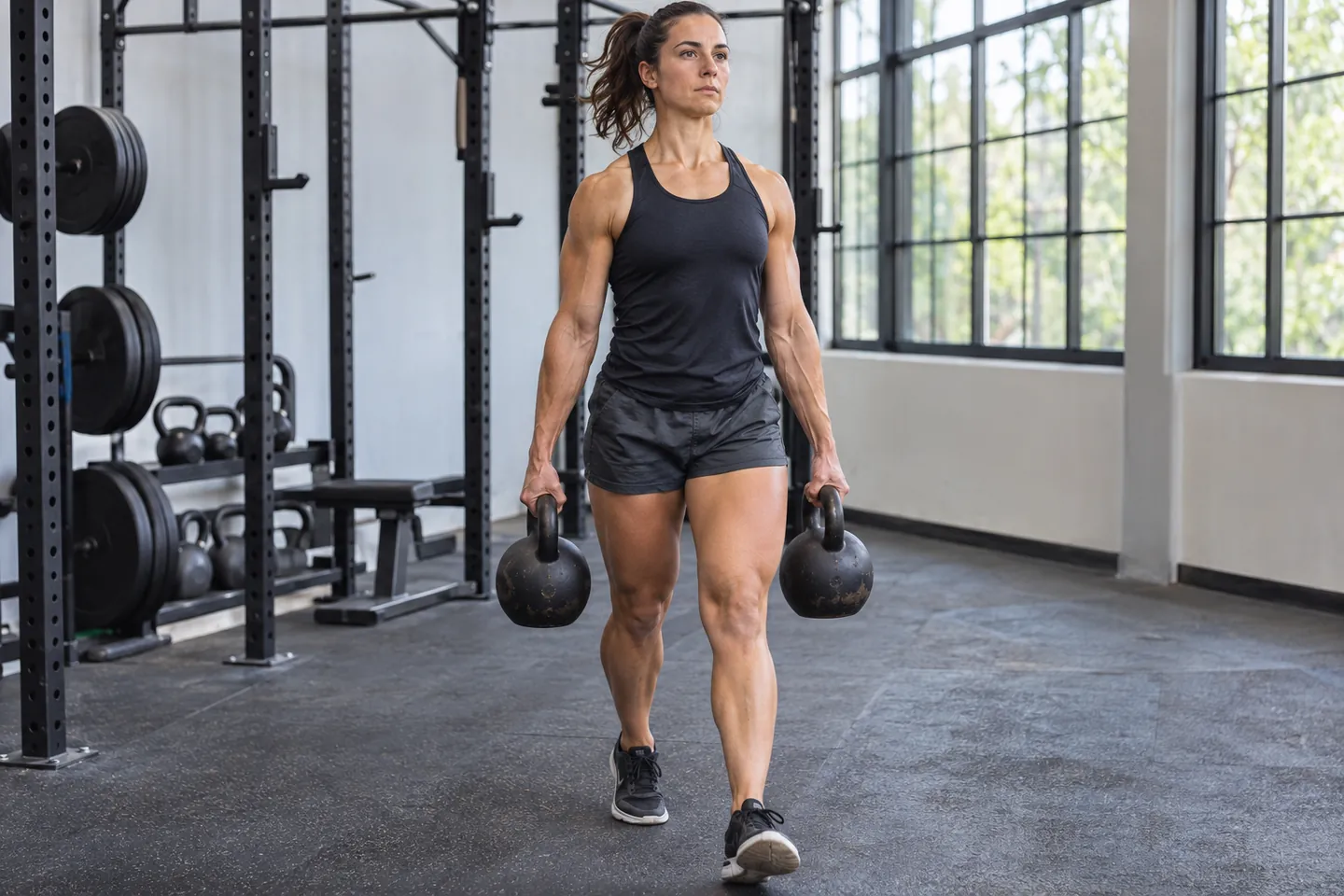
If you only add one grip exercise, make it a loaded carry. The farmer’s carry is simple: pick up a pair of dumbbells or kettlebells, stand tall, and walk a measured distance before setting them down with control. Your hands hold the weight, your trunk keeps you upright, and your legs move you across the floor. It is one of the most honest exercises in a gym, because you either keep holding or you do not.
Begin with a weight you can carry for a comfortable distance with good posture, then stop before your grip opens on its own. You want the last few steps to feel challenging, not to end with a dropped kettlebell bouncing near your feet. Set the weights down deliberately by bending at the hips and knees, the same way you picked them up.
Once the basic carry is familiar, you can vary it. A suitcase carry uses one weight on one side, which adds a challenge for the trunk muscles that resist leaning. Carrying a single kettlebell upside down by the handle, held in front of the shoulder, asks the wrist and forearm to stabilise in a different way. Ask a coach to show you these variations before loading them heavily.
Hangs and holds for support grip
Dead hangs from a pull-up bar are another straightforward option. Grip the bar with both hands, let your body hang with your shoulders gently engaged rather than completely collapsed, and hold for a set time. If full body weight is too much, keep your feet on a box or the floor and take some of the load through your legs.
Static holds with a barbell or dumbbells work in a similar way. Lift the weight to the top of a deadlift position from safety pins or a rack, then simply hold it while standing tall. This lets you use a load heavier than you would carry across the floor, but it should still be approached gradually. A training partner or coach can help set the pins at a sensible height.
Keep the times modest at first. Short holds repeated a few times, with rest in between, usually feel better than one long, grinding effort that leaves the forearms burning for the rest of the session. You are building tolerance in tissues that are not used to this work, so patience is part of the method.
Pinch, wrist and extensor work
Once your support grip is improving, you can add a small amount of pinch work. Holding two smooth weight plates together, edges up, between the fingers and thumb is a classic option. Start light, because the thumb tires quickly and the plates can slip. Keep your feet clear of the drop zone and set the plates down before your hand gives out.
Wrist curls and reverse wrist curls with a light dumbbell train the forearm through a range of motion rather than in a fixed hold. These are usually done seated, with the forearm resting on the thigh or a bench. Use slow, controlled repetitions. There is no benefit in heaving the weight with momentum, and wrists tend to complain about jerky loading.
For the extensors, many people use a thick rubber band around the fingers and practise opening the hand against it. It looks almost too easy, but it gives balance to all the squeezing and holding. A few sets here and there, perhaps as part of a warm-up or cool-down, can be a comfortable way to keep the forearm working in both directions.
How grip supports martial arts
At Konga Fitness, grip matters well beyond the weight room. In Brazilian jiu-jitsu, you hold sleeves, collars, wrists and legs for long periods while your partner tries to free themselves. Grappling grips tend to be more about endurance and smart positioning than raw crushing power, but a stronger, more resilient hand still makes those exchanges less exhausting.
In Muay Thai, the clinch involves controlling the head and arms of a partner at close range. Here the hands work together with the arms and posture, and grip fatigue can make it harder to maintain good position. Boxers and kickboxers rely less on holding, but wrist stability matters when the fist lands on a bag or pad. A well-aligned wrist and a firm, closed hand are part of striking safely.
None of this means martial artists need extreme grip routines. Often the sport itself provides plenty of grip work, and adding heavy forearm training on top can lead to sore fingers. If you train jiu-jitsu several times a week in Mississauga, you might choose lighter carries and some extensor work instead of extra hangs, and let the mats handle the rest.
Programming grip without overdoing it
The simplest approach is to attach grip work to the end of sessions you already do. After a pulling workout, add a couple of rounds of carries. After a lower-body day, add a few hangs. Two or three short exposures per week tend to be enough to see progress for most beginners, especially in the first couple of months.
Progress gradually. You can increase the weight, the distance, or the time, but avoid changing all three at once. Many people find it useful to keep a short training note so they remember what they carried last week. Small increases, repeated consistently, tend to work better than occasional big jumps.
Remember that the hands are also working in your other exercises. If your rows, deadlifts and pull-ups are already heavy, your forearms may be closer to their limit than you think. A strength and conditioning coach can help you balance direct grip work with the total pulling volume in your plan so that nothing gets overloaded.
Listening to fingers, wrists and elbows
Grip training can create a deep, burning fatigue in the forearms. That sensation is normal during and immediately after hard holds. What deserves more attention is pain that is sharp, localised to a joint, lingers into the next day, or comes with tingling or numbness in the fingers. Those signs are a reason to back off and speak with a qualified professional.
The tendons around the elbow can be sensitive to sudden increases in gripping, particularly when they combine with lots of typing or manual work. If the outside or inside of your elbow starts to feel irritated, reduce the volume rather than pushing through. A registered physiotherapist can assess what is going on and suggest how to adjust your training. Our physiotherapy team is one option for members who want an assessment close to where they already train.
Chalk can help when your hands are sweaty, especially in summer or during long sessions, but it does not replace actual strength. Calluses are common for lifters who hang and pull frequently. Keeping them smooth with a little care, rather than letting them build into thick ridges that can tear, is a sensible habit.
Grip in everyday life
Training grip has a pleasant practical side. Carrying all the groceries from the car in one trip, holding a squirming child, hauling a suitcase through Pearson, or shovelling snow off a Meadowvale driveway on a February morning all draw on the hands and forearms. You do not need to train grip for those tasks specifically, but a stronger hand makes them feel less awkward.
For older adults, maintaining the ability to hold and carry things is part of staying independent. Simple carries and holds are generally accessible and can be scaled to very light loads. If you have arthritis or other joint conditions, talk with your doctor or physiotherapist first, then work with a coach who can choose comfortable implements and handle sizes.
There is also a confidence element. When you trust your hands, you approach heavier lifts with less hesitation. A deadlift or a row feels more like a back and hip exercise rather than a nervous wait for the bar to slide. That shift often makes the rest of a session more productive.
A simple starting plan
If you would like a concrete outline, here is one approach many beginners can adapt with a coach’s input:
- After one session: farmer’s carries for a few lengths of the gym, resting fully between each.
- After a second session: assisted or full dead hangs, a few short holds.
- Once a week: light wrist curls, reverse wrist curls and band extensions as a short finisher.
Keep the rest of your program stable while you add these, so you can see how your hands and forearms respond. Increase one variable at a time over the following weeks. If you train martial arts as well, consider how much gripping your classes already involve before adding anything extra.
After six to eight weeks, look back at your notes. Most people find they can carry a little more, hang a little longer, or simply hold their deadlift set without the bar creeping toward their fingertips. That is a realistic, worthwhile outcome.
Getting started at Konga Fitness
Grip strength sits quietly underneath so much of what people do in the gym and on the mats. Giving it a few minutes of focused attention each week is one of the more efficient investments you can make, and it fits easily into training you already enjoy.
If you would like help building grip work into a balanced plan, a coach can show you the variations above and set sensible starting points. You can explore our personal training options for one-on-one guidance, or book a free trial to see how strength sessions at our Timberlea Boulevard location fit your week in Mississauga.
Filed under
Keep exploring
More training insights await.