
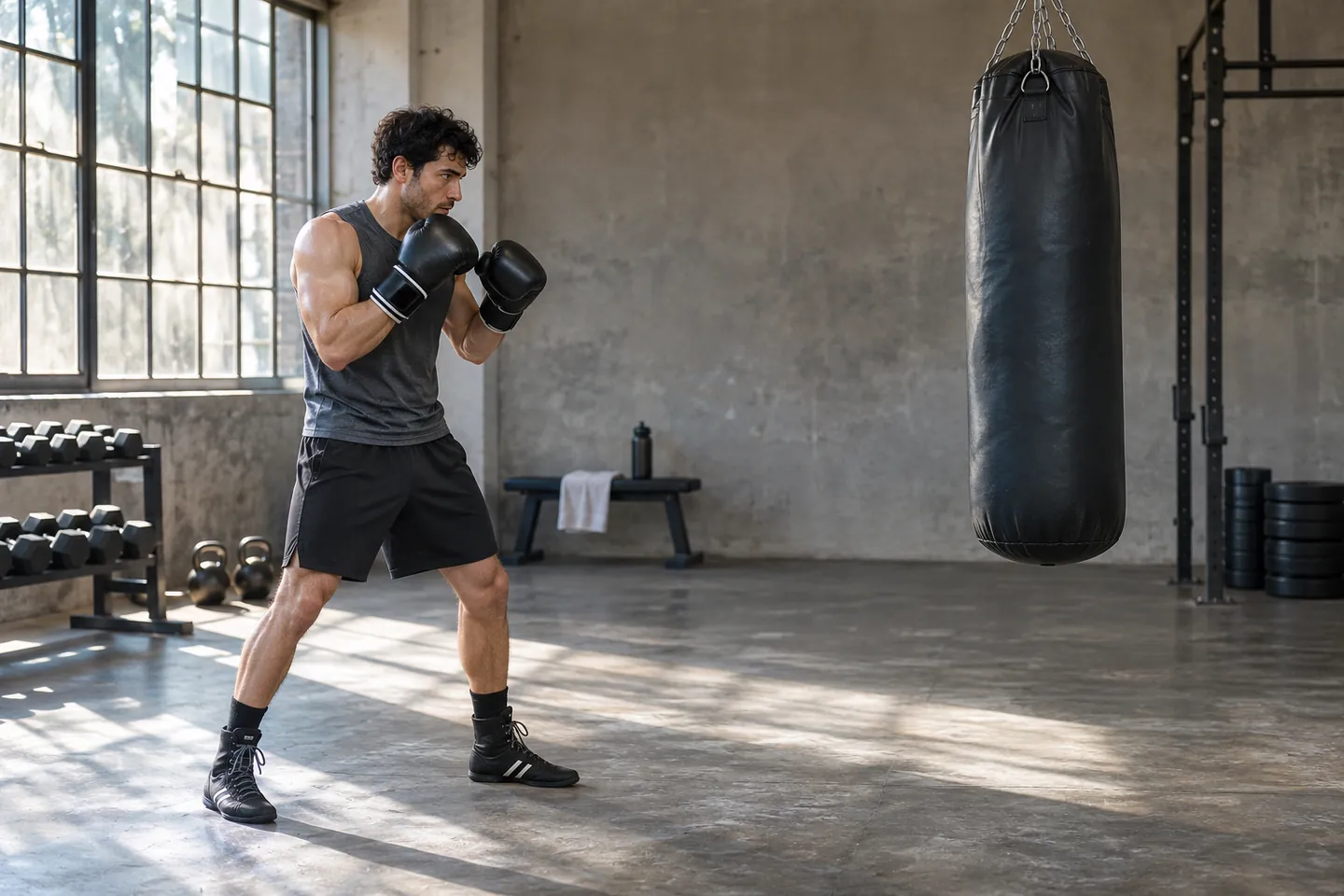
Approach heavy bag practice in Mississauga with clear round goals, coached distance, suitable equipment, and a practical way to review your boxing sessions.
A heavy bag offers an obvious invitation: put on gloves and start punching. The less obvious question is what you want the next few minutes to teach you. Without an answer, a round can become a mixture of hard hits, chasing the swinging bag, and repeating whichever combination you remember. You may finish tired without knowing what improved or what needs attention.
Heavy bag practice in Mississauga can be much more useful when each round has a defined task. The bag gives you a target, but the coach provides context: where to stand, which movement to use, how much contact is appropriate, and what to notice afterward. For a beginner, that structure is often more valuable than a complicated workout plan.
Get oriented before the first round
Ask how the gym wants you to use its bags. Find out which equipment is available for your session, how participants share it, and where to stand while waiting. A bag is part of a larger training area, and movement around it can affect other people. Understanding the room’s routines is part of using the equipment well.
Check the bag and surrounding space with the coach if anything looks unusual. Do not use equipment that appears damaged or improvise adjustments to its mounting. Staff can decide whether it is suitable. Keep your own belongings away from the training area and notice neighbouring stations before beginning.
Confirm the wraps and gloves required for the activity. Have the coach check unfamiliar equipment or an uncertain fit. The presence of padding does not remove the need to learn how to strike appropriately, and it does not make discomfort something to ignore. If your hand position feels wrong, address it before the round.
Choose a technical question
A round becomes easier to assess when it asks one question. Can you return your hands after a simple sequence? Can you find the same starting distance? Can you finish with your feet in the stance you were taught? Your coach can help choose the question most relevant to your current lesson.
The question should be narrow enough that you can remember it while moving. “Improve my boxing” is too broad to guide a repetition. “Reset after each jab and cross” creates a task you can recognise. You may still receive other corrections, but the round has a main purpose.
Write the question in your training notes afterward if it was useful. Over several classes, you can see which themes recur and which become more familiar. This gives bag practice continuity instead of treating every session as an unrelated test of effort.
Let the coach establish distance
The bag is not a fixed instruction about where your feet belong. Different drills may begin at different distances, and the right starting point depends on the movement being taught. Ask the coach to help you set up rather than standing wherever you happen to reach the bag.
If you begin too far away for the task, you may lean or stretch to make contact. If you begin too close, the punch can feel crowded. Those experiences do not automatically mean the punch itself is the only problem. Sometimes the first useful adjustment is where the repetition begins.
After finding the starting distance, notice it. Look at the space between you and the target before the next attempt. Do not become rigid about a floor location if the bag has moved; instead, follow the coach’s instructions for resetting. You are learning a relationship to the target, not memorising one spot in the room.
Start with a familiar movement
Use a punch or short combination you have already been taught. A new target adds feedback and distraction, so it helps when the movement itself is reasonably familiar. If you are still unsure about the sequence, rehearse it with the coach before trying to perform it continuously on the bag.
Begin at the contact level the instructor recommends. Listen to the correction and make a small, clear adjustment. A bag can tempt you to increase force immediately because the feedback is loud and satisfying. Keep the intensity tied to the purpose of the drill rather than the sound you want to produce.
After each early repetition, return to your starting arrangement. That brief reset allows you to notice whether the feet, hands, and distance remain understandable. As the task becomes clearer, the coach may ask you to connect repetitions more smoothly. There is no need to skip the learning stage simply because the bag is available.
Learn what to do when the bag moves
A swinging bag changes the distance and timing of the next attempt. Beginners sometimes follow it around automatically, reaching when it moves away and becoming crowded when it returns. Ask your coach how to respond during the specific drill. Waiting or resetting may be more appropriate than continuing to punch.
Do not grab, stop, or redirect equipment in a way the gym has not taught. The bag’s movement and the people nearby both matter. If you lose the intended setup, pause and regain it under instruction. Keeping the exercise clear is more useful than preserving an uninterrupted stream of contact.
As your training develops, movement around a bag may become part of a deliberate lesson. That is different from chasing it because you have no plan. The distinction is the purpose: you should know what your feet are trying to accomplish and how the movement prepares the next action.
Separate a skill round from an effort round
A coach may use bag work for technical practice, conditioning, or a combination of both. Ask which emphasis applies. A technical round should leave enough attention for the chosen cue. A conditioning round may use a different pace, but the movement and participation boundaries still need to be clear.
Do not assume that every round should end with you unable to continue. That expectation can encourage rushing before the skill is understood. The appropriate challenge depends on the session and your circumstances. Communicate if you need a slower pace, a shorter work period, or another adjustment.
Equally, a round that feels less tiring can still be productive. You may have spent it learning target distance or responding to a correction. Effort is one part of training, but it does not describe all the learning taking place. Evaluate the round against its stated purpose.
Use the breaks for useful decisions
Between rounds, take the recovery the session allows and check practical issues such as glove fit or water needs. Then identify one observation. Perhaps the combination became rushed near the end, or perhaps you kept moving closer to the bag. A brief observation is enough to guide the next round.
Ask the coach whether to repeat the same task or change it. Repetition with a clearer cue can be more useful than introducing a new sequence every round. Novelty is not the only way to make practice engaging. Understanding a familiar movement more clearly can be satisfying in its own right.
Avoid turning the break into a long self-critique. You need a useful next action, not a judgement about your overall ability. “I will begin farther back as instructed and reset after each sequence” is practical. “I looked terrible” does not tell you what to do when the timer starts again.
Share the equipment thoughtfully
In a class, bag access may involve rotation or partnership. Follow the coach’s system and make transitions clear. Step away when your turn ends, keep the area around the next participant open, and avoid offering unsolicited technical corrections while someone is following the instructor’s cue.
If you are working beside another bag, maintain awareness of the space between stations. Do not drift into a neighbour’s movement area while focusing on your own target. When you need to cross the room, use the route the gym recommends and avoid walking through an active drill.
Clean shared surfaces and equipment according to the gym’s policy. Ask what products and methods are appropriate rather than using something that might damage the material. These routines are ordinary parts of participation and help keep the next person’s session straightforward.
Resist turning every observation into a new technique
The bag provides many sensations: sound, movement, contact, and changes in rhythm. It is tempting to interpret each one as proof that you should alter your punch. Discuss uncertain observations with the coach instead of making major technical changes on your own.
For example, a different sound may reflect where you contacted the bag, how it was moving, or another factor you have not noticed. It does not automatically tell you which body part to change. Direct observation helps connect the feedback to the actual movement.
A short permitted video can sometimes support that conversation, but keep privacy and gym rules in mind. Record only what is needed for the question, and ask the coach to interpret the relevant detail. The aim is better understanding, not a highlight reel that encourages you to perform beyond the task.
Finish with a note you can use next time
After the session, record the movement, the round’s purpose, and the most useful correction. You do not need a detailed account of every punch. A few clear lines can remind you where the learning left off and what to ask at the next class.
Unpack your gloves and wraps, follow their care instructions, and check for wear before your next visit. Equipment care and technical practice are connected through preparation: the next session begins more smoothly when your gear is ready and your previous cue is easy to recall.
For boxing training, the heavy bag can become a place to investigate a specific skill rather than simply release effort. Choose one question, work at the assigned pace, and use the coach’s feedback to refine the next attempt. A purposeful round leaves you with something clearer than the fact that you punched a bag for several minutes.
Filed under
Keep exploring
More training insights await.