
See how beginner MMA classes in Mississauga connect stand-up striking, clinch work, takedowns and ground skills into one learnable, safely coached system.
Picture two people who have trained for a year. One has spent every session in a boxing ring and the other has spent every session on a jiu-jitsu mat. Both are skilled, yet if you asked them to spar under mixed martial arts rules, each would quickly find gaps they had never needed to think about. The boxer might not know what to do once their back touches the mat. The grappler might struggle to close distance without getting hit along the way.
Mixed martial arts exists in the space between those two experiences. For many adults who look into MMA classes in Mississauga, the appeal is exactly that blend: one class that covers punches, kicks, clinch work, takedowns and ground positions. The challenge, especially for beginners, is understanding how those pieces fit together rather than treating them as five separate hobbies squeezed into one hour.
This post explains how a well-structured MMA class connects striking and grappling, what the transitions between them actually involve, and how a newcomer can make sense of a sport that, at first glance, seems to contain everything at once.
MMA is a set of ranges, not a list of styles
A helpful way to think about MMA is in terms of distance. At long range, people can kick and punch without touching each other’s bodies. At closer range, they can grab, frame and tie up. On the ground, the conversation becomes about position, control and getting back up or staying on top. Each range has its own skills, and much of the sport happens in the moments when the distance changes.
Thinking in ranges keeps the sport from feeling like a random menu. Instead of asking, “Am I doing boxing or wrestling today?” you can ask, “Which distance are we working on, and how do we enter or leave it?” Coaches often plan sessions around one range and one transition so students aren’t overwhelmed. A night might focus on a jab that sets up a level change, or on standing back up after being taken down.
This structure also explains why MMA students borrow from several disciplines. Footwork and hand techniques often come from boxing, kicks and knees from Muay Thai or kickboxing, and ground positions from Brazilian jiu-jitsu. The MMA class is where those borrowed tools learn to coexist.
Why the stance looks a little different
One of the first things beginners notice is that the MMA stance doesn’t look exactly like a boxing stance or a Muay Thai stance. It is often a compromise. A fighter who only needs to worry about punches can stand fairly bladed and bounce on the balls of the feet. Once takedowns are possible, a stance that is too narrow or too upright becomes easier to disrupt.
So the coach may teach a slightly lower posture, with weight distributed in a way that lets you strike but also react if someone shoots for your legs. Your hands may be positioned to protect against punches while staying ready to frame or underhook. None of this needs to be memorized in one evening. It is worth understanding that the stance is a response to the whole rule set, not a stylistic choice.
If you have trained in another striking art before, expect your instructor to adjust a few habits. That isn’t a criticism of your previous training. It reflects the fact that a stance designed for one set of threats will feel different once a new threat is added.
The striking side in an MMA class
The striking portion of class often looks familiar: shadowboxing, pad work, partner drills with controlled contact. Beginners usually learn a small number of punches and kicks first and repeat them until the basic shapes are clear. What sets MMA striking apart is the extra attention to what happens after the strike lands or misses.
In a pure stand-up sport, a missed punch usually means resetting your guard and moving. In MMA, a missed punch could leave you in range for a clinch or a takedown attempt. That’s why coaches often attach a second action to a strike in drills, such as stepping off at an angle, sprawling, or establishing a frame. You’re learning to finish each strike in a position from which you can deal with whatever comes next.
Glove size matters here too. Smaller MMA gloves allow grabbing but provide less padding than boxing gloves, so many gyms use larger sparring gloves for most partner work and save the smaller gloves for grappling-focused drills. Your coach will tell you what equipment is needed for each part of class. If you are unsure, ask before partner drills begin rather than borrowing whatever is closest.
The clinch: the bridge in the middle
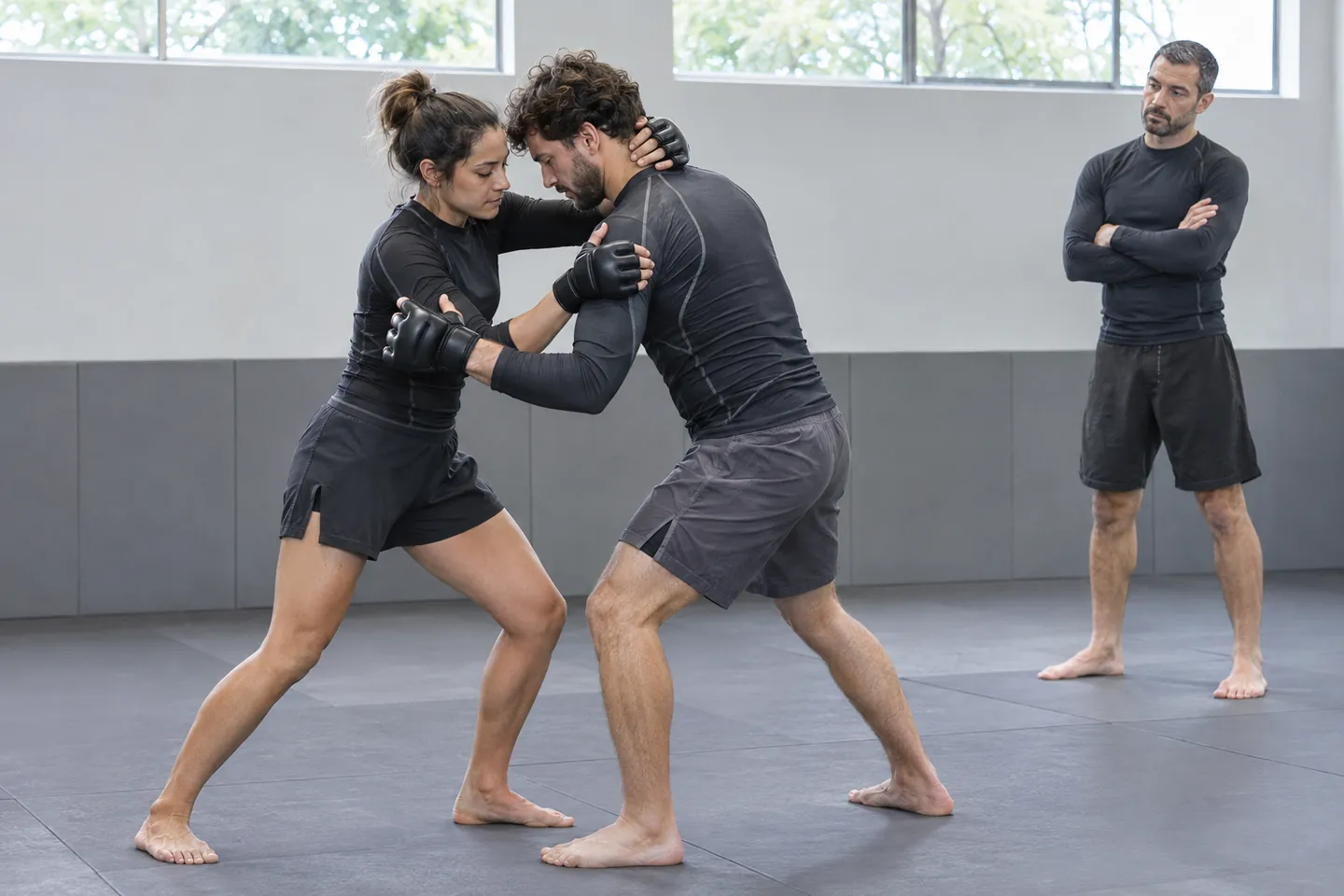
The clinch is where the striking and grappling worlds overlap most visibly. Two people are close enough to hold each other, yet strikes like knees and short elbows may still be part of the game in competition. For beginners, clinch work is often taught without strikes at first, focusing on hand fighting, head position and posture.
This range can feel strange because it is neither stand-up nor ground. You might be working for an underhook, trying to keep your head in a strong spot, or pushing a partner toward a wall pad. Small details, such as where your elbows are or how your hips are aligned, can decide whether you control the exchange or get pulled off balance.
Many students find the clinch is where the “blend” finally clicks. A punch can create the opportunity to close in, the clinch can set up a takedown, and a well-timed exit can return you to striking range. Once you see those links, the other parts of class start to make more sense.
Takedowns and defending them
Takedowns move the action from standing to the ground. In a beginner MMA class, these are introduced with care: slow repetitions, cooperative partners and plenty of instruction about safe falling. Before anyone is taken down at full speed, students usually learn how to land, how to protect their head, and how to tap or communicate if something feels wrong.
Takedown defence is just as important as offence and is often taught alongside it. The sprawl, for example, is a way of moving your hips back and down when someone attacks your legs. Learning to defend takedowns gives a striker the confidence to stay standing, and learning to attack them gives a grappler a way to bring the fight to familiar territory.
The link to striking is direct. Strikes often make takedowns easier because they draw a partner’s attention upward. In the opposite direction, the threat of a takedown can make strikes land more easily because an opponent is worried about their legs. Coaches spend a lot of time on these combinations because they are central to how the sport works.
The ground game in an MMA setting
When the action reaches the mat, MMA students draw heavily on grappling principles from jiu-jitsu and wrestling. The goals are often summarized simply: control position, avoid being stuck underneath, and get back up when appropriate. Beginners usually start with fundamental positions and escapes before learning submissions in any detail.
One difference from sport jiu-jitsu is that in MMA, being on your back carries extra risk because strikes are part of the rule set in competition. That’s why MMA coaches tend to emphasize getting up, using the wall and maintaining strong top positions. A guard position that works well in a gi tournament might be adjusted for MMA because the person on top could strike.
For a beginner, this doesn’t mean there’s ground-and-pound in every class. Most introductory sessions keep ground work as grappling only, with strikes added gradually, under supervision, in controlled drills for students who are ready. Ask your coach how your gym approaches it so your expectations match what will actually happen on the mat.
How a typical class sequences the pieces
Every gym plans differently, but MMA classes often follow a recognizable arc. A warm-up might include movement drills borrowed from both worlds, like shadowboxing followed by sprawls and hip escapes. Then comes technique: perhaps a strike, a clinch entry, and a takedown, practised in pieces and then together.
Later in class, students may do positional drilling, where partners start in a specific situation and work toward a goal. For example, one person might try to stand up from the ground while the other tries to keep them down. These drills are useful because they isolate one transition and let you repeat it many times with feedback.
Not every class covers every range. Some evenings might lean heavily toward striking, others toward wrestling or the ground. Over several weeks, a well-planned curriculum rotates through them so students develop a rounded base. If you’re curious about how your gym structures this, the adult schedule and your coach can help you see which sessions emphasize what.
Learning without getting overwhelmed
The breadth of MMA can feel intimidating at first. There is a lot to learn, and it can seem like everyone else knows more than you. A practical approach is to choose one focus per class. If the session covers a jab, a clinch entry and a takedown, maybe your goal is simply to understand the clinch entry. The rest will become familiar with repetition.
Keep notes after class if it helps. A sentence or two about what you worked on, what made sense, and what didn’t can make the next session more productive. You may find that something confusing in week two becomes obvious in week six once other pieces are in place.
It’s also completely reasonable to take dedicated classes in one discipline alongside MMA. Some students find that a few weeks of focused grappling or striking helps them follow MMA sessions more easily. Others prefer to learn everything in context. There isn’t a single right path, so talk with your coach about your goals and the time you actually have available.
Safety, partners and the culture of the room
Because MMA involves both impact and grappling, a responsible gym puts a lot of emphasis on control. Beginners should expect drills to be cooperative first and to progress gradually. Partners are there to help each other learn, not to win every exchange. Communicating clearly, tapping early and respecting the intensity your coach sets are all part of good training.
If you have injuries, health concerns or are returning after time away, let the coach know before class. They can suggest modifications or tell you which parts of class to sit out. Proper equipment, such as a mouthguard, appropriate gloves and, where recommended, shin guards, helps keep partner work safe.
A good MMA room in Mississauga tends to include people from many backgrounds: office workers who drive in after a shift, university students, parents squeezing in a session before the school run. That variety is part of what makes the room welcoming. Nobody needs to arrive already tough or already fit. You need to arrive willing to learn and respectful of the people you train with.
Is MMA the right starting point for you?
For some people, MMA is a natural first martial art because it gives a broad view of how different skills connect. Others prefer to start with one discipline and add MMA later. Both approaches can work. What matters most is whether the class format suits your learning style and whether you enjoy the process enough to keep coming back.
If you’re drawn to MMA because you want a well-rounded skill set, it can be a satisfying choice. If you’re drawn mainly to fitness, you might also consider striking-based conditioning classes or strength and conditioning as a complement. Many students in Mississauga end up mixing and matching depending on their schedule and interests.
Seeing the pieces come together
The moment MMA starts to make sense often arrives quietly. You throw a jab, notice your partner’s reaction, step in to the clinch and feel your hips line up for a takedown the way your coach described. It might be slow and imperfect, but for the first time, the separate pieces feel connected.
That connection is the heart of mixed martial arts. Striking, clinch work and grappling aren’t competing parts of a class; they’re different expressions of the same problem: controlling distance and position. If you’d like to see how this works in practice, take a look at our MMA classes or book a free trial and experience a session at our Timberlea Boulevard gym for yourself.
Filed under
Keep exploring
More training insights await.