
Practical indoor conditioning ideas for a Mississauga winter, from rowing and skipping intervals to bag rounds, circuits, and recovery habits that keep you moving.
The first real snowfall changes the way a lot of people move. The evening run along the waterfront becomes a slippery gamble, the cycling route turns grey with slush, and the walk you used to take after dinner feels less appealing when it is dark at five o’clock. For many people training in Mississauga, January and February are the months when conditioning quietly drifts away.
It does not have to go that way. Winter is a good time to build the kind of fitness that holds up in the spring: a steady aerobic base, better work capacity, and the ability to recover between hard efforts. The difference is that the work moves indoors, and indoor conditioning rewards a little more planning than heading out the door for a jog.
This article collects practical ideas for keeping your engine running through the cold months in Mississauga. Some use equipment you will find in most gyms, some come straight from combat sports training, and a few need nothing more than a patch of floor. Pick what suits your current level and build from there.
Start by deciding what conditioning means for you
Conditioning is a broad word. For a recreational boxer it might mean finishing three-minute rounds without dropping their hands. For someone returning to exercise after a busy autumn, it might mean climbing stairs without feeling winded or keeping up with their kids at the park. For a person preparing for a spring hiking trip, it might mean walking uphill for an hour at a comfortable pace.
Write down one sentence describing what you want your conditioning to do for you by the end of winter. That sentence shapes the rest of your choices. Someone chasing round-by-round fitness will lean on intervals that mirror the rhythm of a fight. Someone rebuilding general fitness will spend most of their time at a moderate, conversational effort and add harder work gradually.
Being clear about the goal also helps on days when motivation is low. Instead of asking whether you feel like training, you can ask which session moves you closer to that sentence. It is a quieter, steadier question, and it tends to produce better decisions in the middle of a cold week.
Build an aerobic base with steady machine work
Rowers, stationary bikes, air bikes, ski ergometers and treadmills are the obvious winter tools, and they are obvious for good reason. They let you control effort precisely, they are easy on the joints compared with sprinting on hard pavement, and they do not care whether the sidewalks have been salted.
A simple place to begin is twenty to thirty minutes at an effort where you could still hold a short conversation. It feels almost too easy at first, and that is the point. This kind of steady work develops the aerobic system that supports everything else, including your recovery between rounds or sets. Many people skip it because it does not feel dramatic, then wonder why their harder sessions leave them flattened for days.
If thirty continuous minutes on one machine sounds tedious, split it. Ten minutes on the bike, ten on the rower and ten walking briskly on an incline treadmill still count. Changing machines also spreads the work across different muscle groups and keeps your attention from wandering. Keep the effort honest, though; the goal is consistent, moderate breathing rather than a series of mini races.
Borrow the round structure from combat sports
Boxing, kickboxing and Muay Thai gyms have been conditioning people indoors for generations, and the round timer is one of their most useful tools. Working in rounds, typically a few minutes on with a short break between, gives you a clear structure and a natural rhythm. It also makes time pass surprisingly quickly.
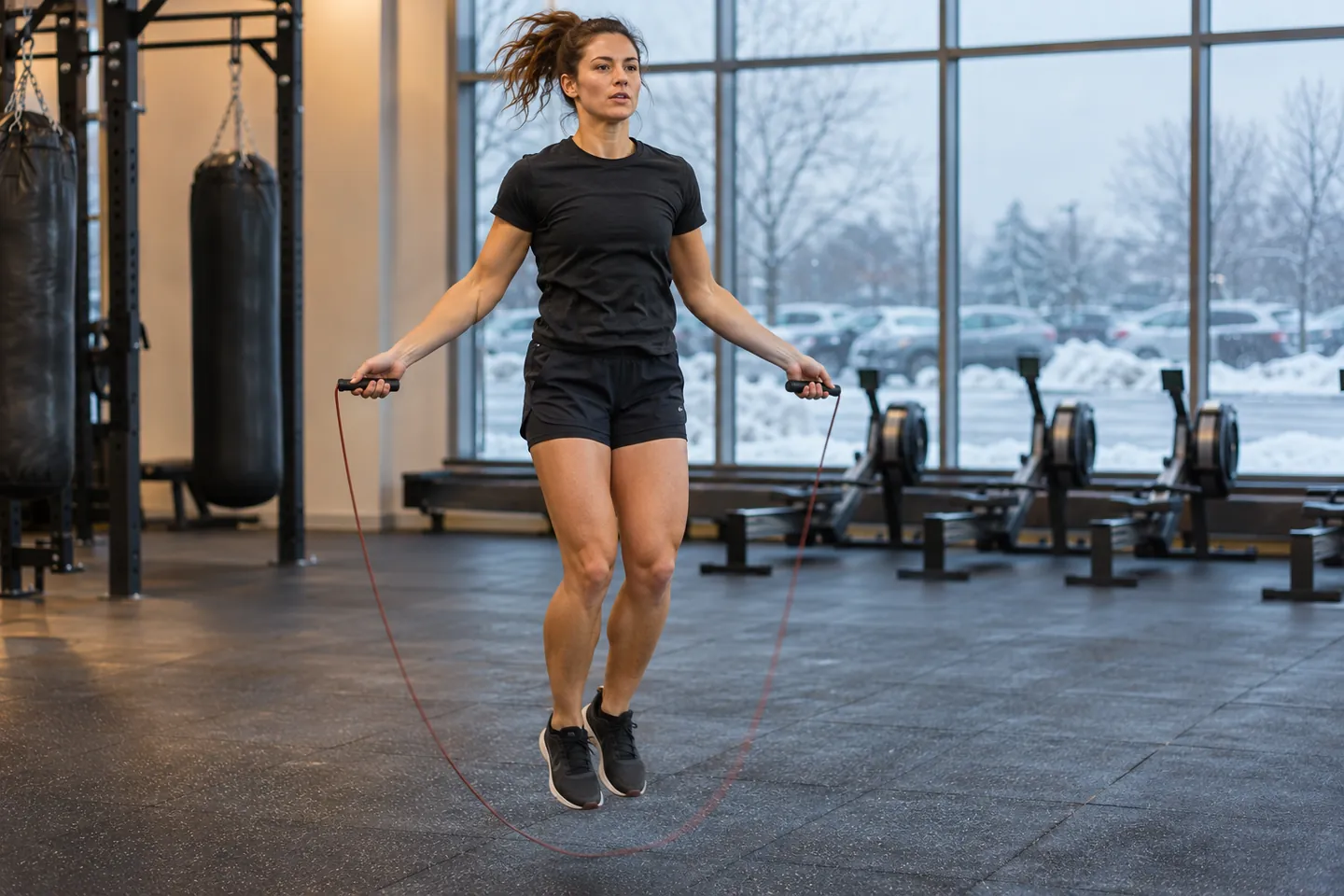
One accessible version is a skipping-and-shadowboxing session. Alternate one round of skipping with one round of light shadowboxing, then repeat for six to ten rounds. Skipping builds foot rhythm and calf endurance, while shadowboxing keeps your shoulders working and asks you to stay light on your feet. If you are new to the rope, simple bounces with a few stops are perfectly fine; you can work toward smoother footwork over the winter.
Bag work adds another layer. On a heavy bag, focus on steady output with clean technique rather than throwing every punch as hard as possible. A useful approach is to work at a moderate pace for most of the round and pick up the tempo for the final twenty or thirty seconds. That teaches you to manage effort, which is exactly what conditioning should do. If you want guidance on technique while you build fitness, a boxing or kickboxing class gives you rounds, coaching and company in one place.
Use intervals, but give them a job
Interval training is popular because it works and because it fits into a busy schedule. The risk in winter is that people try to make every session a hard interval session, partly because it feels productive and partly because it is over quickly. Within a few weeks, they feel run down and start skipping workouts.
Give your intervals a specific purpose. Short, sharp efforts of fifteen to thirty seconds with generous rest develop power and speed. Longer efforts of two to four minutes at a challenging but sustainable pace build the ability to hold a high output. Both have value, but they ask different things of your body and should not be crammed together every day.
For most people, one or two interval sessions per week is plenty, with the rest of the week made up of steady work, strength training and skill practice. On the bike, try something like eight rounds of thirty seconds hard followed by ninety seconds easy. On the rower, try four efforts of three minutes at a strong pace with two minutes of easy rowing between. Record what you did so you can repeat the session in a few weeks and see whether it feels more manageable.
Try circuits that mix strength and breathing
Circuits are a practical way to combine conditioning with strength, especially when time is limited. A circuit might include a lower-body movement, an upper-body push or pull, a carry, and a core exercise, performed one after another with minimal rest. The heart rate stays elevated while different muscles take turns working.
Here is one example of how a beginner-friendly circuit might be organized:
- Goblet squats with a moderate kettlebell or dumbbell
- Push-ups, either from the floor or with hands elevated on a bench
- Farmer’s carries across the gym and back
- Dead bugs or a similar controlled core exercise
- One minute of easy rowing or cycling before starting again
Work through three to five rounds, and choose loads that let you keep good form even when you are breathing hard. The moment technique starts to fall apart, slow down or rest. A circuit is meant to train your conditioning, not to test how much sloppy repetition you can tolerate. If you would like a structured plan for this, the strength and conditioning program is designed around exactly this blend.
Make the most of small spaces at home
Not every winter session has to happen at the gym. Some evenings, particularly after a storm or when the 403 is crawling, it simply makes sense to train at home. A small clear area, a skipping rope if your ceiling allows, and a timer are enough for a useful session.
Bodyweight work can be organized in rounds just like bag work. Try alternating forty seconds of work with twenty seconds of rest across exercises such as step-ups on a sturdy stair, reverse lunges, mountain climbers, inchworms and shadowboxing. Repeat the sequence two or three times. Keep landings quiet if you live in an apartment or townhouse; your downstairs neighbours will appreciate it, and quieter landings usually mean better control anyway.
Stairs are an underrated indoor conditioning tool. Walking up and down a single flight at a steady pace for ten to fifteen minutes can raise your heart rate noticeably, and it trains the legs in a way that carries over to everyday life. Hold the railing, watch your footing, and avoid rushing when you are tired.
Keep skill work in the conversation
Conditioning does not have to be separate from learning. Technical practice often provides a surprising amount of fitness, especially in sports like Brazilian jiu-jitsu and Muay Thai. A round of positional sparring on the mat, or a few rounds of pad work with a partner, will test your breathing in ways that are hard to replicate on a machine.
The advantage of combining skill and conditioning is that both improve together. You learn to stay composed under fatigue, which is a big part of what conditioning means in a combat sport. You also stay mentally engaged, which matters during long stretches when the weather keeps everyone indoors and routines can feel repetitive.
The trade-off is that skill sessions are not always predictable in intensity. Some classes are technical and gentle; others are demanding. Look at the week as a whole, and adjust your separate conditioning sessions so the total load stays manageable. If a hard sparring class is on Thursday, Wednesday is probably a better day for easy cycling than for brutal intervals.
Respect the cold before and after training
Winter training in Mississauga has a logistical side that is easy to overlook. Walking from a cold car or bus stop into a warm gym and immediately starting hard work is not ideal. Give yourself a longer, gradual warm-up in January than you might in July. Several minutes of easy movement, joint circles and lighter versions of the day’s exercises help your body adjust.
The trip home matters too. After a sweaty session, change into dry clothes before heading back outside. A damp shirt in sub-zero wind is uncomfortable at best. Keep a spare layer, a hat and dry socks in your bag, especially if you are walking to transit or clearing snow off the car in the parking lot.
Hydration still matters in winter, even though thirst can feel less obvious in cold, dry air. Bring a water bottle and drink through your session. Many people also find that heated indoor air leaves them more dried out than they expect, so a little extra attention to fluids across the day can help you feel better in training.
Plan for snow days and disrupted weeks
Winter weeks rarely go exactly as planned. School closures, slippery roads, early sunsets and seasonal illness can all interrupt a routine. Rather than treating every disruption as a failure, build flexibility into the plan from the beginning.
One useful idea is to have a short backup session ready to go. Twenty minutes of bodyweight rounds at home, a brisk walk in an indoor space, or a mobility routine can keep the habit alive on days when getting to the gym is unrealistic. The aim is to maintain momentum rather than to replicate your full program.
When you miss several days, return gradually. Pick up with a slightly easier version of your usual session rather than trying to make up for lost time. Conditioning tends to come back faster than people expect, but rushing it is a common route to soreness or a minor strain that costs you more time later.
Protect recovery and sleep
Hard conditioning sessions only pay off if your body has a chance to adapt. Sleep is the most important recovery tool you have, and winter can be both helpful and harmful here. Long nights make it easier to get to bed early, but holiday leftovers, shift schedules and screen time can push bedtimes later than intended.
Keep an eye on how you feel across the week. Persistent heaviness in the legs, unusual irritability, or a resting sense of fatigue are signals to ease off for a few days. Swapping a hard session for an easy walk or a yoga class can do more for your long-term progress than forcing another interval workout.
If you have an injury, ongoing pain, or a medical condition that affects exercise, talk with a qualified health professional before increasing your training volume. Recovery services such as massage or physiotherapy can be helpful parts of a plan when they are guided by a properly trained practitioner who understands your situation.
Track a few simple markers
You do not need sophisticated technology to see whether your winter conditioning is working. A notebook or a note on your phone is enough. Record what you did, how long it took, and how hard it felt on a simple scale from one to ten.
Over several weeks, patterns appear. Perhaps the same rowing session now feels like a six instead of an eight. Perhaps you can complete eight skipping rounds instead of five without stopping. Perhaps your heart rate settles more quickly between bag rounds. These small changes are evidence that the work is doing something, and they are often more motivating than a number on a scale.
Choose markers that connect to the goal you wrote down at the start. If your aim is to last longer in sparring, track how you feel in the final round of class. If your aim is general fitness, track how easily you manage everyday tasks like carrying groceries up the stairs or shovelling the driveway.
Make winter the season you build, not the season you pause
By the time the snow melts and the trails along the Credit River dry out, the people who kept training indoors usually feel the difference. Their first spring run feels easier, their first outdoor bike ride is more enjoyable, and they are not starting over from scratch.
The approach does not need to be complicated. A few steady machine sessions, one or two well-chosen interval days, some circuits or bag rounds, and a reliable backup plan for bad-weather days can carry you comfortably through to March. What matters most is that the plan fits your life and that you can repeat it week after week.
If you would like help structuring your winter training, take a look at the group classes on offer or check the adult schedule for sessions that fit your week. New to Konga Fitness? You can book a free trial and see what indoor conditioning feels like with a coach and a room full of people working alongside you.
Filed under
Keep exploring
More training insights await.