
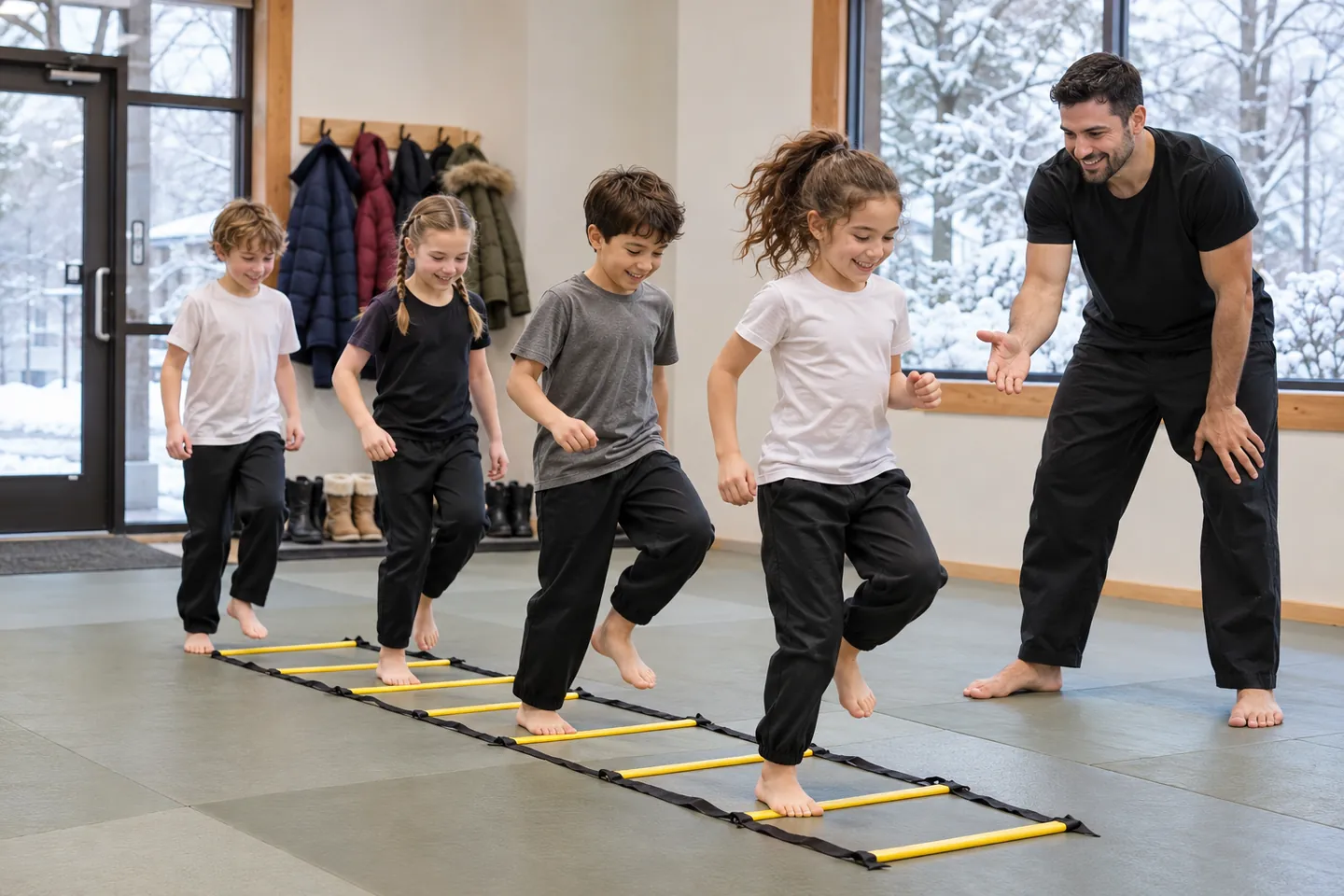
Ideas for keeping kids active indoors through a Mississauga winter: living-room movement games, safe martial arts drills, routines, and structured weekly classes.
By the third indoor recess of the week, most parents can tell. Kids come home with energy that has nowhere to go. They bounce off the couch, wrestle with siblings in the hallway, and ask for screens the moment their boots come off. Winter in Mississauga brings plenty of beautiful snowy days, but it also brings dark afternoons, icy sidewalks and long stretches when outdoor play is hard to arrange.
Children still need to move during those months. Regular physical activity supports their coordination, sleep, mood and general health, and the habits they build now can carry forward for years. The challenge for families is finding ways to keep kids moving when the weather and the calendar are working against you.
This article offers practical ideas for keeping kids active indoors during winter in Mississauga, from simple games at home to structured activities like martial arts classes. Use what fits your family, your space and your children’s ages and interests.
Think in short bursts, not long workouts
Adults often picture exercise as a single block of time: a forty-five-minute class or a run. Children rarely move that way on their own. They tend to be active in short, intense bursts, with breaks in between. Indoor activity works best when it respects that natural pattern.
Instead of trying to schedule an hour of exercise after school, aim for several shorter bouts spread through the afternoon and evening. Five minutes of dancing before homework, a ten-minute obstacle course after snack time, and a quick game of tag in the basement before dinner all add up.
This approach is also easier for parents. You do not need to plan elaborate sessions or clear the whole house. Small pockets of activity fit around homework, meals and the rest of family life, and children are more likely to enjoy them because they feel like play rather than a chore.
Set up a safe movement space
Before encouraging kids to jump and roll around the house, take a few minutes to set up a safer space. Move fragile items, push furniture back, and check for sharp corners. A carpeted room or a play mat can make floor activities much more comfortable.
Basements are often ideal if you have one, because they offer more room and less risk of disturbing neighbours. In apartments and condos, focus on quieter activities such as balance games, animal walks and stretching rather than jumping. Soft socks or bare feet usually provide better grip than slippery socks on hard floors.
Agree on a few simple rules with your children. Examples might include no running near stairs, no climbing on furniture, and stopping when an adult says stop. Clear boundaries help kids enjoy active play without turning the living room into a hazard.
Movement games that need almost nothing
Some of the best indoor activities require no equipment at all. Animal walks are a favourite for younger children: bear crawls, crab walks, frog jumps and inchworms build strength and coordination while making kids laugh. Turn it into a game by calling out animals at random and seeing who can switch the fastest.
Freeze dance is another classic. Put on music, let kids dance freely, and pause the music at random moments. Anyone who moves after the music stops does five jumping jacks or a silly pose before rejoining. It is simple, fun, and surprisingly tiring.
For older children, try a “deck of cards” challenge. Assign an exercise to each suit, such as squats for hearts, push-ups for spades, star jumps for diamonds and sit-ups for clubs. Flip a card and do the number of repetitions shown. Face cards can be ten, and aces can be a short sprint on the spot. Adjust the numbers for each child’s age and ability.
Obstacle courses and balance challenges
Children love obstacle courses, and indoor versions can be built from household items. Couch cushions become stepping stones, a broomstick on two chairs becomes a limbo bar, and a line of painter’s tape on the floor becomes a balance beam. A blanket draped over a table makes a tunnel to crawl through.
Time each child as they complete the course, then challenge them to beat their own time rather than each other’s. This keeps the focus on personal improvement and reduces conflict between siblings of different ages.
Balance challenges are especially useful in smaller spaces. Ask kids to stand on one foot while counting to twenty, then try with eyes closed. Have them walk heel-to-toe along a taped line, or balance a beanbag on their head while moving across the room. These activities build body awareness and stability, which help in sports and everyday play.
Borrow a few ideas from martial arts
Martial arts training offers many movement ideas that work well at home, as long as they stay non-contact and supervised. Stance practice, footwork drills and slow, controlled punches into the air develop coordination and focus. Many children enjoy learning how to move like a martial artist.
Try a simple footwork game. Lay a few pieces of tape in a pattern on the floor and call out steps: forward, back, left, right. Children move in a ready stance with their hands up, stepping lightly to each spot. Add a challenge by speeding up the calls or mixing in squats and jumps.
Shadow drills are another option. Kids can practise a basic stance and throw slow straight punches toward the air or a pillow held by a parent. Keep the focus on good form, balance and control rather than power. Avoid any partner striking at home, and save contact skills for a supervised class where coaches can guide them safely.
Make it a family activity
Kids are more likely to stay active when the adults around them join in. Family workouts do not need to be intense. A short circuit where everyone takes turns choosing an exercise, a dance party after dinner, or a stretching session before bed can all become shared routines.
These activities give parents a chance to move as well, which is especially welcome on winter days when everyone feels cooped up. They also model the idea that physical activity is a normal, enjoyable part of life rather than something reserved for sports teams.
If you have a busy household, consider attaching activity to existing routines. A few minutes of movement after brushing teeth in the morning, or a quick game before dinner each night, can become habits that require little planning. Consistency matters more than length.
Limit screen time without making it a battle
Winter often brings more screen time, and that is understandable. Screens are easy entertainment when it is dark and cold outside. Rather than banning them, many families find it helpful to balance screen time with movement.
One approach is to pair them: twenty minutes of activity earns a certain amount of screen time, or each episode of a show is followed by a short movement break. Some families use active video games or online dance videos as a middle ground, though these work best when they encourage genuine movement.
Talk with your children about why moving matters. Explain that their bodies need activity to grow strong, sleep well and feel good. When kids understand the reason, they are more likely to cooperate, and the conversation becomes less about rules and more about health.
Structured classes add consistency
Home activities are valuable, but many families find that a structured class gives winter weeks a dependable anchor. Regular sessions with a coach and other children provide dependable movement, social interaction, and learning that is hard to replicate at home.
Martial arts classes are especially popular in winter because they happen indoors and combine physical activity with skill development. Children work on coordination, balance, strength and focus, all while learning respect and discipline. Classes are usually organized by age and ability, so kids train with peers at a similar stage.
At Konga Fitness, kids martial arts and kids boxing programs offer age-appropriate, supervised training in a safe environment. Activities are carefully controlled, with an emphasis on technique, fitness and confidence rather than hard contact. You can review the kids schedule to find class times that work around school and family commitments.
Plan around the realities of winter
Winter in Mississauga brings its own logistics. Snowstorms, early sunsets and busy roads can make getting to activities harder. Plan ahead by choosing classes that are reasonably close to home or school, and leave a little extra time for travel on snowy days.
Keep a bag ready with water, indoor shoes if needed, and a change of clothes. Children often get sweaty during classes, and having dry layers for the trip home makes the cold more bearable. Hats and gloves are easy to forget in the rush, so check them before you leave.
On days when weather makes travel unsafe, have a backup plan at home. A favourite movement game, an obstacle course, or a short family workout can keep the routine alive even when you cannot get to class.
Watch for signs your child needs a break
Most children will tell you when they are tired, but sometimes they push themselves too hard or keep going because they are having fun. Watch for signs of fatigue such as clumsiness, irritability or complaints of aches. These are signals to slow down or stop for the day.
If your child has a medical condition, a past injury or any health concerns, speak with your family doctor or another qualified professional before starting a new activity program. Coaches can usually adapt activities when they know about specific needs, so share relevant information with them as well.
Rest days matter for kids too. A balance of active days and quieter days helps their bodies recover and keeps activity enjoyable. The goal is to build a healthy relationship with movement, not to create pressure or exhaustion.
Making winter something to look forward to
Winter does not have to be a season of restless kids and endless screen time. With a few simple games, a safe movement space, and perhaps a regular class, children can stay active, happy and engaged even when it is cold and dark outside.
If you would like to give your child a structured, supportive place to move this winter, explore the kids martial arts program in Mississauga and book a free trial to see whether it fits your family. Questions about age groups or schedules can be sent through the contact page.
Filed under
Keep exploring
More training insights await.