
New to kettlebells in Mississauga? Learn how to choose a starting weight, master the hip hinge and swing, and build a simple, safe routine with good coaching.
A kettlebell looks a little like a cannonball with a handle, and that odd shape is the whole point. Because the weight sits below and away from the grip, it behaves differently from a dumbbell. It swings, it pulls, and it shifts position as you move it, which means your body has to manage it rather than just lift it.
That quality makes kettlebells versatile and genuinely useful. A single bell can be used for swings, squats, presses, carries, and more, and a well-planned kettlebell session can challenge strength, conditioning, and coordination in a compact space. It also means kettlebells reward good technique and punish sloppy habits.
If you are curious about kettlebell training in Mississauga, this guide covers the fundamentals: choosing a starting weight, learning the movements that form the foundation, and putting together a simple routine. It is meant as background before you work with a coach, not a replacement for hands-on instruction.
What makes kettlebells different
Dumbbells and barbells generally keep the weight close to the hands and fairly balanced. A kettlebell’s centre of mass sits outside the handle. When you swing or press it, the bell wants to travel in arcs, and you need to control those arcs with your hips, trunk, shoulders, and grip.
This makes kettlebells particularly well suited to ballistic movements, where the weight is moved explosively and then controlled. The swing is the best-known example. It also makes them useful for exercises where you hold the weight in a particular position, such as the front rack, which challenges posture and trunk control.
None of this makes kettlebells better or worse than other tools. They are simply different, and many training programs use them alongside barbells, dumbbells, body-weight work, and machines.
Choosing a starting weight
Picking the right first kettlebell matters. Too light and you may not feel the movement properly, especially in the swing, where a little resistance helps you learn the hip drive. Too heavy and your technique will suffer, which increases the chance of strain.
There is no universal starting weight, because people arrive with very different backgrounds, sizes, and experience. A coach can help you choose based on how you move and what exercises you will be doing. You may also find that different movements call for different weights. Many people can swing a heavier bell than they can press overhead.
If you are buying a kettlebell for home, it is worth trying a few at the gym first. Handle size, shape, and finish vary, and what feels comfortable in one hand might feel awkward in another.
The hip hinge comes first
The foundation for many kettlebell movements, especially the swing and the deadlift, is the hip hinge. A hinge involves pushing the hips back while keeping the spine in a fairly neutral position, with the knees bending somewhat but the movement coming mostly from the hips.
Many people confuse hinging with squatting. In a squat, the knees bend significantly and the hips travel downward. In a hinge, the hips travel backward and the torso tilts forward. Getting this distinction clear is often the most important early lesson in kettlebell training.
Coaches often teach the hinge without any weight first, perhaps by having you touch the hips to a wall behind you or using a dowel along the back to feel spinal position. These drills may seem basic, but they build the pattern that makes the swing work.
The kettlebell deadlift
Once the hinge feels comfortable, the kettlebell deadlift is a natural next step. The bell sits on the floor between your feet. You hinge back, grip the handle, brace your trunk, and stand up by driving your hips forward until you are upright.
The deadlift teaches you to pick up a weight with your hips and legs rather than rounding your back. It also introduces the feeling of bracing and standing tall at the top. Many coaches have beginners practise deadlifts for a while before introducing the swing.
Keep the movement controlled. Lower the bell back down the same way, with the hips moving back first. Rushing the descent or dropping the bell defeats the purpose of learning the pattern.
Learning the two-handed swing
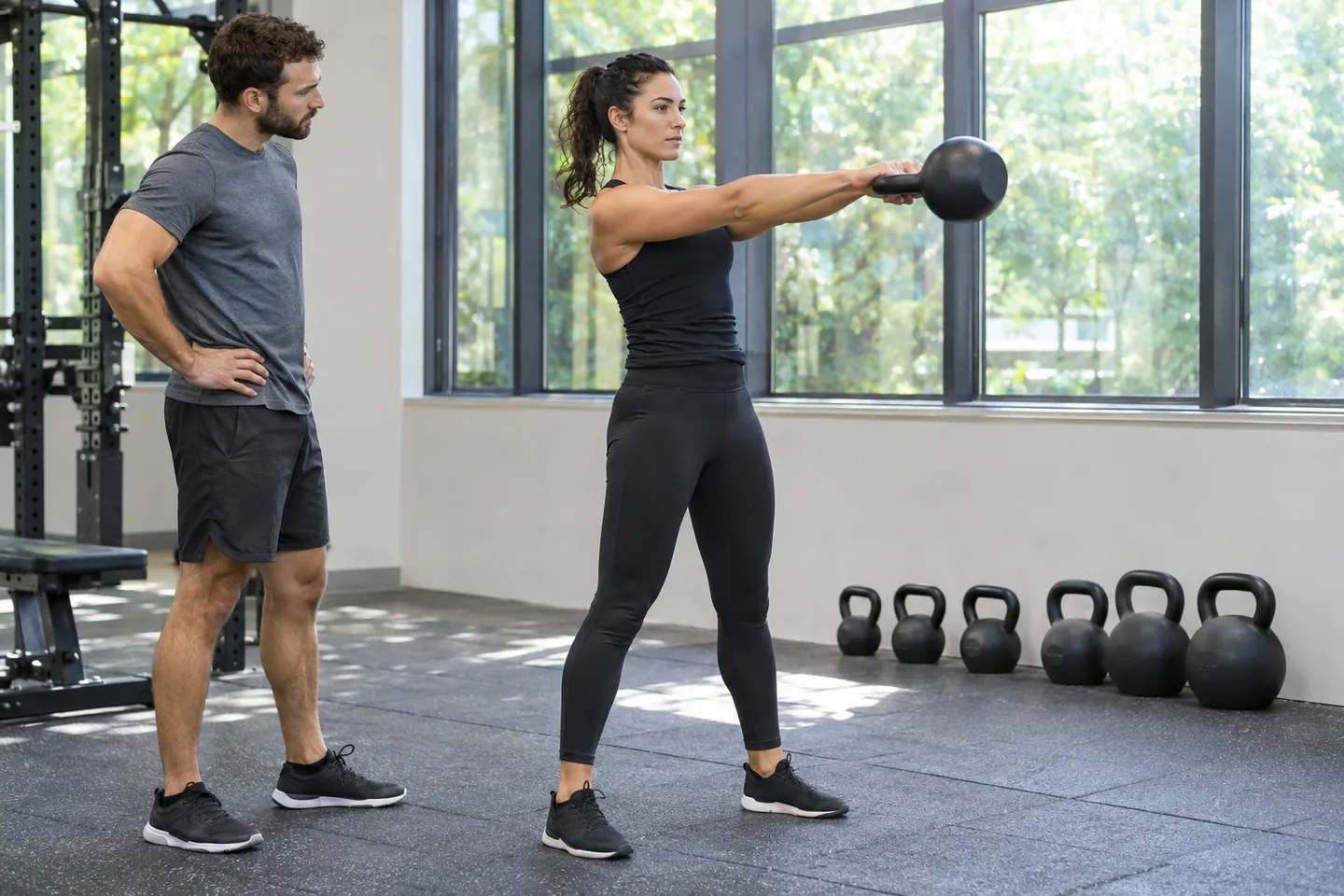
The swing is probably the most recognisable kettlebell exercise. It involves hiking the bell back between the legs, then driving the hips forward powerfully so the bell floats up to around chest height before swinging back down.
The most common beginner mistake is lifting the bell with the arms or squatting it up with the knees. In a good swing, the arms act more like ropes, guiding the bell while the hips provide the power. At the top, you stand tall with glutes engaged and trunk braced, not leaning back.
Another common mistake is letting the bell drag you around at the bottom, with the back rounding as it swings between the legs. A coach can help you find a rhythm where you receive the bell with a strong hinge and send it back up with control. Learning the swing in person is strongly recommended because small details are hard to self-correct.
The goblet squat
The goblet squat is a friendly introduction to squatting with load. You hold the kettlebell close to your chest, usually by the sides of the handle or the bell itself, and squat down between your heels while keeping the torso fairly upright.
Holding the weight in front can actually make squatting easier for some beginners, because it helps counterbalance the body and encourages an upright position. It also challenges the upper back and trunk to stay engaged.
Depth should match your current mobility and comfort. There is no need to force a deep squat if your hips or ankles are not ready. A coach can suggest modifications or mobility work if certain positions are difficult.
Pressing, carrying, and other options
Beyond the hinge, deadlift, swing, and goblet squat, there are many other kettlebell movements. Overhead presses, rows, Turkish get-ups, cleans, snatches, and various carries all have their place.
Some of these, like presses and carries, are relatively approachable once you understand basic positioning. Others, like the clean and snatch, involve more complex technique and are best learned with a qualified coach. The Turkish get-up, a slow movement from lying to standing with the bell held overhead, is valued by many trainers for building shoulder stability and coordination, but it involves many steps and benefits from careful instruction.
There is no need to rush into the advanced lifts. A solid foundation in the basics will make later progressions much safer and more productive.
Grip, hands, and calluses
Kettlebell training places demands on the hands. Swings and cleans in particular involve the handle moving in your grip, which can cause friction. Some people develop calluses or, if technique is poor, small tears in the skin.
Good technique helps reduce friction. So does managing calluses with simple care, such as keeping them from getting too thick. Chalk can help with grip on some exercises, though policies vary between gyms.
If your forearms or wrists are sore after kettlebell training, it may reflect technique, volume, or simply unfamiliarity. Raise it with your coach, and if discomfort persists, consider consulting a qualified healthcare professional.
Putting together a simple routine
A beginner kettlebell routine does not need to be complicated. A few foundational movements done with good technique, two or three times a week, can be very effective for many people.
A simple session might include a warm-up, some hip hinge practice, kettlebell deadlifts, two-handed swings, goblet squats, and a carry. Sets and repetitions should be chosen with your coach based on your current fitness, aiming for quality rather than exhaustion. Rest between sets allows you to keep form crisp.
As you progress, you might add presses, rows, or single-arm variations. The principle remains the same: build on what is solid, and add complexity gradually.
Kettlebells and martial arts
Many martial artists use kettlebells as part of their strength and conditioning. The hip drive in a swing has some overlap with the power generation in strikes and takedowns, and carries and get-ups can support the trunk and shoulder stability that combat sports demand.
That said, kettlebells are a supplement, not a replacement for skill training. A boxer still needs to box, and a grappler still needs to roll. Kettlebell work fits best when it is planned around the rest of the training week so it does not leave you too tired for technical classes.
If you train combat sports in Mississauga and want to add kettlebell work, talk to your coach about how much and when. A couple of short sessions a week is often plenty.
Safety and space
Kettlebells can cause injury if dropped or swung into something. Always train in a clear space with enough room in front of and behind you. Check the floor surface. Rubber gym floors are ideal, while hardwood floors in a home can be damaged by a dropped bell.
If you lose control of a swing, it is generally safer to let the bell go forward and away from you than to fight it back. Make sure no one is in the path. Coaches often teach how to bail out of a lift safely as part of early instruction.
If you have existing injuries, particularly affecting the back, shoulders, or hips, consult a qualified professional such as a physiotherapist before starting kettlebell training. They can advise on which exercises suit your situation.
Where to go from here
Kettlebells are a practical, versatile tool that can support strength, conditioning, and overall movement quality. The key to getting started well is learning the hinge, mastering a few foundational movements with good coaching, and progressing patiently.
If you would like to learn kettlebell fundamentals in Mississauga, our strength and conditioning sessions and one-on-one personal training both offer hands-on coaching. You can also book a free trial and ask a coach to walk you through your first swings.
Filed under
Keep exploring
More training insights await.