
A beginner's guide to kickboxing defence in Mississauga: guard, distance, parries, blocks, checking kicks and practising defence safely with a partner.
Beginners in kickboxing almost always fall in love with offence first. Combinations feel exciting, the heavy bag gives satisfying feedback, and a well-timed round kick on the pads is one of the best feelings in a gym. Defence, by contrast, can seem abstract. Nobody shows off a nice parry on social media.
Yet defence is what allows you to keep training. It protects you in partner drills, makes sparring possible later on if you choose to try it, and gives your offence a structure to return to. Learning kickboxing defence basics in Mississauga is less about reacting to everything perfectly and more about building a few calm, reliable habits that keep you organised under pressure.
This guide covers the core defensive ideas most coaches introduce early: the guard, distance, parries and blocks against punches, defending kicks, and how to practise all of this safely with a partner. It is meant to complement your classes, not replace a coach’s eye.
Defence starts before anything is thrown
The most important defensive work happens before a strike arrives. Your stance, your guard and your distance from your partner decide how much time and space you have to respond. If these are sound, many attacks either cannot reach you or are easier to handle. If they are not, even the best reaction may be too late.
Think of your stance as a home base. Feet roughly shoulder-width apart, weight balanced so you can move in any direction, knees slightly bent, chin tucked. Your coach will refine the details for kickboxing specifically, which often differs a little from pure boxing because you need to lift your legs to check kicks.
Return to that base after every action. When you finish a combination, a defensive movement or a step, your first job is to recover your stance and guard. Beginners often skip this and are caught out of position. Making the return a habit is one of the most valuable defensive skills you can build.
The guard as a shield
The guard is the position of your hands and arms when you are not striking. A common kickboxing guard has both hands held up near the face, elbows tucked toward the ribs, and shoulders slightly raised to protect the chin. The exact height and width vary between coaches and styles, so follow the version you are taught.
A guard is not just a pose. It should be relaxed enough that you are not exhausted after one round, but firm enough that a light touch from a partner does not push your hands into your own face. Your coach may test this with gentle taps on the gloves. Learning the right level of tension takes time.
A big part of guard work is simply keeping it up. Under fatigue, hands drift down, especially after throwing punches or kicks. Pay attention in later rounds, when you are tired. If you notice your hands dropping, deliberately bring them back. Many coaches remind students of this constantly, and for good reason.
Distance management
Distance is the space between you and your partner, and it is one of the most effective forms of defence. If you are outside the range of their kicks and punches, you are safe from those strikes. If you are very close, their longer strikes lose power, but other techniques become possible. In between is the zone where both people can land.
Footwork lets you manage that space. Stepping back, stepping to the side or circling away can take you out of range before an attack lands. Coaches often drill simple patterns: step back as the partner steps forward, angle off to the side, then return to your stance. These movements become automatic with repetition.
Practise noticing distance during partner drills. Before your partner throws, ask yourself whether they can reach you from where they are. Over time, you will develop an instinct for when you are in danger and when you have a moment to breathe.
Parrying straight punches
A parry is a small redirecting movement of the hand that guides an incoming punch slightly off its line. Against a straight punch such as a jab, a common parry uses the rear hand to tap the incoming glove a little to the side. The movement is short; you are nudging, not swatting.
Beginners often overreach with parries, chasing the punch with a big movement that pulls their own guard apart. Keep it compact. The parrying hand travels only a few centimetres and then returns to the guard. Your coach may have you practise parries slowly with a partner throwing light, predictable jabs before increasing the pace.
Parries work best when you are relaxed and watching your partner’s shoulders and chest rather than their gloves. Stiffness and staring at the hands tend to make you slower. As with everything in defence, calm repetition is the key.
Blocking hooks and body shots
Hooks travel on a curved path toward the side of the head or body. A common defence is to raise the guard on that side, bringing the glove close to the head and the elbow tight, so the incoming hook lands on your forearm and glove rather than your head. This is sometimes called a high block or cover.
For punches to the body, many coaches teach bringing the elbow down to protect the ribs, sometimes with a slight turn of the torso. The aim is to absorb the shot on the arm rather than the midsection. Your coach will show you how much to move and how to stay balanced.
Blocking is not about being hit hard and toughing it out. In training drills, partners should throw at controlled speeds and light power so you can practise the shape of the block safely. If a drill feels too intense, say so and slow it down.
Defending kicks
Kicks bring a new dimension to defence. A round kick to the leg, body or head travels from the side with significant force, and you need different options than you would use against punches. Three common responses are checking, blocking and moving out of range.
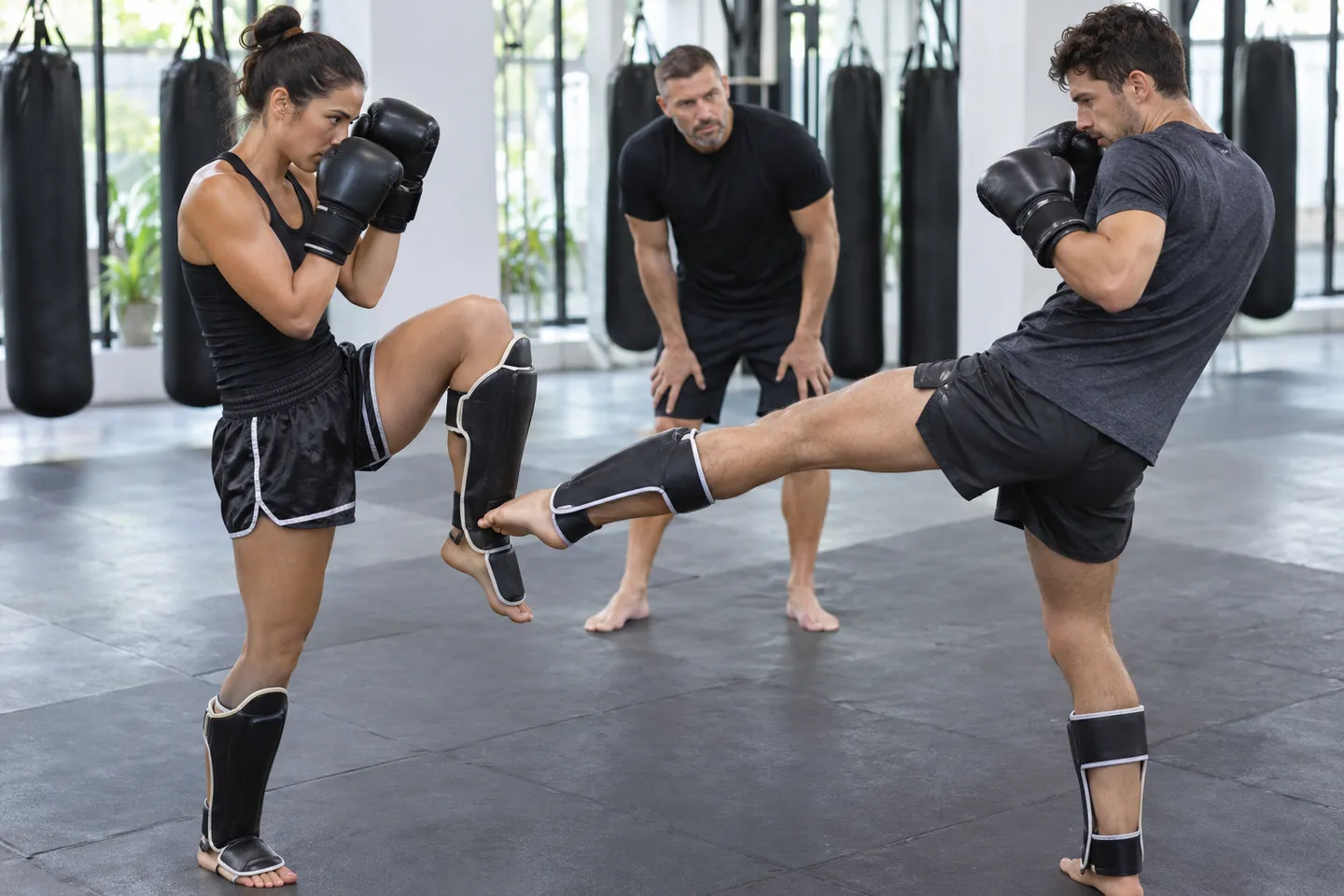
Checking involves lifting your shin to meet an incoming low kick, so the kicker connects shin to shin rather than landing on your thigh. It requires balance and timing, and coaches usually introduce it slowly with light kicks. Many gyms practise checks with shin guards on both partners, and the emphasis is on lifting the leg in the right direction rather than jamming it out aggressively.
For body and head kicks, a high, tight guard with the arm protecting the head and ribs is common. Stepping back or to the side so the kick misses entirely is another option. Some coaches introduce catching kicks later in a beginner’s development. As always, follow the specific techniques your coach teaches for each drill.
Defence as a starting point for offence
Good defence does not end when the strike has been stopped. Many of the most effective combinations begin with a defensive action. After parrying a jab, you might return with a jab of your own. After checking a low kick, you might step in with a punch. This idea is often summarised as “defend, then respond.”
Practising these simple pairings helps defence feel less passive. Instead of waiting to be hit, you start to see each defensive movement as an opportunity. That shift often makes beginners more engaged and confident during partner drills.
Keep the responses simple at first. One defensive movement and one return strike is plenty. Add complexity only when the basic pairing feels comfortable and controlled.
Practising defence safely with a partner
Defensive drills always involve someone throwing strikes at you, so communication and control matter. Agree on the speed, power and target before each drill. Start slowly, with predictable patterns, and only speed up when both partners are comfortable. Light contact means light contact.
The partner throwing strikes has a responsibility too. Your job is to help your partner practise, not to catch them out. Throw clean, consistent strikes at the agreed pace. If your partner misses a defence, do not punish it with extra power. Gyms with good culture rely on this mutual care.
Wear the appropriate equipment for the drill, which often includes gloves, shin guards and a mouthguard. Ask your coach what is required. If anything hurts in a way that seems more than ordinary training soreness, stop and let the coach know.
Building defensive habits over time
Defence takes longer to learn than offence because it depends on reacting to someone else. You cannot practise it fully on a bag. It develops through many hours of partner drills, shadowboxing with defensive movements built in, and eventually more dynamic exercises if you choose to progress that far.
Shadowboxing is underrated here. When you shadowbox, include parries, blocks, checks and footwork alongside your combinations. Imagine an opponent throwing at you and respond. It sounds simple, but it helps build the habit of defending as part of every round.
Be patient. Many experienced kickboxers say their defence kept improving for years. If you train two or three times a week in Mississauga, you will likely notice your guard, distance awareness and reactions sharpen gradually across the first few months.
Learning defence at Konga Fitness
Defence is the quiet backbone of kickboxing. A solid stance, a sensible guard, good distance management and a few reliable responses to punches and kicks make training safer and more enjoyable, and they give your offence a much stronger foundation.
If you would like to learn these basics with coaching, visit our kickboxing program page, look at the adult schedule, and book a free trial at our Mississauga gym. Bring your questions about guard and footwork to that first class; coaches are always glad to slow a defensive drill down until it makes sense.
Filed under
Keep exploring
More training insights await.