
Learn how beginner kickboxers in Mississauga build footwork, step off the centre line and create angles, with drills to practise in class and at home.
Picture two beginners sparring lightly for the first time. They face each other squarely, step forward and back in a straight line, and trade punches and kicks along an invisible rail drawn between their noses. Every attack comes from directly in front and every retreat goes directly behind. It is honest effort, but it looks a bit like two people stuck on a train track.
Footwork is what lifts them off that track. In kickboxing, the way you move your feet decides where you can strike from, how easily you can be hit, and how balanced you are when you throw. Angles, meaning positions where you are slightly to the side of your partner rather than straight in front, are one of the most useful outcomes of good footwork. They let you see your partner clearly while making it awkward for them to reach you.
This post explains the basics of kickboxing footwork and angles for beginners training in Mississauga. It is meant to help you understand what your coach is teaching and why, not to replace the coaching itself. Footwork is very hard to learn from text alone, so treat this as a companion to time on the mats.
The stance comes first
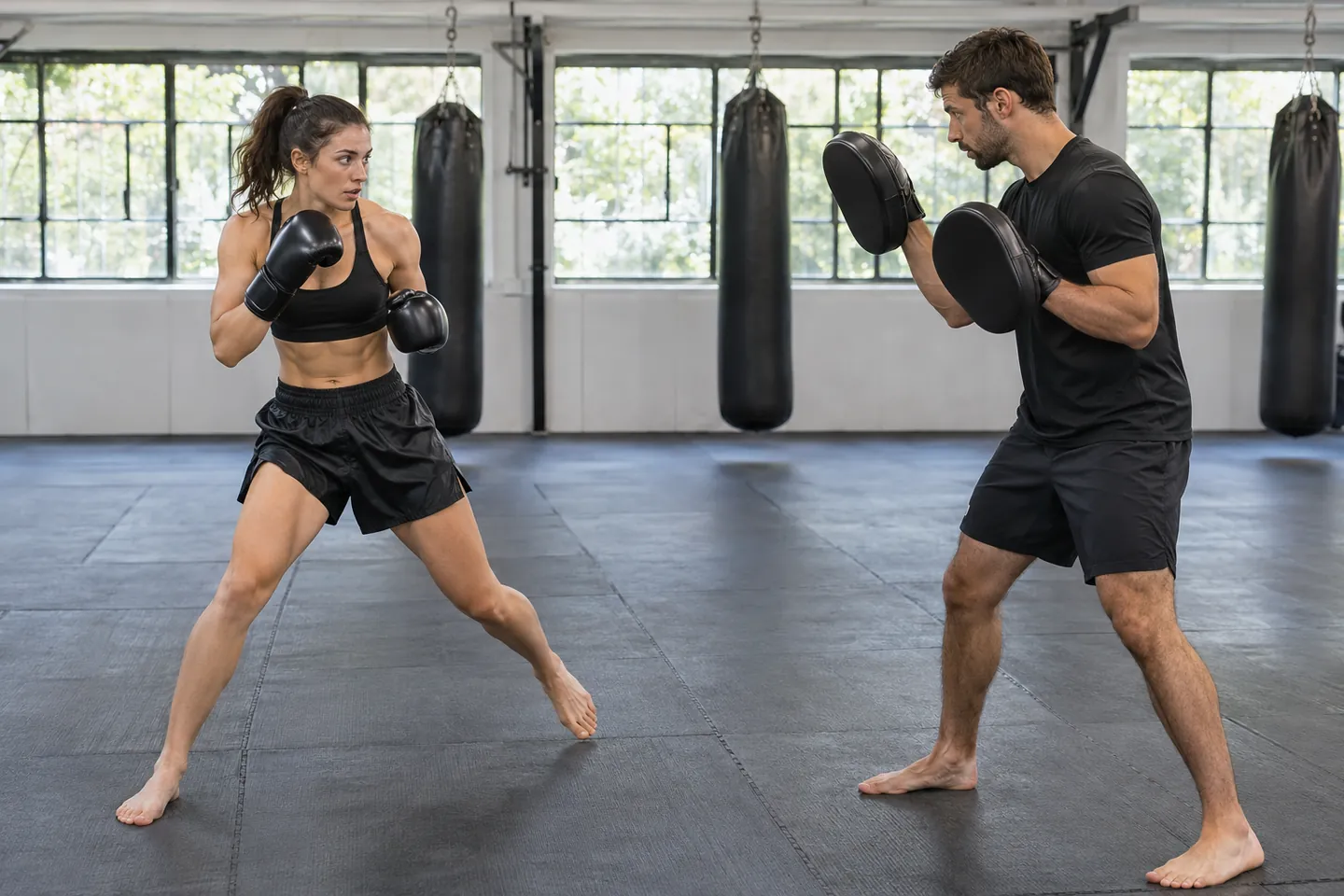
Every footwork drill starts from your stance. In a typical kickboxing stance, your feet are roughly shoulder-width apart or a little wider, staggered so the lead foot is in front and the rear foot behind and slightly to the side. Your weight is spread fairly evenly, knees softly bent, with your hands up in guard.
If the stance is too narrow, you will tip over easily when you move or kick. Too wide, and you will feel stuck and slow. Too square, and you present a big target. Too side-on, and your rear weapons become harder to use. Your coach will help you find a version that suits your body, and it may take a few classes before it feels natural.
Check your stance often. After a combination, glance at your feet. If they have drifted together or crossed, reset. Good footwork is mostly the habit of returning to a solid base after every movement.
Step, don’t cross
One of the first footwork principles most coaches teach is to avoid crossing your feet. When you move forward, the lead foot steps first and the rear foot follows by the same distance. When you move back, the rear foot steps first and the lead foot follows. Moving left or right follows the same idea: the foot closest to the direction of travel moves first.
This step-and-drag pattern keeps your stance intact. If you cross your feet or bring them together, you lose balance and the ability to strike or defend for a moment. In a drill that might not matter much. In sparring it is often when people get caught.
Practise this slowly before trying to do it quickly. Small, controlled steps are far more useful than big lunges. Many beginners take steps that are too large and end up stretched out and off-balance. Think of moving the stance as a unit rather than walking.
Why the centre line matters
The centre line is the imaginary line running between you and your partner. When you are directly on it, both of you have easy access to each other with straight punches and kicks. That is fine when you are attacking, but it means you are also in the most obvious position to be hit.
Stepping off the centre line, even by a small amount, changes that relationship. If you move slightly to one side while your partner is still facing where you used to be, they need to turn to line up their attacks. During that moment, you may have a clear view of their side or their open guard.
This is the essence of creating angles. You are not trying to run around in circles. You are using small, deliberate steps to make your position a little better and theirs a little worse.
The pivot
A pivot is one of the most practical ways to change angles quickly. Typically, you keep the ball of your lead foot planted and swing the rear foot around in an arc, rotating your whole stance. Your coach will show the exact version they prefer, as details vary between styles and gyms.
A small pivot can turn you so that you are facing your partner from a new angle while they are left facing empty space. Pivots are often taught after a punch combination: you throw, then pivot off to the side rather than stepping straight back.
The key with pivots is balance and guard. Keep your hands up as you rotate, and land in a proper stance. If you feel dizzy or lose your footing, slow down. Pivoting quickly with poor balance is less useful than pivoting slowly and arriving ready.
Lateral steps and side steps
Side steps move you left or right without changing the direction you face. They are useful for slipping off the centre line before or after an attack, or for staying out of range of a partner’s strongest weapon.
Coaches often teach side steps alongside an awareness of which side is safer for a given situation. For example, moving toward your partner’s lead side or rear side can change which of their strikes is most available. Those tactical details are best learned directly from your coach, who will explain them in the context of the drills you are doing.
Start with small steps and immediate resets. Step, check your stance, step again. When this becomes comfortable, add a strike before or after the step. That sequence of move, set and hit is the foundation for more advanced angle work.
Footwork that sets up kicks
Kicks bring a particular challenge to footwork because they require you to shift weight onto one leg. If your feet are in the wrong position before a kick, you either cannot throw it well or you lose balance afterwards.
Small adjustments often help. Many coaches teach a short step with the lead foot to open the hips before a rear roundhouse, or a switch step to bring the rear leg forward before a lead kick. These movements also tend to change your angle slightly, which can make the kick land on a more open target.
Ask your coach which setups they want you to use and practise them slowly. A clean, balanced kick from a good position is more valuable than a powerful kick thrown from a stance that leaves you wobbling.
Drills you can practise outside class
Footwork is one of the easiest things to practise at home because it needs little space and no equipment. Even a small living room or a basement in Erin Mills or Meadowvale is usually enough to work on basic patterns.
A simple drill is to mark a square on the floor with tape or use the lines of a rug. Move forward, back, left and right in your stance without crossing your feet, resetting each time. Then add pivots. Then add a jab or a jab-cross before or after each movement. Keep the pace easy and focus on landing balanced.
Shadowboxing in front of a mirror is another useful option. Watch your feet as you move and notice when they drift together or cross. If you have been given specific drills in class, practise those rather than inventing your own, so your home work supports what your coach is teaching.
Using footwork in partner drills
Footwork comes alive when you have a partner. Pad drills where your coach or partner moves around and you have to follow, adjust and strike teach you to read distance and angle in real time. These drills are usually controlled and progressive, starting slowly and building as your confidence improves.
Communicate with your partner. If they are moving too fast for you to keep up with good form, ask them to slow down. If you are the pad holder, move at a pace your partner can match. Controlled practice builds skill; chaotic practice mostly builds frustration.
As you progress, you may move on to light, technical sparring if your gym offers it and your coach thinks you are ready. There, footwork and angles become much more meaningful. Wear proper protective gear, agree on intensity with your partner, and follow the coach’s rules for the session.
Common beginner mistakes
Beginners tend to make a few predictable footwork errors. They stand flat-footed and heavy, which slows every movement. They take steps that are too large and end up stretched out. They cross their feet, especially when moving sideways. They drop their hands while concentrating on their feet. They forget to reset after combinations.
None of these are unusual, and coaches expect them. The fix is mostly attention and repetition. Pick one issue at a time to work on. If you try to fix everything at once, you will probably fix nothing.
Video can help too. If your gym allows it and your partner is comfortable, a short clip of a drill can show you things you cannot feel in the moment, such as how wide your stance actually is or how often your rear heel lifts.
Footwork as a fitness skill
Even if you train kickboxing mainly for fitness rather than competition, footwork matters. Moving well makes classes more enjoyable and efficient. You waste less energy on clumsy steps and feel more coordinated as the rounds go on.
Footwork drills are also good conditioning. A few minutes of continuous light movement, changing direction and pivoting, raises your heart rate and challenges the muscles of your legs and hips. Many people are surprised by how tiring it can be.
Over months, you may notice your balance and coordination improving outside the gym too. Stepping off a curb, catching yourself on an icy Mississauga sidewalk, or changing direction quickly while playing with your kids can feel easier.
Take the next step in class
Good footwork and smart angles are skills built gradually through coached practice. Start with your stance, step without crossing your feet, learn to pivot and side-step, and connect those movements to your punches and kicks. Practise at home, communicate with your partners, and be patient with the process.
If you would like to work on these skills with coaches who teach footwork from day one, take a look at our kickboxing program or book a free trial at Konga Fitness in Mississauga. You can also explore Muay Thai if you would like to see how footwork changes with clinching and elbows added to the mix.
Filed under
Keep exploring
More training insights await.