
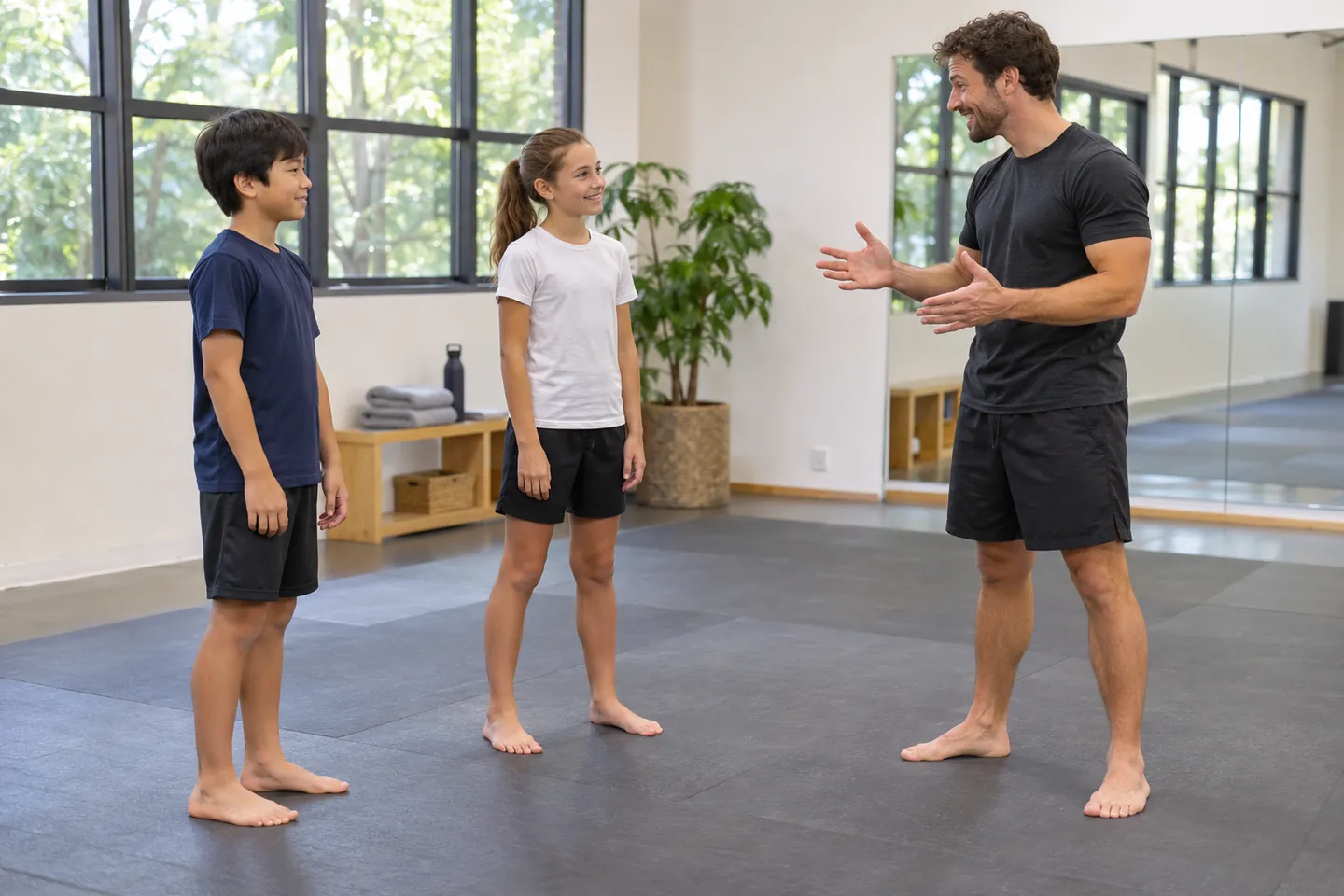
Explore partner cooperation in kids martial arts in Mississauga with clear roles, respectful stop signals, supervised activities, and useful parent conversations.
Working with a partner asks something different from copying a coach alone. A child needs to understand their own role while noticing another person’s readiness, space, and instructions. They may have to wait, switch tasks, or speak when something is unclear. These small exchanges are part of the learning experience, even when the activity itself looks simple from the parent seating area.
Partner cooperation in kids martial arts in Mississauga should develop within clearly explained, supervised activities. Parents can support the idea of cooperation without recreating drills at home or assuming that every paired exercise involves contact. Ask the coach what the current task includes and how children are taught to work together. The details matter more than a broad promise that martial arts automatically creates teamwork.
Understand the purpose of the paired activity
Ask the instructor what children are meant to learn from a particular partner task. The purpose may involve taking turns, following a signal, or completing an assigned role. Knowing that aim helps parents interpret what they see. A child waiting quietly may be doing exactly what the exercise requires rather than failing to participate.
Do not assume every partner activity is a contest. Some tasks work only when both children cooperate at a predictable pace. Turning them into a race can change the lesson. Encourage your child to follow the coach’s goal rather than deciding that the most successful student is always the fastest or loudest.
If the activity includes equipment or contact, ask how it is introduced and supervised for that group. Understand the actual expectations rather than relying on photographs or terminology. The coach should explain the roles and boundaries before children begin. Parents can then reinforce the same boundaries in ordinary language.
Make roles clear before starting
Children need to know who begins, what each person does, and when the roles change. These details can be easy to miss while watching the main movement. A useful question for a child to learn is, “What is my job first?” It directs the instructor to the part of the exercise that needs clarification.
If your child often becomes confused during partner tasks, describe the pattern to the coach. Perhaps they understand the action but not the handover. Perhaps they start when the other child is still preparing. Specific observations help the instructor choose a clearer demonstration or a smaller starting task.
Avoid solving the role confusion by calling instructions from the sideline. The child may then rely on a parent while the partner follows the coach, creating two different versions of the drill. Use the gym’s communication process and let the instructor establish the shared plan for both students.
Treat readiness as something to check
A partner should not be surprised by the start of an activity. Children need to follow the coach’s signal and any readiness process taught in class. This habit can be explained simply: both people should know what is happening before the exercise begins. It applies whether the task involves movement, equipment, or an ordinary turn-taking game.
If a child is uncertain, they should be able to pause and ask. Help your child practice the words outside class without reenacting the drill. “Are we starting now?” or “Can the coach show us?” are clear, useful phrases. They make communication part of participation rather than something reserved for emergencies.
Parents can recognize this behaviour afterward. Mentioning that a child waited until the partner was ready gives cooperation a concrete form. It is more useful than praising only the visible movement. The setup and communication help create the conditions in which the movement can be learned.
Make stop signals nonnegotiable
Ask how the class teaches children to stop an activity. Both partners should understand the signal and respond immediately. A stop should not require an argument about whether the other child is allowed to use it. The coach can clarify the situation after the activity has paused.
Explain that respecting a stop is part of being a good partner. It is not losing, giving up, or allowing someone else to control the game unfairly. A supervised exercise depends on clear boundaries, and stopping when asked protects those boundaries. The child should also know they can ask the instructor for help.
Do not practice this idea through rough sibling play. Use ordinary noncontact games or conversations if you want to reinforce it at home. Martial arts techniques should remain within the instructed setting, and children should not use family members as targets. The home boundary is clear even when everyone appears enthusiastic.
Let different abilities coexist
Partners may have different levels of experience or confidence with the task. The coach should decide how students are matched and what adjustments are appropriate. Children can learn that cooperation means following the agreed exercise, not forcing the other person to perform at a preferred pace.
Avoid praising a child for carrying the whole pair or criticizing them for being the slower partner. Those descriptions can make the relationship feel like a ranking. Instead, ask whether they understood their role and communicated when needed. The instructor can address technical differences without turning them into personal labels.
If your child repeatedly feels mismatched or uncomfortable, speak with the coach privately. Describe the situation and ask how pairing is managed. Do not approach another child directly with instructions or criticism. The instructor is responsible for the class arrangement and should have the opportunity to respond.
Distinguish helping from taking over
A child who remembers the task may want to coach the partner. Sometimes a simple reminder is part of the activity; sometimes it interferes with the instructor’s lesson. Ask what kind of peer feedback the coach encourages. Children need clear limits around their responsibility for another student’s learning.
Helping may mean waiting, listening, or asking the coach to demonstrate again for both people. It does not necessarily mean giving a detailed correction. A student can be cooperative without becoming an authority over the partner. That distinction is especially useful when siblings or close friends work together.
At home, avoid assigning the more experienced child the job of teaching martial arts to another child. They may not understand the full instruction or how to supervise the activity. Let them share enthusiasm through conversation, while technical questions and practice remain with the coach.
Respond to disagreement without assigning instant blame
Children may disagree about whose turn it is or what the instruction meant. Encourage them to pause and ask the instructor rather than settling the disagreement through louder voices or unexpected movement. A shared demonstration can resolve a misunderstanding more clearly than competing explanations.
If your child describes a difficult interaction afterward, listen to the account and ask what happened before and after the moment. Avoid immediately deciding that the partner was careless or that your child must have misunderstood. You may have only part of the story. Bring a specific concern to the coach for context.
The aim is to restore a workable learning arrangement, not win an argument between families. Ask what the children are being taught to do when confusion occurs and how your child can use that process. Clear procedures help turn an ordinary disagreement into another opportunity to practice communication.
Notice cooperation beyond the drill
Partner habits also appear during equipment handovers, movement between stations, and the end of class. A child may make room for another student, return a shared item, or wait for an instruction before changing roles. These actions contribute to the learning environment even when they are less visible than a technique.
Recognize one specific example when it fits naturally. Avoid turning every cooperative act into a reward negotiation. The child can understand that sharing a class includes ordinary responsibilities to other people. Appreciation is useful when it names the contribution without making every helpful action a transaction.
Keep expectations realistic. A child may cooperate well in one situation and struggle in another. Ask what was different about the task before deciding that progress has disappeared. The coach can help identify whether the next step involves clearer roles, a simpler activity, or more practice with a familiar routine.
Support a shared learning culture
Ask the child to remember a moment when a partner made the task easier to understand. Perhaps the other student waited, repeated the agreed signal, or suggested asking the coach together. Discussing that example gives cooperation a recognizable shape. It also helps the child notice contributions from others, rather than viewing a successful round only as evidence of their own performance.
Parents help shape the meaning children attach to partner work. If every car ride focuses on who performed best, cooperation may begin to sound secondary. Ask instead what made the activity work for both people and what they would ask the coach next time. These questions keep attention on the shared task.
Explore kids martial arts at Konga and use the free trial page to ask about current beginner activities and supervision. A useful introduction should make roles, boundaries, and communication understandable. Partner cooperation grows through those ordinary practices: knowing the task, respecting a pause, taking a turn, and helping the other student participate without taking over their learning.
Filed under
Keep exploring
More training insights await.