
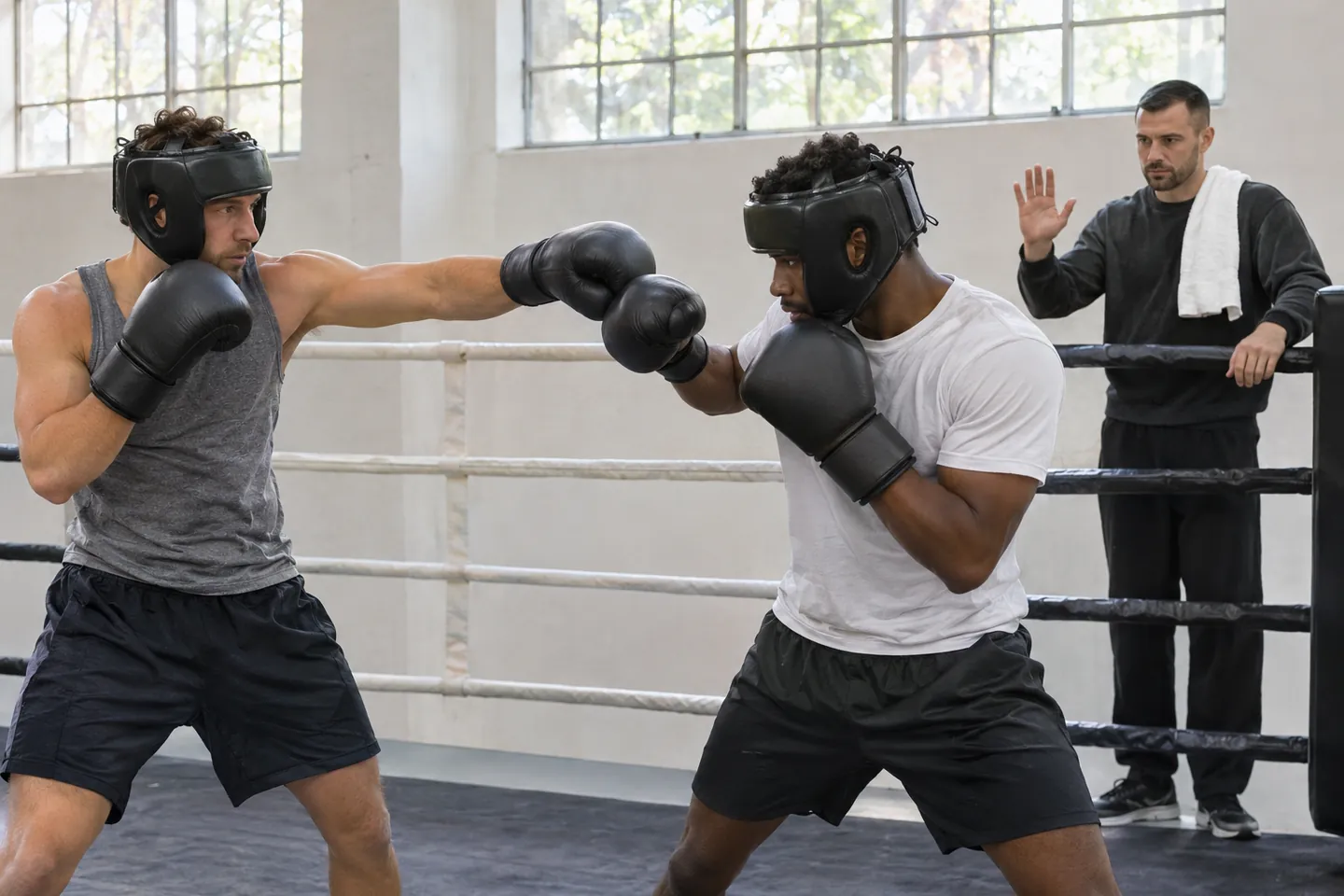
Wondering if you're ready for light sparring in Mississauga? Learn the skills, habits, equipment and coach conversations that usually come first in boxing.
Most people who join a boxing class spend their first weeks hitting pads, bags and the air in front of a mirror. Sooner or later, someone in the room starts gearing up with headgear and a mouthguard, and a quiet question appears: when do I do that? For some beginners the question arrives with excitement. For others it comes with a knot in the stomach. Both reactions are normal.
Light sparring in Mississauga gyms is usually treated as a stage of learning rather than a test of toughness. It is a controlled exercise in which two people practise boxing skills against a moving, thinking partner, with reduced power and a clear agreement about intensity. Being ready for it has less to do with how hard you can punch and more to do with whether you can stay composed, follow instructions and look after the person in front of you.
This post walks through the signs that often suggest you are approaching that stage, the gaps that suggest you are not there yet, and how to have a useful conversation with your coach about it. Nothing here replaces the judgement of the person who actually watches you train. Think of it as a way to organise your own observations before you ask.
What “light” actually means
The word light gets used loosely, so it helps to define it before deciding whether you are ready. In a well-run session, light sparring means punches land with a touch rather than a thud. The goal is to show that an opening existed, not to exploit it. Both partners move at a speed where they can see what is coming and respond, and either one can slow things down at any moment.
It also means the exercise has a purpose. A coach may ask a pair to work only the jab, or to have one person attack while the other defends, or to practise moving off the ropes. These limits keep the round focused and make it easier for both people to keep the pace honest. Open, unrestricted sparring is a different activity, and many recreational boxers never need it.
If your picture of sparring comes from fight footage, adjust it. The rounds you see on television involve experienced athletes with a very different aim. The light rounds you might do in a class look slower, quieter and more conversational. Partners often stop to laugh, reset or ask a question. That is not a lesser version of boxing. It is the version where learning happens most reliably.
Your basics hold up when you are tired
One of the clearest signals of readiness is that your stance, guard and footwork do not fall apart late in a session. Anyone can hold a tidy position in the first round of pad work. The more useful question is what happens in the last few minutes, when your shoulders are heavy and your breathing is loud.
Watch yourself, or ask a coach to watch you, during the final rounds of bag work. Do your hands drift down to your chest? Do your feet end up square, or crossed? Does your chin lift as you get tired? These habits matter in sparring because fatigue arrives quickly when someone is moving and punching back. If your fundamentals still look recognisable when you are worn out, you have a foundation that can handle a partner.
This does not require perfection. Every boxer’s form slips somewhat under fatigue. What you are looking for is a position you can return to without thinking hard, so that your attention is free for the person in front of you rather than consumed by remembering where your rear hand belongs.
You can defend, not just attack
Beginners often spend more time learning punches than learning how to avoid them, simply because punches are more fun and easier to drill alone. Before sparring, though, defence becomes the priority. You should be comfortable with at least a few basic responses: keeping a high guard, catching or parrying a jab, rolling or slipping a straight punch at slow speed, and stepping out of range.
Partner drills are where this is tested. If your coach has paired you up for slow, pre-arranged exchanges, notice how you react when a glove comes toward your face. Do you close your eyes? Turn your head away? Freeze? These are natural reflexes, and they soften with repetition. Someone who can keep their eyes open and respond calmly to a slow punch is in a much better position to spar safely than someone who flinches at every movement.
It also helps to be honest about whether you know what to do after you defend. A parry followed by nothing is fine at first, but sparring is easier when you have a simple answer ready, such as a jab back or a step to the side. Your coach can suggest one or two responses to practise until they feel automatic.
You can control your own power
Control is the skill that most directly protects your partner. In light sparring, the person who cannot manage their power becomes a problem very quickly, because the other person has to raise their own intensity to stay safe. Before you spar, you should be able to throw a punch at a chosen percentage of effort and actually hit that number.
There is a simple way to test this during pad work. Ask your coach to call out different intensities and see whether your punches change accordingly. Many people discover that their “half speed” is close to full speed, especially on the rear hand. Others find that their power creeps upward as a round goes on, without their noticing. Both patterns are worth working on before a partner is involved.
Control also includes reactions. When you get tagged with a light punch, the instinct for many people is to fire back harder. Noticing that instinct, and choosing to stay at the agreed level, is a sign of maturity in the sport. Coaches tend to trust students who show this kind of restraint, because it makes the whole room safer.
Your conditioning supports the round
A light sparring round still asks a lot of your body. You are moving constantly, holding your hands up, breathing under stress and making decisions. If you are gassed after one minute of shadowboxing, a sparring round will feel overwhelming, and tired people make poor choices about defence and control.
You do not need elite fitness. You do need enough to complete a few rounds of technical work without your guard collapsing. Regular attendance at boxing classes, plus some general conditioning, usually builds this over time. Many members in Mississauga find that a couple of weeks of consistent training, rather than occasional heroic sessions, does more for their stamina than anything else.
Pay attention to recovery too. If you are still sore and sluggish two days after a hard class, your body may need more time to adapt before you add the extra demands of sparring. Sleep, hydration and sensible scheduling around work and family all play a part. It is far better to arrive at your first sparring session fresh than to squeeze it in after a long shift and a slow drive home on the 401.
Your head is in the right place
Readiness is partly a matter of attitude. Ask yourself why you want to spar. Good reasons include wanting to test your skills in a more realistic setting, enjoying the problem-solving of a live partner and wanting to understand boxing more fully. Less helpful reasons include wanting to prove something, settle a score with a training partner or impress someone watching.
It also helps to be comfortable with being hit lightly and with looking clumsy. Your first rounds will probably feel chaotic. You may forget everything you drilled, run out of breath quickly and get caught by the same punch several times. That is part of the process, and the people around you went through it as well. If the possibility of looking awkward feels unbearable, give yourself more time in partner drills first.
Finally, consider your nerves. A little anxiety is normal and can even sharpen your attention. Overwhelming fear, though, tends to make people tense up, hold their breath and either freeze or swing wildly. If you notice strong anxiety, say so. A good coach can design a gentler entry point, such as defence-only rounds or very slow technical exchanges.
Health and equipment checks
Before any contact work, take a moment to consider your health. If you have a history of concussion, a heart condition, high blood pressure, recent surgery, an eye condition or any ongoing medical concern, speak with your doctor before sparring, and tell your coach what you have been advised. This is not a formality. Contact sports carry real risks, and the people responsible for your training need accurate information.
Equipment matters as well. Light sparring usually calls for heavier, well-padded gloves rather than the bag gloves you might use for pad work, along with a properly fitted mouthguard. Headgear is common in recreational settings. Ask your coach exactly what is expected at your gym and which glove weight they recommend for your size. A mouthguard that has been fitted correctly is far more comfortable, and more protective, than one fresh out of the package.
Keep your gear clean and in good condition. Gloves with collapsed padding or torn lining should be replaced. Hand wraps should be washed regularly. Small details like these make the experience safer and more pleasant for everyone in the ring.
Signs you may want to wait a little longer
It is just as useful to recognise when you are not ready. If you still need reminders about your basic stance in most classes, if your defence disappears when you get tired, or if you find it hard to keep partner drills at the requested pace, it is worth building those skills further before you spar.
Another sign is that you feel pressured. Maybe a friend keeps urging you to jump in, or you feel you are falling behind people who joined at the same time. Readiness is individual. Some people spar within a few months; others train for much longer before they want to, and some never spar at all and still get enormous value from boxing. None of these paths is wrong.
If you are recovering from an injury, managing a busy period at work, or not sleeping well, those are also reasonable reasons to wait. The skill of sparring will still be there when your life has a little more room for it.
Talking to your coach about it
The most direct way to find out whether you are ready is to ask. Choose a quiet moment before or after class rather than interrupting a drill. You might say something like, “I’ve been thinking about trying light sparring at some point. What would you want to see from me first?” This frames the conversation around learning rather than permission.
Listen carefully to the answer. Your coach may point to specific habits, such as dropping your rear hand when you jab, or suggest a particular drill to work on. They may also say you are ready now and invite you to a supervised round. Either way, you leave with something concrete.
Be honest about your experience and concerns. If you are nervous, say so. If you have done some sparring before at another gym, explain what it was like. The more information your coach has, the better they can match you with a suitable partner and set an appropriate intensity.
What a first round often looks like
When the moment comes, your first light sparring round will likely be short and carefully structured. A coach may pair you with a more experienced member who is skilled at controlling the pace. The two of you will touch gloves, agree on the intensity, and begin moving.
Expect to feel a rush of adrenaline. Your breathing may quicken and your vision may narrow slightly. Focus on a few simple things: keep your hands up, keep breathing, use your jab and move your feet. Your partner is there to help you learn, not to win the round. If at any point you feel uncomfortable, you can step back, raise a glove and say “stop” or “slow down.” Good partners will respond immediately.
After the round, take a few minutes to reflect. What felt manageable? What surprised you? Did you remember to breathe? Write a few notes if that helps. These observations will guide your next sessions in the regular classes, and they give your coach something specific to build on.
Being a good partner from day one
Sparring is a shared activity, and your responsibilities extend beyond your own safety. Arrive with clean gear and trimmed nails. Match your partner’s intensity rather than escalating. If you land a cleaner punch than intended, acknowledge it and ease off. If your partner is clearly struggling, slow down and give them space to reset.
These habits make you someone people want to train with. In a community gym, reputation travels quickly. Members who are known for control and respect tend to get better partners and more useful rounds, which in turn speeds up their own development.
Taking the next step
Readiness for light sparring is built from many small things: a steady stance, reliable defence, controlled power, enough conditioning to stay composed, and a clear head about why you want to do it. None of these arrive overnight, and all of them improve with consistent, supervised practice.
If you are training in Mississauga and want to keep building toward that stage, our boxing classes give you structured technique work, partner drills and coaching from people who can tell you honestly where you stand. You can check the adult schedule for sessions that fit around your week, or book a free trial if you have not started yet. The first conversation with a coach is often the most useful step of all.
Filed under
Keep exploring
More training insights await.