
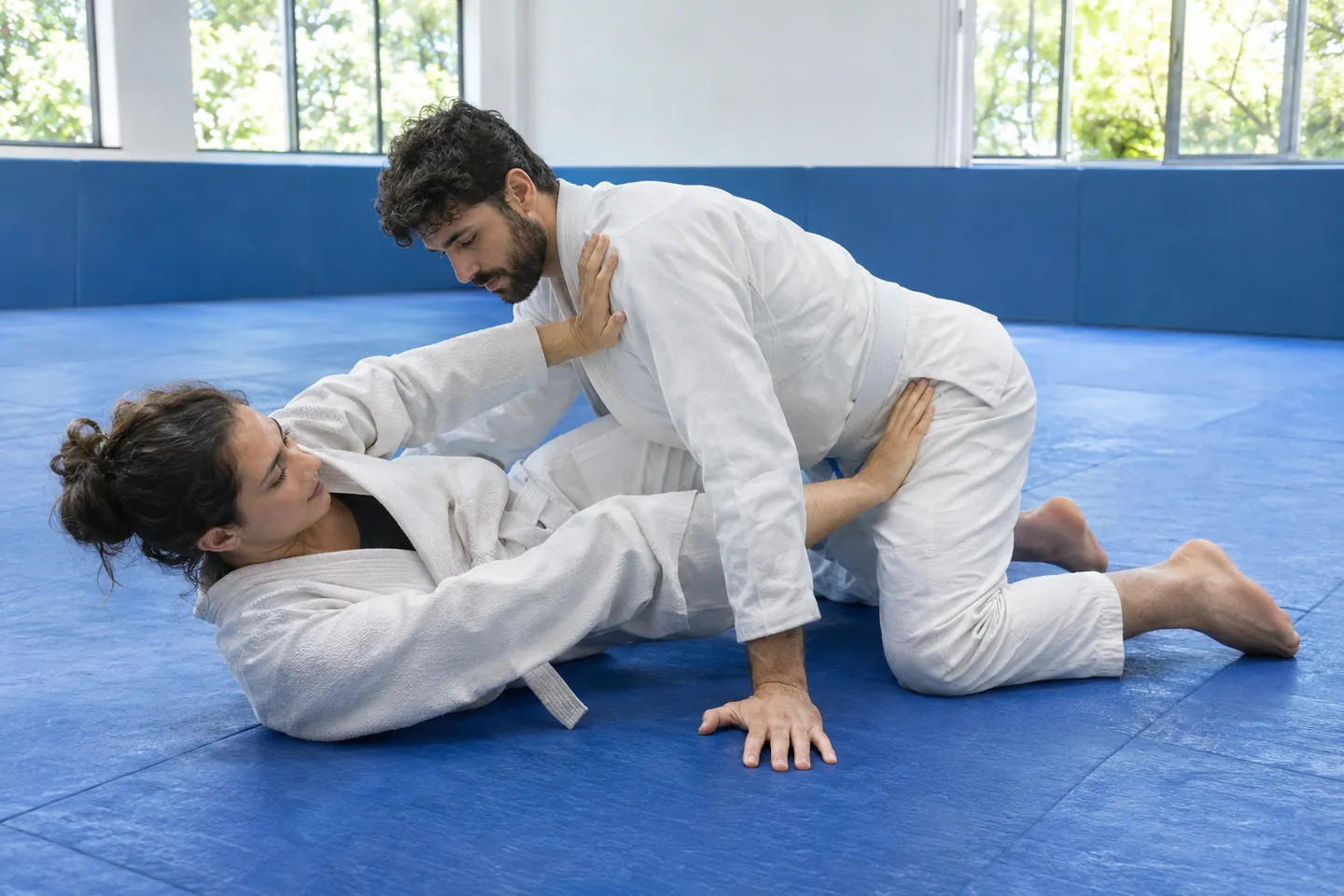
A beginner's guide to learning Brazilian jiu-jitsu escapes in Mississauga, covering breathing, frames, hip movement, patience, and drilling bottom positions safely.
Almost every beginner in Brazilian jiu-jitsu has the same early experience. A training partner settles on top, the weight feels enormous, and suddenly breathing takes conscious effort. The instinct is to push hard with both arms, which works for about three seconds before your shoulders burn and nothing has changed. Then the round ends, and you wonder what you were supposed to do.
That moment is exactly why escapes matter so much in the first months of training. Before you can think about sweeps or submissions, you need to be able to stay calm on the bottom and work your way back to a safer position. Escapes teach patience, structure, and timing in a way that few other parts of the art can.
If you are learning Brazilian jiu-jitsu in Mississauga, or thinking about starting, this guide explains how beginners can approach escapes with less frustration. It is not a technique manual. Your coach will show you the specific movements. Instead, it covers the mindset and habits that help those movements make sense.
Escapes are about position, not panic
The word “escape” suggests something sudden and explosive, but most escapes in jiu-jitsu are slow and methodical. You are rarely trying to throw someone off you in one motion. You are building a sequence of small improvements: creating a little space, protecting your neck and arms, turning onto your side, and gradually recovering a guard or getting back to your knees.
Thinking of escapes as a series of steps changes how you behave under pressure. Instead of looking for one big burst, you look for the next small thing you can improve. Can you get your elbow inside? Can you turn your hips a few degrees? Each small gain makes the next one more possible.
This also makes escapes less exhausting. Explosive efforts against a heavier or more experienced partner drain energy quickly. A patient, structured approach lets you keep working for an entire round, which matters a great deal when you are still building conditioning.
Breathing comes first
When someone is on top of you, your chest and diaphragm may be compressed, and your breathing can become fast and shallow without you noticing. Fast, shallow breathing tends to feed the sense of panic, which makes clear thinking harder. Learning to breathe steadily from the bottom is one of the most underrated skills in jiu-jitsu.
Try to notice your breath at the start of each round. If you can, exhale slowly and deliberately. Some people find it helpful to turn slightly onto one side, which often relieves direct pressure on the chest. Your coach may have specific suggestions for breathing in particular positions, and those are worth asking about.
If you ever feel genuinely unable to breathe or in pain, tap. Tapping is not failure; it is how training partners keep each other safe. Every experienced practitioner has tapped thousands of times. A good training room in Mississauga or anywhere else treats the tap as a normal and respected part of practice.
Frames instead of pushes
One of the first concepts most coaches introduce for escapes is the frame. A frame uses the structure of your bones, typically your forearms and shins, to hold space rather than muscling your partner away. The difference is subtle at first but becomes obvious with practice.
When you push with straight arms, you are using muscle, and muscle tires. A partner can also use straight arms against you, for example by catching an arm and isolating it. A frame, by contrast, often places your forearm across your partner’s hip, collarbone, or neck area in a way that blocks their movement without requiring constant effort.
Ask your coach to show you where frames go in each escape you are learning, and why. Understanding the purpose of each frame helps you place it correctly even when the position is slightly different from the drill. Frames are less about strength and more about angle and placement.
Moving your hips is the engine
Frames create space, but your hips are what use it. Most escapes involve moving your hips away from your partner, turning onto your side, or bridging to shift their weight. The classic movement many beginners drill is often called shrimping, a sideways hip escape that slides your body away from pressure.
Hip movement can feel awkward at first, especially if you are not used to moving on the ground. Solo drills at the start of class are there for a reason. Moving up and down the mat with hip escapes and bridges builds the coordination you will need when a partner adds weight. It is worth taking these drills seriously rather than rushing through them.
If you have any back, hip, or neck concerns, mention them to your coach before training. Some movements can be modified. If something persists or worries you, a physiotherapist or other qualified health professional can help you understand what is going on. Our physiotherapy team is one option if you want an assessment.
Protect first, then escape
A common beginner mistake is trying to escape while leaving the neck or arms exposed. An experienced partner will often use the moment you reach or push to set up a submission. Learning to protect yourself before you try to move is a habit that saves a lot of frustration.
Coaches often describe a defensive posture: elbows tight to your sides, hands near your neck, chin slightly tucked. From that posture, you can wait for an opportunity rather than creating one by reaching. It feels passive, but it is actually an active choice to stay safe while you watch for your partner’s weight to shift.
Once you feel safe, you can begin the escape sequence. This order matters. Protect, then create space, then move your hips, then recover. If you skip the first step, you may find yourself solving a new problem, such as an arm lock, rather than the original one.
Start with the most common positions
Escapes exist for many positions, but beginners usually start with a small set. Mount, side control, and back control are common starting points because they are positions you will find yourself in frequently during your first months of rolling. Each has its own priorities and typical escapes.
Rather than trying to learn every variation at once, focus on one or two escapes for each position. Drill them until you can perform them smoothly against a cooperative partner, then gradually add resistance under your coach’s guidance. Depth with a few techniques serves you better than a shallow familiarity with many.
Keep a simple training notebook if it helps. After class, write down the position, the escape you practised, and the one detail your coach emphasised. Over a few weeks, you will have a small personal reference that reflects exactly what you have been taught.
Drilling with a good partner
Escapes are learned through repetition with a partner who understands the drill. In the early stages, your partner should give you realistic but cooperative pressure, allowing you to complete the movement correctly. Then, as your understanding improves, they can gradually add more resistance.
Communicate with your partner. If they are pressing too hard for the stage of the drill, say so politely. If they are too light and you are not feeling the position realistically, ask them to add a bit more weight. Most training partners appreciate clear communication; it makes the drill more useful for both of you.
When you are the top partner, remember that your job is to help your partner learn. Hold the position the way the coach described and let them work. You will be on the bottom soon enough, and you will want the same consideration.
Positional sparring builds real escapes
Many classes include positional sparring, where one partner starts in a dominant position and the other tries to escape. These rounds are where drilled techniques start to become practical. They are also where frustration can be highest, because escapes that worked in drilling suddenly seem impossible.
Be patient with this phase. Positional rounds are meant to be difficult. Success is not measured only by whether you escaped. Did you keep your breathing steady? Did you protect your neck? Did you create a frame and hold it? These are all signs of progress, even if the round ended with your partner still on top.
Your coach may set specific goals for these rounds, such as reaching a particular frame or recovering a half guard. Following those goals, rather than trying to win the round, helps you build the skill in layers.
Expect slow, real progress
Escapes are one of the areas where progress in jiu-jitsu is easiest to notice over time, but it does not happen quickly. In the first weeks, you may feel stuck in nearly every bottom position. After a couple of months, you might notice that you stay calmer, that you lose less energy, and that occasionally you get back to guard.
These changes are meaningful even if they seem small. Being able to stay composed under a heavier partner is a skill that carries over into the rest of your training and arguably into life outside the gym. Many people find that learning to wait calmly while uncomfortable is one of the most valuable things jiu-jitsu teaches.
Try not to compare your escapes with those of training partners who have been on the mat for years. Compare yourself with where you were last month. That is a fairer and more motivating measure.
Bringing it into your training week
Adult schedules in Mississauga can be tight, between commutes on the 401 or 403, shift work, and family commitments. When you do get to class, try to arrive with a clear goal. If your coach has been teaching side control escapes, decide that today you will focus on getting the first frame right. A single focus makes your time on the mat more productive.
Outside class, light solo movement such as hip escapes and bridges on a mat at home can help with familiarity, as long as you stick to what you have been taught and keep it gentle. Avoid trying new techniques from videos without discussing them with your coach first. They may conflict with what you are learning or skip important safety details.
Rest matters as well. Escapes require a lot of effort from the hips, core, and shoulders. If you are feeling unusually sore, take that into account when planning your next session.
Ready to learn on the mat
If you want to develop calm, practical escapes with coaching that starts at the beginner level, explore our Brazilian jiu-jitsu classes and see what times fit on the adult schedule. New students are welcome to book a free trial and experience a class before making any commitment. Learning to escape is one of the most rewarding parts of starting jiu-jitsu, and it begins with a single steady breath on the bottom.
Filed under
Keep exploring
More training insights await.