
How beginners in Mississauga can learn Muay Thai elbow strikes safely, from shadow drills and pad work to partner etiquette and controlled, coached progress.
There is a reason Muay Thai is called the art of eight limbs. Alongside punches and kicks, it uses knees and elbows, and those last two give the sport much of its distinctive close-range character. For many newcomers, elbows are both the most intriguing part of the curriculum and the most intimidating. They look sharp, fast and a little dangerous, because they are.
That is exactly why elbows deserve a slower, more careful introduction than almost anything else in the striking toolbox. Learning Muay Thai elbows safely in Mississauga is less about finding a hidden trick and more about respecting the technique: building the shape in the air, landing it on appropriate equipment, and practising with partners in ways that keep everyone training next week.
This article is for adult beginners who have started Muay Thai, or are thinking about it, and want to understand how elbow work is usually approached in a responsible gym. Your coach’s instructions always come first; what follows is context to help you get more from those instructions.
Why elbows are taught later
In most classes, new students spend their first sessions on stance, footwork, the basic punches and the round kick. Elbows usually arrive a little later, once you can stand in a balanced position, turn your hips and keep your guard reasonably organised. That order is deliberate. An elbow is a short-range strike thrown close to your partner, and doing it well depends on fundamentals that are already in place.
Elbows also carry more risk than most strikes. The point of the elbow is hard and narrow, and even a light, accidental connection can cause a cut. In professional bouts, elbows are a common reason for cuts. In a recreational class, the goal is the opposite: to learn the movement without ever landing one on a partner’s face.
So if your coach keeps you on jabs and teeps for a while before introducing elbows, that is not a sign that you are behind. It is a sign that the gym is building your base properly. When elbows do arrive, you will be in a much better position to learn them well.
The shapes you are likely to meet
There are several elbow variations, and different coaches group them differently. Common ones include a horizontal elbow that travels across in a slicing line, an uppercut elbow that rises from below, a downward elbow that drops from above, and a spinning elbow that comes from a turn. You will not learn them all at once.
Most beginners start with the horizontal elbow, because its path is relatively easy to see and it connects naturally to the body rotation you have already practised in punches. The uppercut elbow often follows. Downward and spinning variations tend to be left for later, once control and spatial awareness are more developed.
Ask your coach which variation you are working on in each drill. The names can blur together at first, and trying to mix several shapes in one round usually produces none of them clearly. One shape, done with attention, is a better day’s work than four rushed ones.
Building the movement in the air
The first stage is usually shadowboxing or slow practice without a target. You might stand in front of a mirror, raise the elbow into position, turn through the hips and shoulders, and let the striking surface travel along its intended path. The hand of the striking arm stays close to your own head rather than flying away.
Speed is not the goal here. You are checking that the shoulder rotates rather than just the arm swinging, that your balance stays over your feet, and that your other hand is still protecting your face. Slow repetitions show up problems that speed would hide. If something feels awkward, it is much easier to fix now than after hundreds of fast repetitions.
Pay attention to how you finish. A completed elbow should leave you in a position from which you can recover your guard or continue into another technique. If you are spinning off balance or leaning far past your feet, the strike has gone beyond what you can control. Ask the coach to watch one or two repetitions and give you one thing to adjust.
Landing on pads and bags
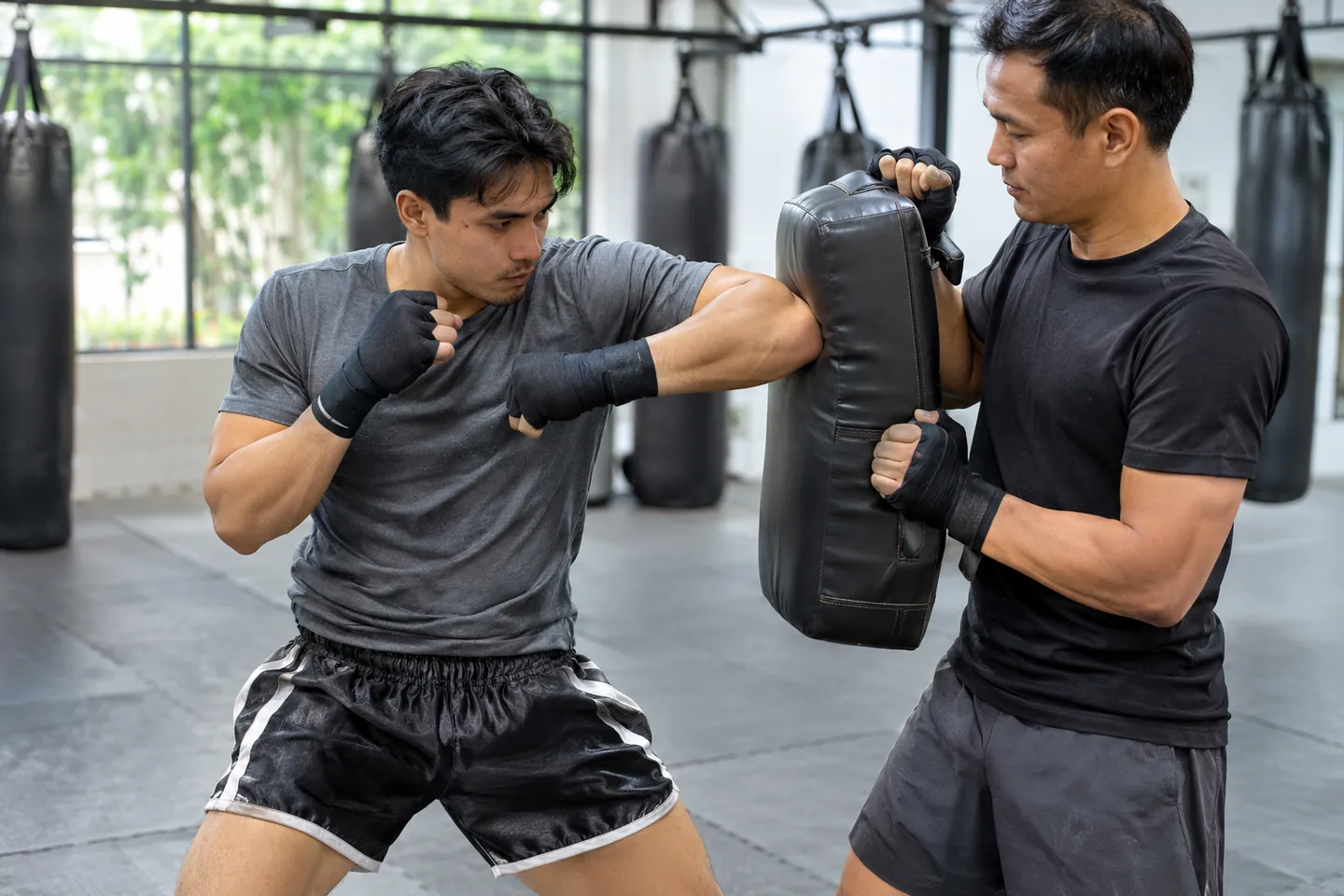
Once the shape is familiar, coaches typically introduce a target. Thai pads and thick strike shields are common choices, because they offer a broad surface and good padding. Heavy bags are another option, although some gyms prefer pads at first so a holder can adjust the angle and give feedback.
Start at a controlled pace and moderate intensity. The aim is to land with the intended part of the arm, at the intended angle, from the intended distance. If you are reaching too far, you may hit with the forearm instead. If you are too close, the elbow can get jammed. Your coach will help you find a distance that suits the drill.
Remember that the pad holder is a person. Their hands and forearms are behind that pad, and an elbow that slips off the edge can find them. Strike the centre of the target, communicate if you feel unsure, and stop if the holder changes position unexpectedly. Good pad work is a cooperative exercise, not a test of how hard you can hit someone else’s arms.
Holding pads for elbows
Holding pads for elbow work is a skill in its own right. For horizontal elbows, holders commonly angle a Thai pad so the surface meets the striking arm at a sensible angle, with their own head well out of the line of travel. For uppercut elbows, the pad may be held lower and angled differently. Your coach will demonstrate the hold for each drill.
Keep your arms firm without locking your elbows straight, and stay alert. If you are unsure what your partner is about to throw, ask them to tell you before each set. When a partner is tired or rushing, it is fine to say so and slow the pace down. Many minor injuries in pad work come from fatigue and miscommunication rather than from any one dramatic mistake.
Swapping roles regularly helps both people improve. Holding teaches you to see the technique from the outside, which often makes your own elbows clearer when it is your turn to strike. Many experienced students say they learned some of their most useful corrections while holding pads.
Partner drills without contact
At some point, you may practise elbows in partner drills that do not involve pads. In a responsible recreational setting, these drills are typically done with no contact to the head and often with the elbow stopping short or touching only a gloved hand or forearm. The purpose is timing and distance, not impact.
Shoulder-to-shoulder clinch drills sometimes include elbow entries, where you practise creating the space and angle for an elbow while your partner responds. Again, the strike itself is usually shown, not landed. Listen carefully to the coach’s instructions about where to place the elbow and how much speed to use.
If a partner is going harder than the drill calls for, it is reasonable to ask them to slow down. If they continue, step away and let the coach know. Elbows magnify the consequences of poor control, and gyms that take them seriously expect everyone to protect each other.
Elbows and sparring rules
Many recreational gyms do not include elbows in regular sparring at all. Others allow them only with specific protective equipment, between experienced partners, and with clear agreements about intensity. The rules vary, and it is entirely normal for a club’s general sparring to leave elbows out.
If your gym does allow elbows in some form of sparring, it will usually be well after you have trained for a long time and have shown consistent control. There is no hurry. You can enjoy Muay Thai for years, and even compete in some formats, without ever throwing a live elbow at a training partner’s head.
Always follow the rules set for each round, and confirm them with your partner before you touch gloves. If you are unsure whether elbows are allowed, assume they are not. That habit alone prevents a lot of avoidable problems.
Looking after your own elbow joint
Throwing elbows repeatedly can also be demanding on your own body. The shoulder rotates quickly, the trunk twists, and the arm folds tight. A thorough warm-up that includes the shoulders, upper back and hips makes the movement feel smoother. Cold, stiff joints tend to complain under fast rotational work.
When you strike pads, land with the area your coach describes rather than the point of the joint in a way that feels sharp or jarring to you. If you notice discomfort in your own elbow, shoulder or neck that lingers after class, reduce the volume and speak with a qualified professional. Our physiotherapy and massage services are available to members who want help managing training aches, though any assessment and advice will come from those practitioners directly.
Building general strength in the shoulders and upper back can also help you handle rotational striking. Many members who train Muay Thai two or three times a week in Mississauga add a session of strength and conditioning to round out their week.
Patience and gym culture
There is a temptation, especially after watching fight highlights, to want to throw beautiful elbows early. Those highlights reflect years of training, coaching and conditioning. They also come from a competitive context with very different rules to a weeknight class in a Mississauga gym where people need to be at work the next morning.
The culture of a good gym makes patience feel normal. Coaches progress elbows carefully, experienced students model control, and newcomers learn that the most respected people on the mats are often the ones who make their partners feel safe. That is the environment worth looking for, and the one we aim to create.
Treat elbows as a privilege that comes with responsibility. When you take that view, the technique becomes something to refine with care rather than something to show off, and the whole room benefits.
Starting Muay Thai at Konga Fitness
Elbows are part of what makes Muay Thai distinctive, and learning them thoughtfully is one of the rewarding stages of progressing in the sport. Begin with the shape, add targets slowly, respect your partners, and let your coach decide when you are ready for each new step.
If you would like to explore the sport with that kind of careful coaching, take a look at our Muay Thai program page, or book a free trial to experience a class at our Timberlea Boulevard gym in Mississauga before committing to anything.
Filed under
Keep exploring
More training insights await.