
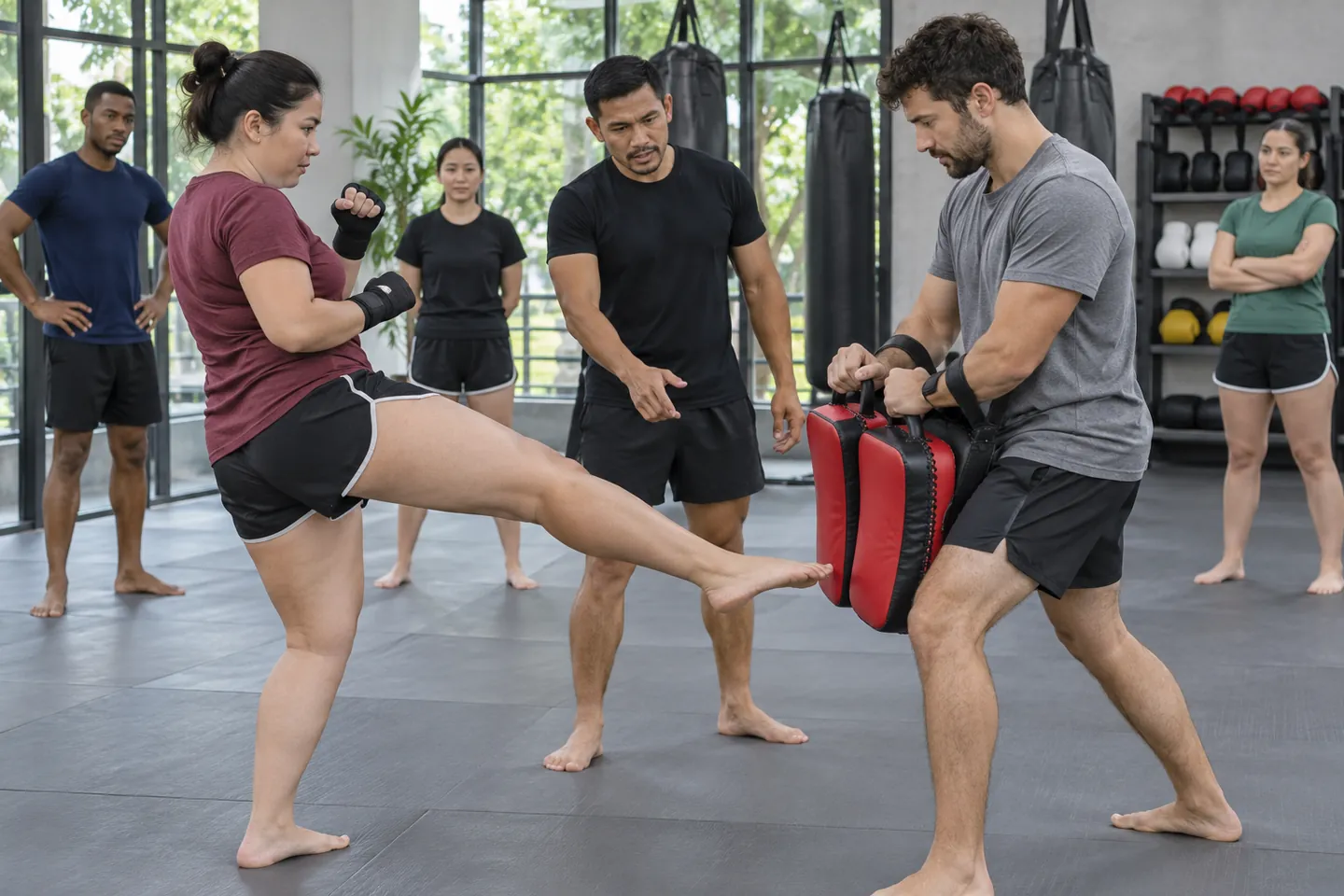
Approach Muay Thai kicks in Mississauga with sensible beginner goals, coach-led progressions, equipment questions, and practical ways to review each lesson.
For many new students, kicks are the reason Muay Thai first catches their attention. They look athletic, coordinated, and completely different from an ordinary gym exercise. Then the first lesson arrives, and a seemingly straightforward movement asks you to think about your feet, balance, hands, distance, and return all at once. The gap between watching and doing can be surprising.
Learning Muay Thai kicks in Mississauga is easier to approach when the first goal is understanding rather than height or impact. A coach can observe the whole movement and choose a manageable starting point. Your part is to follow that progression, explain what feels unclear, and give the lesson enough patience to become familiar. There is no requirement to make the opening attempts look dramatic.
Decide what you want from the lesson
Before class, consider whether you are interested in learning a sport, finding an engaging exercise routine, or developing a new physical skill. Share that with the coach. It gives context to your questions and helps keep expectations realistic. A beginner who wants a regular recreational activity does not need to borrow the goals of someone preparing for competition.
It also helps to name the concern underneath your excitement. You might worry about balance, coordination, or whether a past limitation will affect the exercise. Explain the practical issue clearly. A coach can discuss class modifications, and a healthcare professional can address individual medical questions where needed. Neither conversation requires pretending that everything feels easy.
Avoid promising yourself a specific kick height by a particular date. That target can encourage you to chase an appearance before understanding the movement. A more useful early goal is to recognize the coach’s starting position, follow the assigned action, and finish under control. Those are things you can discuss and review during a lesson.
Watch the complete demonstration
When a coach demonstrates a kick, it is natural to watch the moving leg. Try to also notice the beginning and the finish. Where does the student start relative to the equipment? What happens before the kick? How does the coach return to the position used for the next repetition? The full sequence provides context that a single striking moment cannot.
Ask to see the movement again if you lose a part. A useful question identifies the missing information: “Can you show the return once more?” is easier to answer than “Can you explain everything?” You are allowed to need a second look. A demonstration is instruction, not a test of how quickly you can copy something unfamiliar.
Do not combine the live explanation with several remembered internet tutorials. Those sources may teach different exercises to people with different experience. First understand the version being taught in the room. Later, you can ask why another example appears different. That order keeps your practice connected to someone who can actually observe you.
Let range follow the assigned task
A high kick can draw attention, but height is not a universal measure of good beginner practice. Follow the target and range your coach assigns. If the movement becomes difficult at that range, say so. The coach may adjust the task or use a simpler drill to clarify what is happening.
Avoid forcing the leg toward a target just because another student reaches it easily. People arrive with different movement histories, experience, and current abilities. Their task may also differ from yours. Comparing the visible endpoint without knowing the full instruction can lead you away from the learning goal that makes sense for your session.
If a movement causes pain, stop and communicate. Do not use another person’s reassurance or an online slogan to decide that you should continue. A class can help you learn technique, but it cannot diagnose every symptom. Get appropriate advice when a health concern affects your ability to train comfortably.
Treat the equipment setup as part of the lesson
Pads and bags are not interchangeable teaching situations. The coach will choose equipment and explain how it is used in the particular exercise. Ask where to stand, when to begin, and what signal means stop. A clear setup lets you focus on the movement without guessing at the distance or timing.
If you work with a pad holder, both people need instruction. Confirm the assigned kick and the expected level of effort before starting. A partner should not discover the movement through surprise. If the pad shifts or the holder is not ready, stop and reset. The pair’s agreement matters more than completing a sequence without interruption.
Do not improvise extra strikes after the demonstrated action. A holder may be preparing for a reset, not another impact. Likewise, if you are holding equipment, do not unexpectedly change its position to challenge the striker. Variations should come from the coach and be understood by both people before they begin.
Learn to notice the return
The striking moment is brief, but the return often reveals what the student understands. After the kick, can you find the position requested by the coach? Do you need several unplanned steps? Are you ready to stop and hear feedback? These observations are useful because they describe what happened rather than simply judging the kick as good or bad.
If the finish is repeatedly uncertain, tell the coach. You may be asked to slow down, reduce the range, or separate the movement into parts. Accept the adjustment without treating it as a demotion. A simpler task can make a confusing relationship visible and give you something specific to practice.
During early lessons, allow enough space between repetitions to reset properly. Rushing into another kick can carry a mistake forward until you no longer know where it began. The coach may eventually connect movements more continuously, but that progression should have a purpose. Constant motion is not automatically better learning.
Separate useful effort from a power contest
A loud pad impact can feel rewarding. It can also distract a beginner from the assigned task. If the lesson emphasizes a controlled movement, stay with that instruction. Ask the coach what level of effort is appropriate and use the same standard when working with different partners. The sound alone cannot tell you whether the exercise was done well.
Your pad holder should feel able to request a slower pace or a reset. Respond immediately and without teasing. The person is helping create the learning environment, not auditioning to tolerate whatever force you choose. Cooperative rounds depend on both people being willing to speak and listen.
When you are tired, notice whether the movement still resembles the assignment. If attention and control are slipping, ask for an adjustment or take the break the coach recommends. More repetitions are only useful when they still serve the lesson. Finishing a round does not require ignoring every sign that its quality has changed.
Ask questions that produce observable feedback
Instead of asking only whether a kick was powerful, ask what the coach wants you to change next. That question invites a practical priority. You might be given a cue about the setup, the timing, or the return. Choose that cue for the next few attempts rather than trying to solve every possible detail simultaneously.
Describe what you notice in your own words. “I feel as though I am reaching for the pad” gives the coach a useful experience to investigate. It does not need to be a correct technical diagnosis. Your observation and the coach’s view can be combined to decide what the next attempt should look like.
After a correction, ask whether the new version is closer to the goal. This closes the feedback loop. Without that check, a beginner may exaggerate a cue or apply it in the wrong part of the movement. A brief confirmation helps ensure that diligent practice is reinforcing the intended change.
Keep home practice within clear boundaries
Do not turn a hallway, kitchen, or crowded living room into an improvised kicking station. Ask the coach whether any noncontact rehearsal is appropriate for your space and experience. Often, a simple starting-position review or a slow approved movement is more sensible than trying to reproduce padwork without the equipment or supervision.
Avoid asking friends or family members to hold household objects as targets. They may not understand the drill, and furniture or improvised pads can behave unpredictably. Children should never become practice partners for an adult’s new striking skill. Keep striking practice in the coached setting unless you have explicit, suitable instruction for an alternative.
If you cannot remember the exercise, write the question down instead of inventing the missing pieces. A note such as “Ask about where to reset after the kick” gives the next lesson a useful starting point. There is no penalty for letting a coach clarify something before you rehearse it repeatedly.
Review progress over several visits
An early sign of progress may be understanding the instructions more quickly or finishing a controlled repetition without an extra adjustment. Another may be knowing when to stop and ask for help. These changes are less visible than a high kick, but they make future learning more manageable and support better partner practice.
Keep your training plan realistic for life in Mississauga. Work schedules and travel can affect attendance, so choose a class routine you can repeat. Consistent coached sessions provide opportunities for observation and correction. A burst of unsupervised enthusiasm followed by a long gap may offer fewer chances to understand what is actually improving.
The Muay Thai program at Konga is a place to discuss these beginner goals, and the free trial page can help you arrange an introduction. Come ready to learn the complete movement, communicate with the holder, and give modest repetitions your attention. Kicking becomes a skill through that process, one coached adjustment at a time.
Filed under
Keep exploring
More training insights await.