
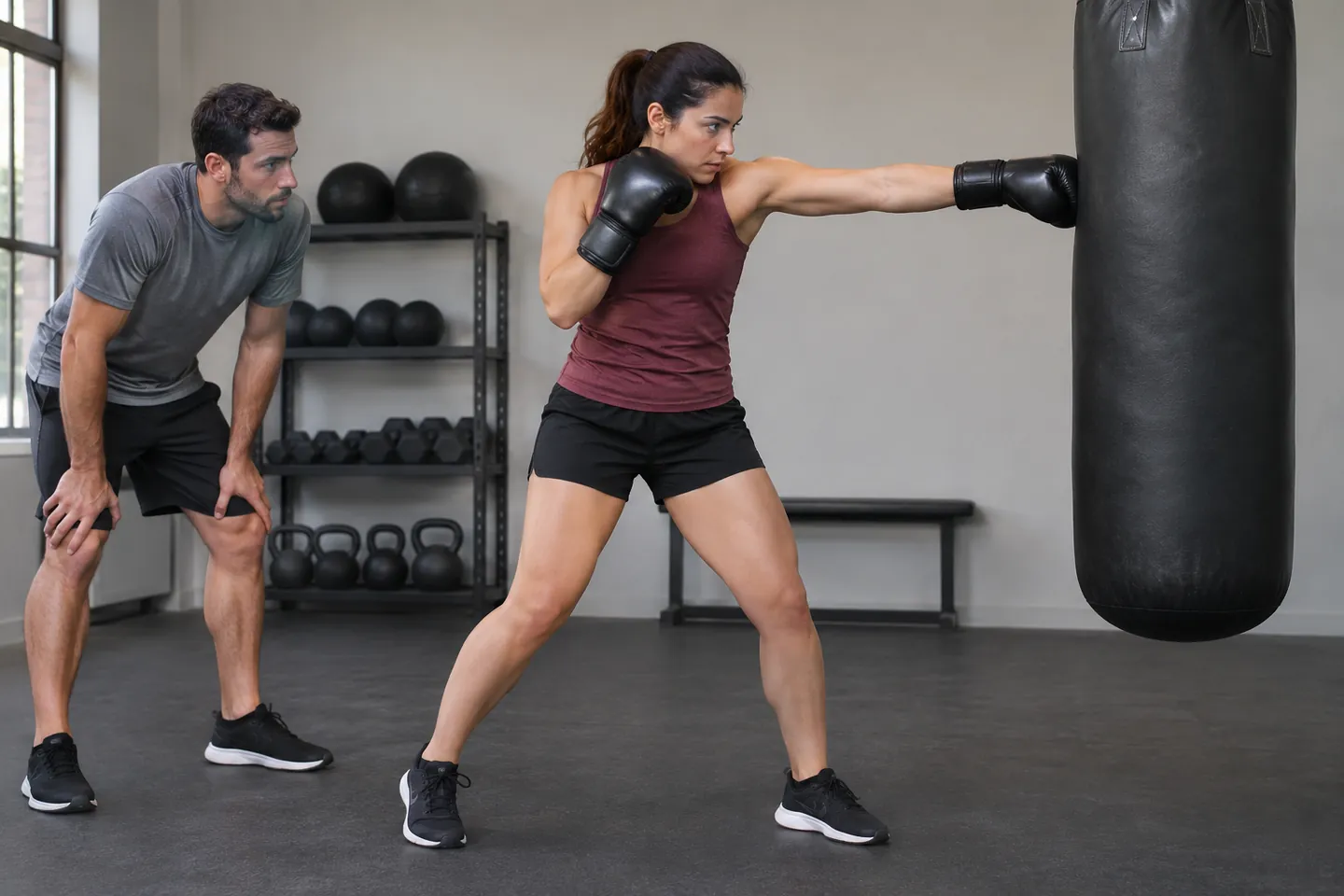
Understand beginner cross practice in Mississauga through coached movement, patient target work, useful corrections, and a clear return to your boxing stance.
There is a particular moment in a beginner boxing lesson when the rear hand first enters the picture. The lead-hand punch may be starting to feel familiar, and then the coach demonstrates a cross. Suddenly the movement appears to involve much more than sending a fist forward. Your body turns, your feet feel different, and returning to your original position takes more thought than expected.
That experience is a good reason to learn the cross patiently. The punch is commonly introduced as a rear-hand straight, but the useful lesson is how your body participates in the action and how you organise the return. For adults learning the boxing cross in Mississauga, a coach’s direct observation is more valuable than trying to assemble technique from isolated instructions online.
Begin with the lesson your coach is teaching
Different demonstrations can emphasise different parts of a movement. One instructor may first ask you to notice the turn, while another begins with the hand’s path. Those cues can be teaching choices rather than competing claims about what boxing should look like. Ask what the current exercise is meant to clarify.
If your coach is teaching a basic cross from a stationary stance, stay with that task. A video of a boxer moving, slipping, or changing distance introduces circumstances that may not apply. Bringing several versions into the same beginner repetition makes it harder to understand the feedback you receive.
The most useful opening question is often, “What should I pay attention to first?” It invites the coach to choose a manageable starting point. You do not need a full technical explanation before moving, but you should know enough to recognise the main purpose of the first few attempts.
Notice why the rear hand feels different
The rear hand begins from a different location in your stance than the lead hand. That alone changes how the action feels. Beginners sometimes try to make it travel like a jab while the rest of the body remains fixed, then wonder why the movement feels crowded or awkward.
Watch the coach demonstrate the complete action, including the feet and torso. Ask to see it slowly from the side if the front view is unclear. You are looking for how the parts relate to one another, not trying to memorise a collection of separate positions.
Try the movement without a target if that is the coach’s chosen introduction. Removing the desire to hit something can free attention for coordination. Keep the pace controlled and follow the demonstrated range. A successful first attempt may simply be one in which you understand the direction of the movement and can return without confusion.
Let the turn be taught, not forced
People often hear that a cross involves rotation and respond by turning as far as possible. More movement is not automatically more useful. The amount and timing should match the drill and the coaching you receive. Ask the instructor to identify where the action begins and what a suitable finishing position looks like.
Pay attention to the feet as part of the demonstration. Do not force them to remain planted if the coach is teaching them to move, and do not add an exaggerated pivot because you have seen one elsewhere. The relationship between the floor, feet, and turning body deserves individual observation.
If something feels uncomfortable, stop and describe it. The answer may involve changing the setup, reducing the task, or seeking advice outside the class when appropriate. A written description cannot determine the cause of discomfort, and pushing harder is not a useful substitute for understanding what is happening.
Keep the target from taking over the lesson
Once a pad or bag appears, it is easy to forget every instruction except making contact. The target becomes a finish line, and your body tries whatever seems necessary to reach it. Before striking, let the coach establish an appropriate starting distance and explain how much contact the exercise calls for.
Begin with controlled attempts. After each one, check the result against the chosen cue. Did you complete the movement the coach demonstrated? Did you finish where you expected? Were you able to return without taking an unplanned step? These questions give the target a role in the lesson without letting impact become the only measure.
If the bag moves away, avoid stretching after it automatically. Pause or reset as instructed. A moving target changes the situation, and you may not yet be practising the footwork needed to respond. Learning to recognise when the original task has changed is itself useful awareness.
Include the lead hand in the picture
The rear hand is the main focus, but the other hand does not disappear from the task. Ask your coach where it should remain during this version of the cross. Beginners may lower it, pull it back unnecessarily, or move it simply because the rear side is moving.
Rather than trying to monitor both hands constantly, use the coach’s preferred cue. You might rehearse the action slowly while they watch the non-punching hand. This lets you keep your attention on the main movement while receiving feedback about a detail you cannot easily see.
Avoid solving the issue by stiffening the whole upper body. If holding the lead hand in place makes the cross feel impossible, explain that sensation. The coach may simplify the movement or change the cue so that the parts can work together more naturally.
Make the return an intentional action
The cross is not complete when your rear hand reaches the target. You also need to return to the position expected for the next action. In an introductory drill, that usually means recovering the familiar stance and guard the coach has taught.
Pause after the return and assess whether you recognise your arrangement. If you are facing a different direction, standing much narrower, or leaning toward the bag, ask which part to adjust. The answer might concern the starting distance, the amount of movement, or the sequence of the return. Let the coach identify the priority rather than changing everything at once.
This complete-repetition approach becomes particularly useful when combinations are introduced. A cross that ends in an organised position gives the next movement a clearer beginning. If every cross requires a separate recovery step, adding another punch may simply hide the unresolved issue inside a longer sequence.
Connect the jab and cross gradually
A jab followed by a cross is a common beginner combination, but knowing each punch separately does not mean the connection will be immediate. Begin at a pace where you can recognise the first punch, its transition, the second punch, and the ending. The coach can help you understand which details remain the same and which change when the movements connect.
You may initially need a small pause between punches. That is a teaching tool, not necessarily the final rhythm. As the relationship becomes clearer, the coach may ask you to reduce the pause. The goal is to make the sequence understandable before making it fluid.
Do not rush the second punch because you are excited to reach it. The first action affects where the cross begins. If the jab leaves you reaching or off position, the cross has to start from that situation. Sometimes improving the combination means revisiting the first punch rather than trying harder with the second.
Ask for corrections you can test
Feedback becomes practical when it describes something you can attempt on the next repetition. If a correction feels vague, ask for a demonstration or a simpler explanation. “Can you show me the position you want me to finish in?” gives the coach a concrete way to clarify.
Once you have a correction, test it at a manageable pace. Notice whether the movement becomes easier to organise, and ask the coach whether the intended change is visible. Your feeling matters, but it is not the only evidence. A movement can feel unfamiliar because it is new even when it better matches the instruction.
Write down the correction afterward in language that will make sense to you. A useful note might describe the starting distance, the return, or a reminder about the non-punching hand. Avoid collecting so many cues that the next session begins with a page of competing instructions.
Use power as a later conversation
The cross is often associated with power, which can encourage beginners to judge every attempt by impact. For an early lesson, that emphasis may distract from the details you are trying to learn. Ask the coach what intensity is appropriate and what needs to be consistent before it changes.
Equipment fit and condition belong in that conversation. Use the wraps and gloves required for the activity, and ask for help if the hand position inside the glove feels wrong. Do not treat protective equipment as permission to ignore discomfort or strike at an intensity beyond the assigned task.
When the coach does introduce greater effort, keep the same interest in the whole repetition. Can you still follow the movement, return to the expected position, and respond to feedback? If not, slowing down may make the next correction easier to identify.
Carry one clear lesson into the next class
A productive cross lesson does not need to end with a perfect punch. It can end with a better understanding of how your rear side participates, where to stand, or how to return. Those are specific gains that you can revisit rather than a vague impression of having worked hard.
For boxing instruction in Mississauga, bring the coach one question about the part that remains unclear. You may need another demonstration, a simpler drill, or more time with the same movement. The cross becomes less mysterious when you treat it as a complete, coached action and give each correction enough attention to become useful.
Filed under
Keep exploring
More training insights await.