
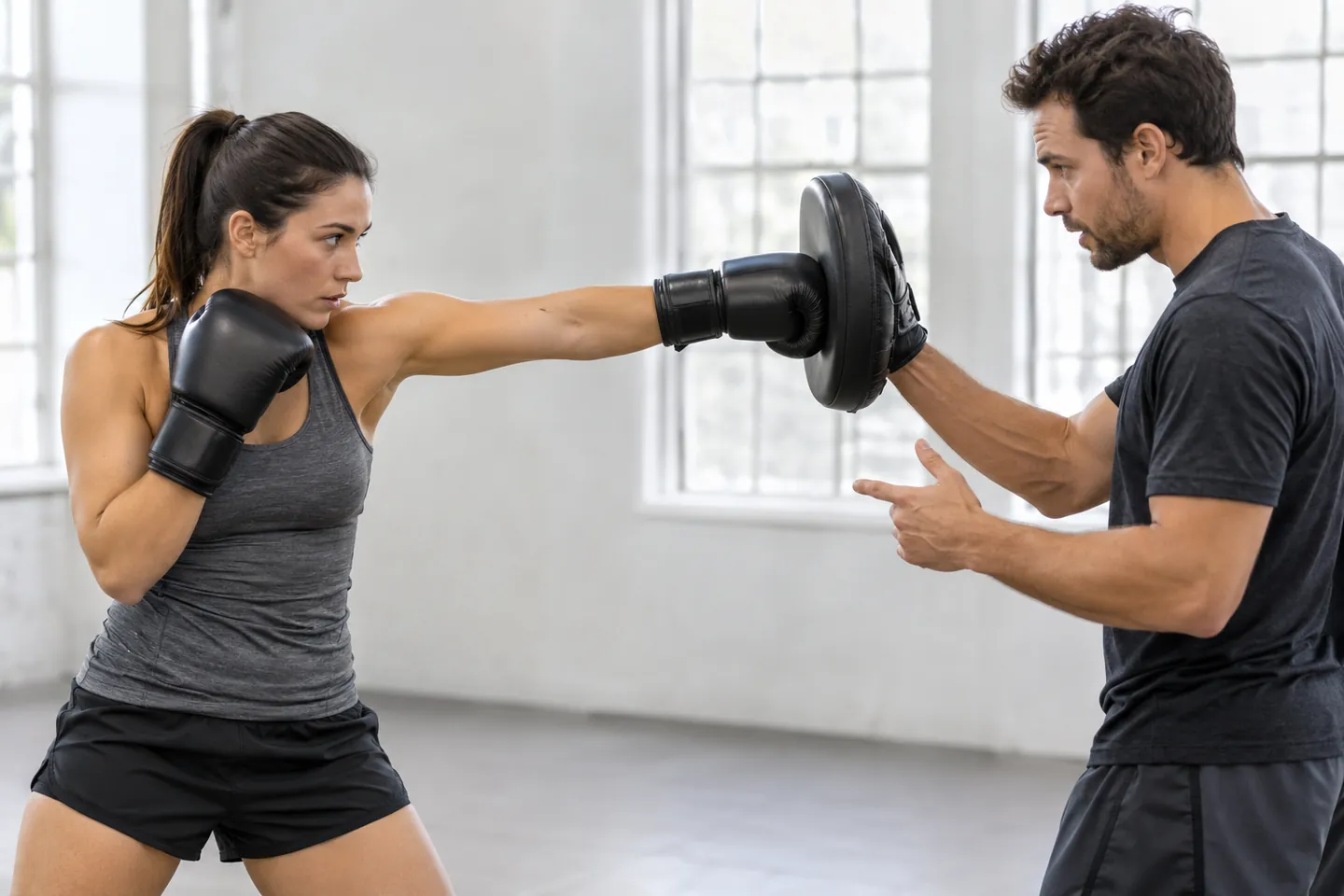
Explore a beginner's approach to learning the boxing jab in Mississauga, with practical ways to use coaching, target distance, slow practice, and feedback.
The jab is often one of the first punches a beginner learns, which can make it sound like a movement you should understand immediately. In practice, even a single straight punch contains several things to coordinate. Your hand moves, your body responds, your attention goes toward a target, and you need to return to a position from which you can begin again. Simple does not mean automatic.
Learning the boxing jab in Mississauga is a useful opportunity to develop a broader skill: practising one thing with enough care to notice what changes. You do not need to make the punch powerful or fast on the first day. You need a clear demonstration, a suitable task, and feedback that helps you distinguish a complete repetition from a hurried one.
Know which hand and which task
In a basic boxing lesson, the jab is generally taught as a straight punch with the lead hand. Ask your coach to identify the lead side in your stance and demonstrate the movement from an angle you can follow. If you are facing the instructor, the mirrored view may be confusing; watching from beside them can make the sequence clearer.
The name alone does not explain the current drill. You may be practising the movement without a target, touching a pad at a controlled pace, or learning to coordinate a small step with the punch. Ask which version you are working on. Adding details from another lesson or video can distract from what the coach wants you to understand now.
Begin with the assigned version and keep your expectations narrow. A technical repetition is a chance to observe the movement. It is not a demonstration of how hard you can hit. The more clearly you understand the task, the easier it becomes to recognise when speed or effort is getting ahead of the instruction.
Establish a repeatable starting point
Before moving the hand, find the stance and guard your coach has taught. Notice where your feet are and how your hands are arranged. You are not trying to freeze your entire body. You are creating a reference so that the punch begins from a consistent place.
If every attempt starts with a different hand position, the coach has more variables to untangle. A brief reset lets you repeat the same question: what happens when I send this hand forward from here and bring it back? Consistency at the beginning helps you understand the feedback that follows.
Keep the other hand within the instruction too. Beginners can become so absorbed in the moving hand that the rest of the position changes unnoticed. Ask the coach what to pay attention to with the non-punching side. One useful cue may be enough; avoid filling your head with a long checklist before every repetition.
Watch the complete movement
When the coach demonstrates, observe the action from start to return. The most visible moment is often the hand arriving at a target, but that is only part of the repetition. Notice how the instructor finishes and whether they are immediately ready for another action.
Ask for a slow demonstration if needed. Watch once for the arm, once for the whole body, and once for the return. You do not have to see every detail at the same time. Breaking down your observation can make the movement less overwhelming without changing the exercise itself.
Then attempt the action at a pace that permits correction. If you are unsure about the path of the hand or its alignment, let the coach see it before striking equipment with force. A written explanation cannot inspect those details for you. Direct feedback is particularly valuable when your impression of the movement differs from what the instructor observes.
Treat the return as part of the jab
A common beginner experience is to focus on reaching the target and then leave the hand in an unfamiliar place. The next repetition begins with a repair rather than a clear starting position. Instead, think of the jab as a journey out and back, completed when you have returned to the instructed arrangement.
Use a pause after the return if your coach agrees. The pause gives you time to check whether you recognise your stance and hand position. If not, reset before repeating. You are building a pattern that includes its own ending, which makes later combinations easier to discuss.
Do not turn the return into a frantic pull that disrupts everything else. Ask the coach how the action should feel at the current pace. Smooth, clear repetition is a more useful early aim than trying to make one part of the punch exceptionally fast while the rest remains uncertain.
Choose a target distance deliberately
Standing at the wrong distance can make a manageable punch feel awkward. If the bag or pad is too far away for the assigned drill, you may reach beyond the position you were taught. If it is too close, you may feel crowded before the hand has followed its intended path.
Let the coach help set the distance. Once it is established, notice your starting location and avoid changing it unconsciously between attempts. If the bag swings or the pad holder moves, pause and ask whether you should reset. You do not need to chase every change in the target during an introductory drill.
A missed or awkward contact does not automatically mean you need more force. It may indicate that the distance, timing, or movement is unclear. Describe what happened and let the coach decide which variable to address first. This keeps the lesson focused on understanding rather than compensating with effort.
Use a bag as a learning surface
The sound of a bag can be satisfying, but it is not a complete measure of technique. A loud impact does not tell you whether you returned to your stance or followed the assigned movement. During early practice, pay attention to the coach’s criteria instead of trying to reproduce the loudest sound in the room.
Start at the intensity the instructor recommends and use suitable, properly fitted equipment. If something feels uncomfortable in your hand, wrist, or elsewhere, stop and raise it. Do not continue merely because the bag seems soft or because another participant is hitting harder. Your task and current experience are the relevant reference points.
After several repetitions, step back mentally and ask what you are learning. Can you begin from the same position? Is the target distance becoming more familiar? Does the return feel clearer? These observations give bag work a purpose beyond accumulating punches.
Add movement only when the basic action is understood
A jab with a step introduces another coordination problem. The feet and hand now need to follow a relationship the coach has chosen for the drill. Before trying to blend them, ask to see the action slowly and identify what starts first, what happens together, and how you finish.
It may help to rehearse the step alone, then the punch alone, before combining them under instruction. The aim is not to create separate habits that never connect. It is to understand the pieces well enough that the combined task is no longer a blur.
Keep the travel distance modest while learning. A large step can make the timing harder to see and may leave you reaching or arriving too close to the target. If the combined movement becomes confusing, return to the simpler version. Simplifying a task is a practical way to regain useful feedback.
Make feedback specific enough to use
When a coach offers a correction, repeat it back in ordinary language if you are unsure. “You want me to finish with my hand back here before I go again?” is a useful clarification. It shows what you understood and gives the instructor an opportunity to refine the cue.
Work with one main correction for a short period. Trying to change your feet, shoulders, hand path, breathing, and speed simultaneously can make it difficult to know what helped. A focused cue creates a small experiment. You try the adjustment, the coach observes, and you decide whether the movement is becoming clearer.
If the cue does not make sense after several attempts, say so. People understand explanations differently. The instructor may demonstrate from another angle or use a different task. Repeating a phrase you do not understand is not the same as receiving useful instruction.
Practise with a question rather than a quota
A fixed number of punches can organise a session, but the number should not be the only purpose. Choose a question such as, “Can I return to the same starting position?” or “Can I keep the distance consistent?” Then use the practice to gather an answer.
If your coach recommends independent rehearsal, stay with the version you have learned and use an appropriate clear space. Avoid adding contact, speed, or unusual resistance based on a video you have not discussed. A familiar slow movement can support the next lesson; an improvised variation may create a different task altogether.
After class, write one sentence about the most useful correction. You may remember a specific demonstration better than a technical term. Record it in words you will understand next time, and bring the note back if you need clarification.
Recognise progress in the whole repetition
The jab may become more familiar before it becomes noticeably faster. You might need fewer reminders about the starting stance, find the target distance more readily, or return your hand without a separate pause to think. These are worthwhile changes because they make the movement easier to repeat and discuss.
During local boxing training, ask your coach what a successful beginner jab should look like in the drill you are doing. That question keeps the standard relevant to your stage. One punch, practised with attention from start to finish, can teach you how to approach every new skill that follows.
Filed under
Keep exploring
More training insights await.