
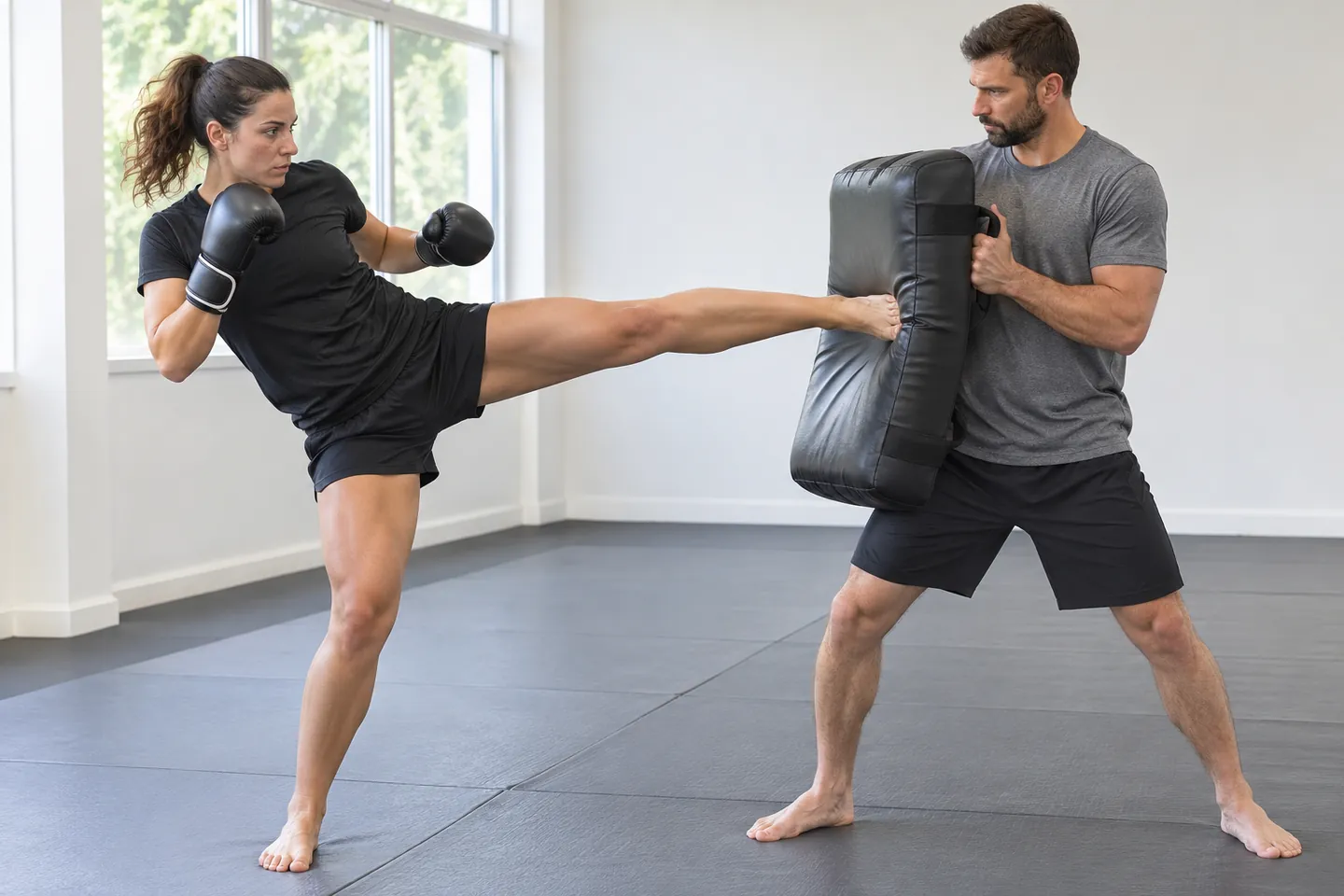
A patient, beginner-friendly look at learning the kickboxing roundhouse kick in Mississauga, from stance and pivot to balance, targets, and coaching feedback.
Watch an experienced kickboxer throw a roundhouse kick and the whole thing seems to take a fraction of a second. The leg swings, the shin lands, and the person is back in stance before you have worked out what happened. Then you try it yourself and discover that your supporting foot is stuck to the floor, your arms have wandered somewhere unhelpful, and you are wobbling after every attempt.
That gap between watching and doing is normal. The roundhouse is one of the signature techniques taught in kickboxing classes in Mississauga and almost everywhere else, and it asks your body to coordinate a pivot, a hip turn, a leg path, and a return to balance all at once. Very few people find it natural on the first night.
This article breaks the kick into the parts beginners most often struggle with, explains why coaches teach it the way they do, and offers some honest expectations about how the movement develops over weeks rather than minutes. It is not a substitute for instruction in the room, but it may help you arrive at your next class with better questions.
Why the roundhouse feels awkward at first
Most daily movement happens in a straight line. You walk forward, climb stairs, and step off curbs with your hips facing roughly where you are going. The roundhouse asks for something different: a rotation through the body while standing on one leg, with the kicking leg travelling in an arc rather than straight ahead.
Because of that rotation, the kick involves more of the body than many newcomers expect. If any single piece is stiff or mistimed, the rest of the movement compensates in strange ways. A planted supporting foot can twist the knee uncomfortably. A hip that stays square can make the leg feel like it is swinging from the wrong place. Arms that flail outward can pull the shoulders off balance.
None of this means you lack talent. It means the kick has several moving parts, and they need to be learned in an order that makes sense. Coaches in beginner classes usually spend more time on the setup and pivot than on the leg itself, because those early pieces decide whether the rest of the kick has a chance to work.
Start with the stance you will kick from
Every roundhouse begins from a stance, and if the stance changes every time you kick, the kick will change too. Before worrying about the leg, ask your coach to check your foot width, the angle of your feet, and where your weight sits. A stance that is too narrow can feel unstable on one leg. A stance that is too wide can make it hard to lift the rear leg at all.
It also helps to know which kick you are practising. A rear-leg roundhouse travels from the back foot and usually carries more rotation. A lead-leg roundhouse is shorter and often involves a small step or switch first. Beginners are generally introduced to one version before the other, and mixing the instructions for both is a common source of confusion.
Take a moment between repetitions to return to your stance and recognise it. That small reset gives the coach a consistent starting point to observe, and it gives you a reference for noticing what changes when a correction lands.
The supporting foot does more than you think
If there is one detail that beginners hear about repeatedly, it is the pivot of the supporting foot. As the kicking leg comes around, the foot you are standing on generally turns outward so the heel moves toward the target direction. This turn lets the hips open and rotate rather than forcing the knee to twist on a fixed foot.
Many people forget the pivot because their attention is on the kicking leg. Others pivot too late, after the leg has already swung, which makes the turn feel like an afterthought. Some coaches will have you practise the pivot alone, rising slightly onto the ball of the foot and turning, before adding any leg movement. It may seem like a dull drill, but it isolates the piece that most often goes missing.
Footwear and floor surface matter here too. Kickboxing is typically practised barefoot on mats, and a mat that is damp with sweat or a foot that is sticky can make turning harder. If the pivot feels grippy or uncomfortable, mention it. Small practical adjustments are part of learning, not a distraction from it.
Let the hips turn the kick over
Once the supporting foot is turning, the hips can follow. In a typical roundhouse, the hip of the kicking leg rotates over and through, which is what gives the kick its curved path and allows the shin to arrive at an angle. Coaches sometimes describe this as turning the hip over or rolling through the kick, though the exact language varies from gym to gym.
Beginners often keep their hips facing forward and try to swing the leg sideways from there. This tends to produce a kick that slaps with the foot, lacks reach, and feels strained in the groin or lower back. When the hips rotate, the leg has room to travel and the movement usually feels less forced.
Rotation does not mean spinning wildly. You still want to be able to stop and return. If you find yourself turning so far that you lose sight of the target or end up facing away, ask your coach how much rotation suits the current drill. There is a range that works, and finding it is easier with someone watching from the side.
Arms, guard, and counterbalance
Your arms have two jobs during a roundhouse. They help you stay protected, and they help you stay balanced. Those jobs can seem to conflict. Some styles teach the arm on the kicking side to swing down and back as a counterweight, while the other hand stays near the face. Others emphasise keeping both hands higher. Your coach will teach the version used in their classes, and it is worth following that version rather than copying something from a video.
Whatever the approach, flailing is the common beginner problem. Arms that fly outward pull the upper body off line and make the landing unsteady. If you notice your hands drifting far from where they started, slow the kick down and pay attention to the arms alone for a few repetitions.
Breathing belongs here too. Many people hold their breath through the whole kick. A short exhale as the kick lands is a cue you will hear in many gyms, partly because it keeps you from bracing rigidly. Ask whether your coach wants that in the current drill.
Shin, foot, and choosing the striking surface
In kickboxing and Muay Thai, the roundhouse is often taught to land with the lower shin rather than the top of the foot. The shin is sturdier, and landing with it usually reflects a kick that has turned over properly. Beginners frequently land with the foot instead, especially when the distance is a little long or the hip has not rotated.
There is no need to rush into hard contact to learn this. Shield work and pad work at moderate pace let you feel where the kick is arriving. If the contact keeps landing on your foot or ankle, that is useful information. It may point to distance, rotation, or timing, and your coach can help you sort out which.
Shin conditioning is a topic people love to talk about online, often with exaggerated advice. In a beginner setting, the sensible approach is simply consistent, controlled practice with appropriate equipment. If your shins are bruised or sore beyond ordinary training discomfort, tell your coach and consider speaking with a qualified health professional rather than pushing through.
Distance changes everything
A kick that works perfectly at one distance can fall apart at another. Too far, and you reach with the foot, lean back, and lose balance. Too close, and the kick jams before the leg can travel through its arc, often landing with the knee or thigh.
During drills, let your partner or coach set the distance and try to notice where you are standing when the kick works. Some people find it helpful to look at their lead foot’s position relative to the pad holder. Over time, you will start to recognise good kicking range without measuring it.
When the target moves, beginners tend to chase it with the kick rather than adjusting their feet. Early on, it is perfectly reasonable to pause, reset your distance, and try again. Adjusting range on the move is a later skill, and you will build toward it more efficiently once the basic kick is reliable.
The return is part of the technique
What happens after the kick lands matters as much as the kick itself. A roundhouse that leaves you spinning, falling forward, or standing with your hands down is not finished. In class, coaches will usually ask you to bring the leg back to stance, or in some drills to let it continue through and land in a different position.
Ask which return the current drill wants. Some coaches prefer the leg to retract along a similar path. Others teach letting the kick swing through when it misses. Both have reasons behind them, and mixing them up mid-drill causes confusion.
A good test is whether you could throw another technique immediately after landing. If the answer is no because you are off balance, slow the kick down until the return becomes reliable. Speed can be added once the whole cycle holds together.
Flexibility, hips, and realistic expectations
People sometimes avoid kickboxing because they assume they need to be flexible to kick. In reality, many beginners start with kicks aimed at the body or legs rather than the head, and those targets do not demand unusual flexibility. Height comes later for those who want it, and some experienced practitioners rarely kick high at all.
Hip mobility does help, and many classes include warm-ups that prepare the hips, groin, and hamstrings. If you sit for long hours, whether at a desk near Square One or behind the wheel on the 401, you may notice tightness that affects your kick. Gentle, regular mobility work can help over time, and classes such as yoga are one option some people use alongside striking.
If you feel sharp pain in the hip, knee, or back while kicking, stop. Discomfort from unfamiliar effort is different from pain that signals something is wrong. A physiotherapist or other qualified professional can assess persistent issues, and your coach can suggest modifications in the meantime.
How practice tends to progress
Most beginners move through a few rough stages. First, the kick feels like a collection of separate pieces: pivot, then hip, then leg, then return. Later, the pieces start to overlap, and the kick feels like one movement more often than not. Eventually, you can throw it at different distances and from different setups without thinking through each step.
That process takes weeks and months rather than one class. Training two or three times a week gives the movement enough repetition to settle without overloading your legs. Between classes, a few slow, controlled shadow kicks in a clear space can help, provided they match what your coach taught and you are not adding force or speed you have not practised with supervision.
It can be useful to write down the one correction that helped most after each class. Over a month, those notes form a picture of how your kick has changed, which is often more encouraging than relying on memory.
Bringing the roundhouse into a kickboxing class
In a typical beginner class, the roundhouse will appear in shadow work, partner drills on pads or shields, and simple combinations with punches. You may throw it after a jab and cross, or practise checking or blocking it when a partner kicks at a controlled pace. Each context teaches something slightly different about timing and balance.
If you are curious about learning the roundhouse properly, our kickboxing classes introduce the kick step by step at a pace that suits newcomers, and Muay Thai offers another angle on the same technique. The easiest way to see how it feels is to book a free trial and let a coach watch a few of your first kicks. One clear correction from someone standing beside you is often worth more than an evening of guessing.
Filed under
Keep exploring
More training insights await.