
Learn how beginners in Mississauga can practise the Muay Thai teep, from balance and chambering to distance, pad work, and using the push kick with control.
Ask a room of experienced Muay Thai practitioners which technique they would keep if they could only keep one, and a surprising number will name the teep. It is not the flashiest weapon in the sport. It does not have the drama of a roundhouse kick or the close-range intensity of the clinch. But it shows up constantly, quietly shaping the space between two people.
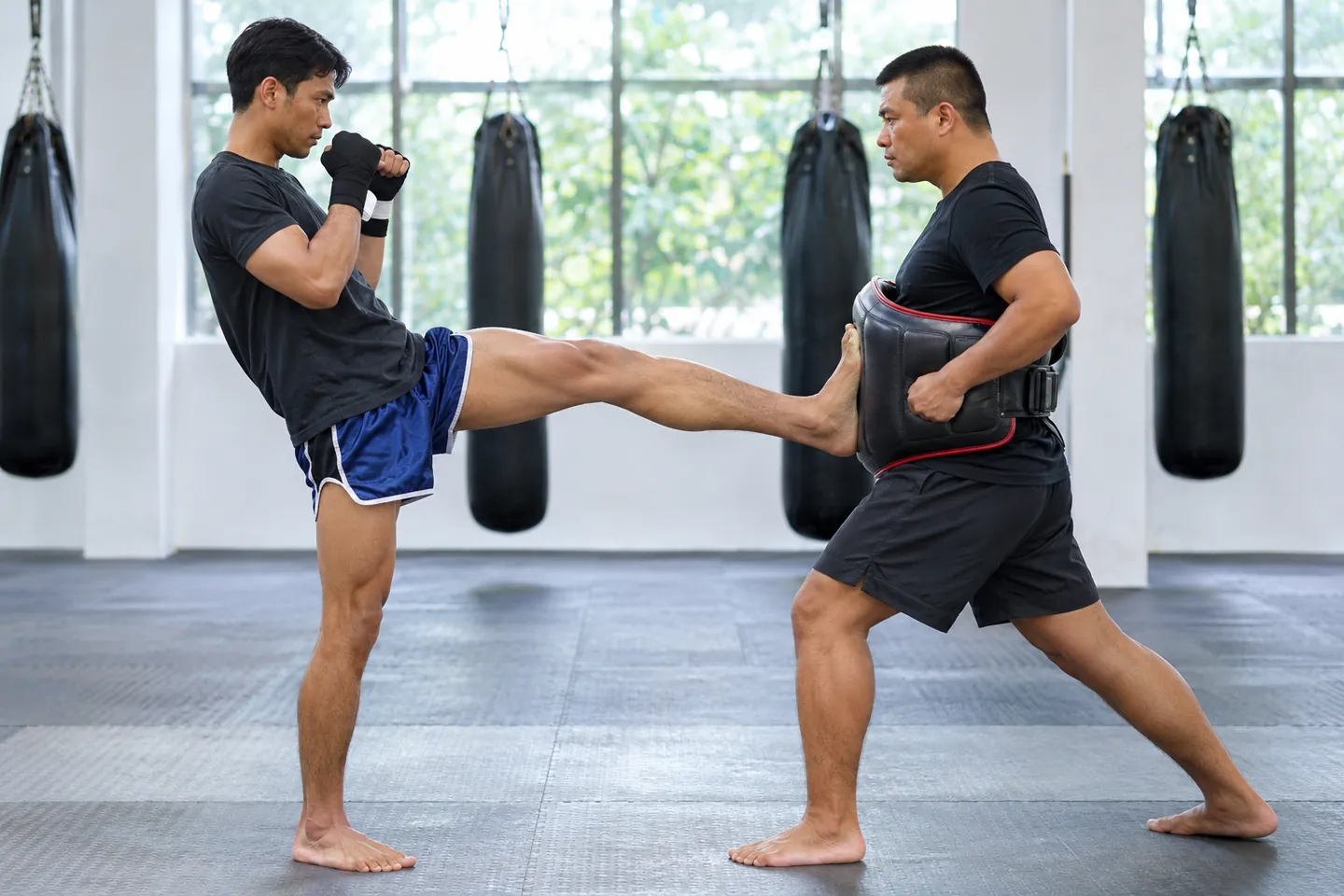
The teep is a front push kick. Instead of swinging the leg around, you lift the knee and extend the foot forward, usually connecting with the ball of the foot or the sole. It can keep someone at a distance, interrupt their forward movement, or set up other techniques. For beginners training in Mississauga, it is also a wonderful teacher of balance and timing.
This guide looks at how someone learning Muay Thai in Mississauga can approach the teep in their first months of training. It focuses on what to pay attention to, how to practise without rushing, and how to use coaching well. The exact mechanics will come from your coach; the aim here is to help those instructions land.
What the teep is for
Before practising any technique, it helps to understand its job. The teep is primarily a distance tool. If someone is walking toward you, a well-timed push kick can stop their momentum and reset the space. That makes it different from kicks designed mainly to score or damage.
Because of that purpose, a good teep is often more about timing and placement than raw force. Beginners sometimes try to kick through the target as hard as possible, which can pull them off balance. A teep that lands at the right moment, with the body upright and the guard intact, often accomplishes more than a heavier one thrown at the wrong time.
Ask your coach to explain the purpose of the version you are drilling. Some drills focus on the lead leg, others on the rear leg. Some practise a quick, snapping push; others focus on a longer, pushing extension. Knowing which one you are working on helps you judge whether a repetition was successful.
Balance on the standing leg
Every kick is also an exercise in standing on one leg. For the teep, your supporting leg carries your weight while the other leg lifts and extends. If the standing leg is unstable, the kick will wobble, and you may find yourself stumbling forward or backward after each attempt.
Spend time noticing how your weight shifts as you lift the knee. Your coach may ask you to hold the knee up briefly before extending, which is a useful way to check balance. If you cannot hold that position steadily, the extension will be harder to control.
Strength and mobility both play a role here, and they develop over time. If you notice that one side is much less stable than the other, mention it to your coach. Supplementary work, such as the kind covered in strength and conditioning sessions, may help, but let a qualified coach guide what is appropriate for you.
The knee comes first
Many coaches teach the teep in two stages: lift the knee, then extend the foot. This chambering of the knee is important. It gives the kick a clear line toward the target and allows you to adjust at the last moment. It also keeps the kick from swinging upward, which can turn a push into something that looks more like a flick.
At slow speed, pay attention to where your knee points when it rises. It should generally point toward the target you intend to reach. If your knee drifts sideways, the foot will usually follow. Watching yourself in a mirror, if one is available, can help you see this.
Once the knee is up and pointed correctly, the extension tends to follow more naturally. With practice, the two stages merge into a single smooth movement, but separating them at first makes it easier to identify where something is going wrong.
Posture and guard
A frequent beginner habit is leaning far back while kicking, as if to give the leg more room. Some lean is normal, depending on the version being taught, but excessive leaning makes recovery slow and leaves you vulnerable. Your coach will show you the posture they want, and it is worth matching it carefully.
Your hands should not drop just because your legs are busy. In Muay Thai, the guard stays relevant throughout. Beginners often find their hands drifting down or swinging out to the sides for balance. Try to notice this, perhaps by asking a partner or coach to watch your hands specifically during a set.
A useful mental check after each teep is to ask whether you could immediately defend or throw another technique. If the answer is no, something in your posture, balance, or guard probably needs adjustment.
Distance and the target
Distance changes everything about a push kick. Too far away, and you will reach, lose balance, or fall short. Too close, and you will not have room to extend, so the kick becomes a cramped shove. Finding the right range is a skill that develops with repetition and feedback.
When working on pads or a belly protector, let your pad holder or coach set the distance initially. Notice how far that is, perhaps by looking at the space between your lead foot and theirs. Then try to recognise that range on your own over subsequent rounds.
In more advanced drills, your partner may move forward or back, and you will need to adjust. Early on, though, consistency matters more than adaptability. A teep thrown repeatedly from the same distance helps you learn what the right range feels like.
Return the foot and reset
What happens after the teep connects is easy to overlook. Beginners sometimes let the foot fall wherever it lands, leaving them in an awkward stance or square to their partner. A controlled return to your stance is part of the technique, not an afterthought.
Ask your coach where the foot should land after the kick. Practise placing it there deliberately, even if it slows you down at first. Over time, the return becomes automatic, and you will find yourself ready for the next action much sooner.
Resetting after each repetition also helps your learning. If you begin each teep from a consistent stance, you can compare repetitions meaningfully. If every attempt starts from a slightly different place, it becomes much harder to understand what changed between good and less good kicks.
Practising on pads and bags
Pad work with a coach or partner is one of the best ways to learn the teep. A good pad holder gives you a clear target, sets the distance, and can offer immediate feedback. Belly pads or kick shields are commonly used, and your gym will provide guidance on what is appropriate.
On the heavy bag, the teep feels different. The bag moves away and swings back, which can be useful for timing practice but can also encourage pushing too hard. Start gently and focus on the mechanics: knee, extension, return. Use properly fitted equipment and stop if something in your foot, knee, hip, or back feels uncomfortable.
Solo shadow practice without a target also has value. It lets you focus purely on balance, posture, and the path of the leg without worrying about contact. Many people find that a few minutes of slow teeps in front of a mirror before class helps them warm into the movement.
Learning to use it with a partner
Eventually, the teep moves from drills to light partner work. This introduces timing: throwing the kick when your partner steps forward, or using it to interrupt their rhythm. At first, this will feel difficult. You may throw too early, too late, or not at all because you are concentrating on defending.
Your coach will usually structure this progression carefully, often starting with cooperative drills where your partner steps in at a predictable moment. These drills build a sense of timing without the pressure of free sparring. Take them seriously, and communicate with your partner about the pace and intensity you are both comfortable with.
Control matters greatly in partner work. The teep can be a forceful technique, and a push kick to the midsection thrown carelessly can wind someone. Match the intensity your coach describes and adjust for your partner’s experience and size.
Common beginner frustrations
Several frustrations come up often. The kick feels weak. Balance is shaky. The foot slips off the pad. You fall forward after the kick. These are all normal parts of learning, and most of them improve with patient repetition and coaching.
When something goes wrong, try to identify a single cause rather than many. Was the knee low? Was the distance off? Did you lean too far? Discuss it with your coach and work on one correction at a time. Changing too many things at once makes it hard to know what helped.
It is also normal for one side to feel much better than the other. Most people have a preferred leg. Your coach may encourage you to practise both, even if one feels awkward, because a balanced skill set is useful as you progress.
Fitting teep practice into your week
Whether you train once or several times a week in Mississauga, the teep will likely appear regularly in class. Use those moments well. Instead of treating the teep as a warm-up kick to rush through, give it the same attention you would give a new combination. A few focused repetitions often teach more than many careless ones.
If you have a little time at home, gentle balance practice can support your progress. Standing on one leg while brushing your teeth, for example, is a simple way to build familiarity with single-leg stability. Keep anything you do at home within what your coach has recommended.
Recovery is part of training as well. Kicking places demands on the hips, knees, and lower back. If you experience persistent discomfort, consider consulting a qualified professional. Services such as massage or physiotherapy can be helpful for some people, but they should be guided by a practitioner who has assessed your situation.
Start your Muay Thai training
If you are curious about the teep and the rest of the Muay Thai toolbox, explore our Muay Thai program. Beginners are welcome, and coaches will walk you through techniques like the push kick at a pace that suits your experience. When you are ready, book a free trial to try a class and feel how this simple, versatile kick begins to change the way you manage distance.
Filed under
Keep exploring
More training insights await.