
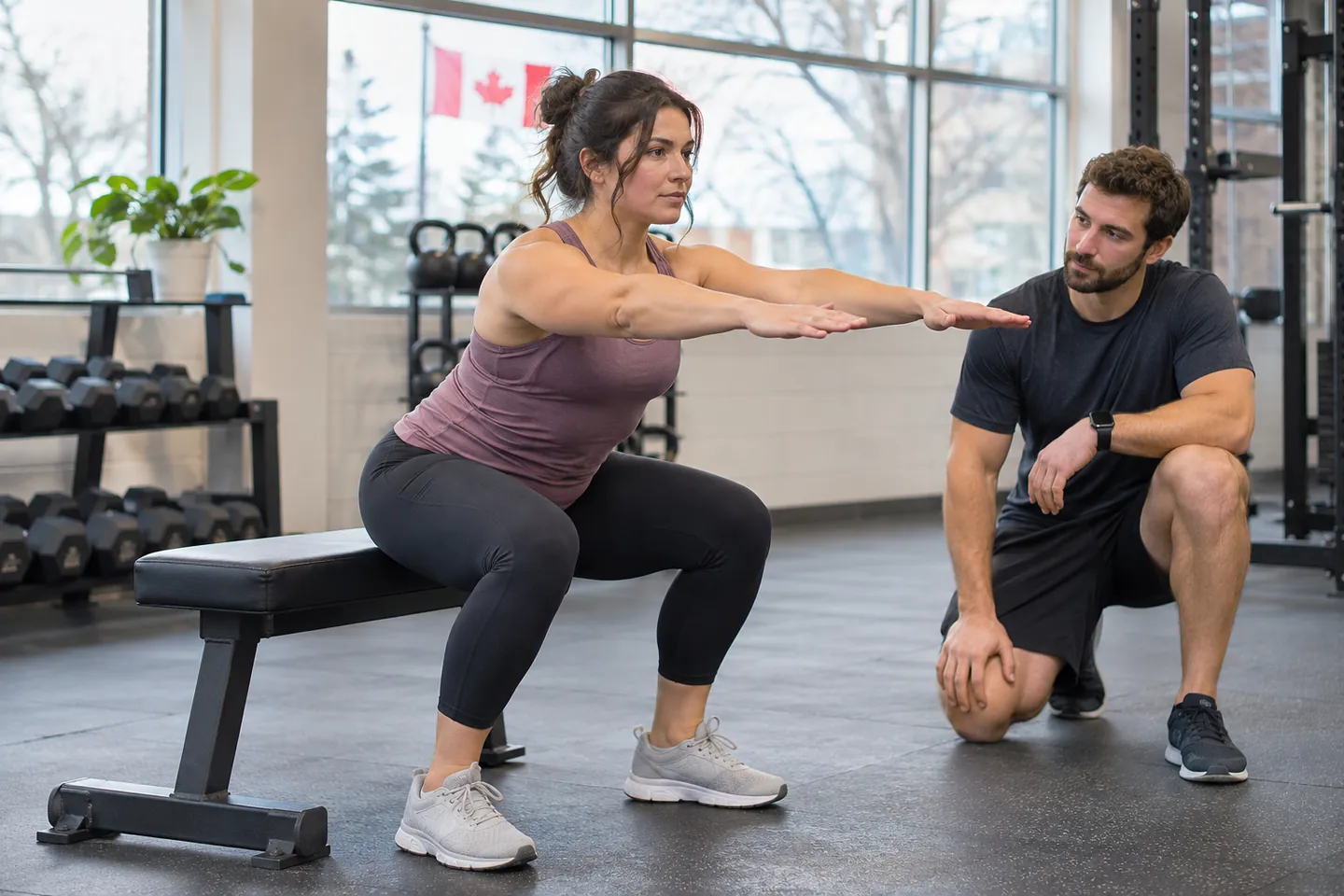
Approach squat coaching in Mississauga with clear questions about setup, exercise variations, feedback, practice notes, and learning at a manageable pace.
The squat is a familiar word that can hide a surprising number of questions. Where should you stand? Which version should you learn first? What is the coach watching? How do you know whether a cue is helping? Learning the squat with a coach in Mississauga is an opportunity to work through those questions in a setting where someone can observe your attempts and respond.
This is a guide to making that coaching conversation productive, rather than a universal technique prescription. People bring different experience and movement preferences to the gym, and the version chosen for one person may not be the best starting point for another. Your useful first task is to understand the movement you have been given, the reason for its setup, and what you should pay attention to while practising.
Tell the coach what you have already tried
Begin with an accurate account of your experience. Perhaps you have followed bodyweight workouts at home, used a machine in another gym, or attempted a squat with a weight after watching a video. Mention what felt familiar and what remained confusing. This helps the coach avoid assuming that recognizing the name means you understand the setup.
Describe any relevant concerns in ordinary language. You might feel uncertain about balance, forget where to place your feet, or rush when you try to count repetitions. These are useful teaching details. You do not need to arrive with a theory about why they happen.
If you have relevant restrictions or professional guidance, share them before beginning. The coach needs that context when deciding how to introduce the task. Your history is information for the session, not something you need to minimize to appear ready.
Ask which squat variation you are learning
A squat can be practised with different supports, targets, and equipment. Ask the coach to name or describe the version selected for you. If the program uses a bench, a held weight, or another tool, understand what role it plays in the exercise.
The description matters because it gives you a reference for future sessions. “The squat we did last time” may become ambiguous once you have tried several variations. A short note about the equipment and setup makes it easier to recognize the intended task later.
Avoid treating variations as a ranking of personal worth. An introductory version is a teaching choice, not a label that defines your ability forever. The relevant question is whether the version helps you learn the intended movement and gives the coach useful information about your next step.
Watch the setup before the movement
Ask for a demonstration that includes how the coach approaches the exercise, where the equipment is placed, and how the starting position is established. Watching only the middle of a repetition can leave important decisions unexplained.
Then practise setting up yourself while the coach checks. This reveals whether you understood the instructions and gives you a chance to ask about details before adding repeated movement. If the setup includes an adjustable object, learn which parts should be checked each time.
The surrounding space matters too. Know where to place unused equipment and how much room the exercise needs. Learning those practical details helps you focus on the task instead of discovering halfway through that a bag, bottle, or nearby station is in the way.
Use one clear cue at a time
A coach may observe several things, but you do not necessarily need to think about all of them simultaneously. Ask which cue is the priority for the next attempt. A single instruction is easier to evaluate: you can try it, notice what changes, and discuss the result.
If the cue uses a metaphor that does not make sense to you, request a different explanation. Some people understand a demonstration immediately; others prefer a description of the sequence or a target to move toward. The useful cue is the one you can actually apply.
After the attempt, say whether the instruction helped. You might explain that it clarified the beginning but became difficult to remember near the end. That feedback lets the coach refine the teaching instead of repeating the same phrase more loudly.
Understand the intended range for your version
Images online can make squat depth look like a universal competition. In a coached session, ask what range of movement is intended for the version you are practising and why. Your task is to follow that instruction, not to match a photograph without context.
If the coach uses a target, ask how you should interact with it. Do not guess whether it is a place to sit, a reference point, or something to approach without contact. Small distinctions can change your understanding of the entire exercise.
Describe your experience as you practise. If the movement feels unfamiliar or something feels wrong, communicate promptly. The coach can only use information they can observe or that you share. Trying to conceal uncertainty makes the teaching process harder rather than demonstrating commitment.
Keep the first learning goal modest and specific
A useful initial goal might be remembering the setup or performing the instructed sequence with fewer reminders. Those are concrete skills you can discuss at the end of the session. They may be more appropriate starting measures than selecting an impressive resistance.
Ask what would indicate readiness for a change. The answer should relate to the coach’s assessment and your program. It might involve greater familiarity, a clearer understanding of the movement, or a different exercise choice. You do not need to decide the progression by comparing yourself with another member.
Do not turn the first successful attempt into an obligation to change everything immediately. Repeating a clear version can help you recognize what made it work. Learning includes remembering and reproducing the task, not merely encountering a harder version as quickly as possible.
Learn how effort will be discussed
Your coach may ask how difficult the set felt or how many more repetitions you think you could have completed. If that language is unfamiliar, ask for an explanation and give an honest estimate rather than searching for the answer you think they want.
You can also describe practical changes during the set. Perhaps you stopped remembering the cue, began rushing, or felt uncertain about the final repetition. These observations help distinguish a learning issue from a simple desire to increase the challenge.
If something is painful or feels wrong, stop and tell the coach. A coaching session should provide room for that communication. The purpose of the appointment is to guide appropriate work, and accurate feedback is part of the information needed to do that.
Ask before using video as feedback
A brief video can sometimes help a person understand what the coach is describing, but filming should follow the facility’s rules and respect other people in the space. Ask permission and arrange the view so that uninvolved members are not included.
If video is used, agree on what you are looking for. Watching a recording without a clear question can become an exercise in criticizing every detail of your appearance. A specific coaching point makes the tool more useful and keeps the conversation focused on the movement.
Do not assume that a recording turns you into your own technique expert. Use it alongside the coach’s explanation. If you notice something you do not understand, ask about it rather than adopting a correction from an unrelated online example.
Write down the details that made the lesson useful
After the appointment, record the variation, important setup details, and the cue that helped most. Include anything you were asked to remember before the next session. A few clear lines can preserve a lesson that otherwise becomes vague after several days.
If independent practice is part of your plan, confirm exactly which version you should use and what work is intended. Do not assume that every exercise demonstrated during an appointment was assigned for unsupervised repetition. Ask what should wait until you next train together.
At the following session, use your notes to show what you remember. Explain the setup before beginning and invite correction where needed. This turns the record into a learning aid instead of a collection of exercise names that you never revisit.
Connect the squat to the larger program
The squat is one part of a training plan, not a test that determines whether you belong in the gym. Ask how it relates to the other movements you are learning and why it receives a particular amount of attention in your sessions.
If the exercise remains confusing, discuss whether a different explanation or variation would help. Progress does not require you to keep repeating an instruction that you cannot understand. A clear conversation can reveal whether the issue is setup, vocabulary, pacing, or the choice of task itself.
Konga’s personal training service offers a starting point for people seeking coached exercise instruction. Contact the team to discuss your experience and current options. Arrive ready to describe what you notice, ask for clarification, and practise a manageable version. Those habits make the lesson more useful than trying to look experienced from the first repetition.
Filed under
Keep exploring
More training insights await.