
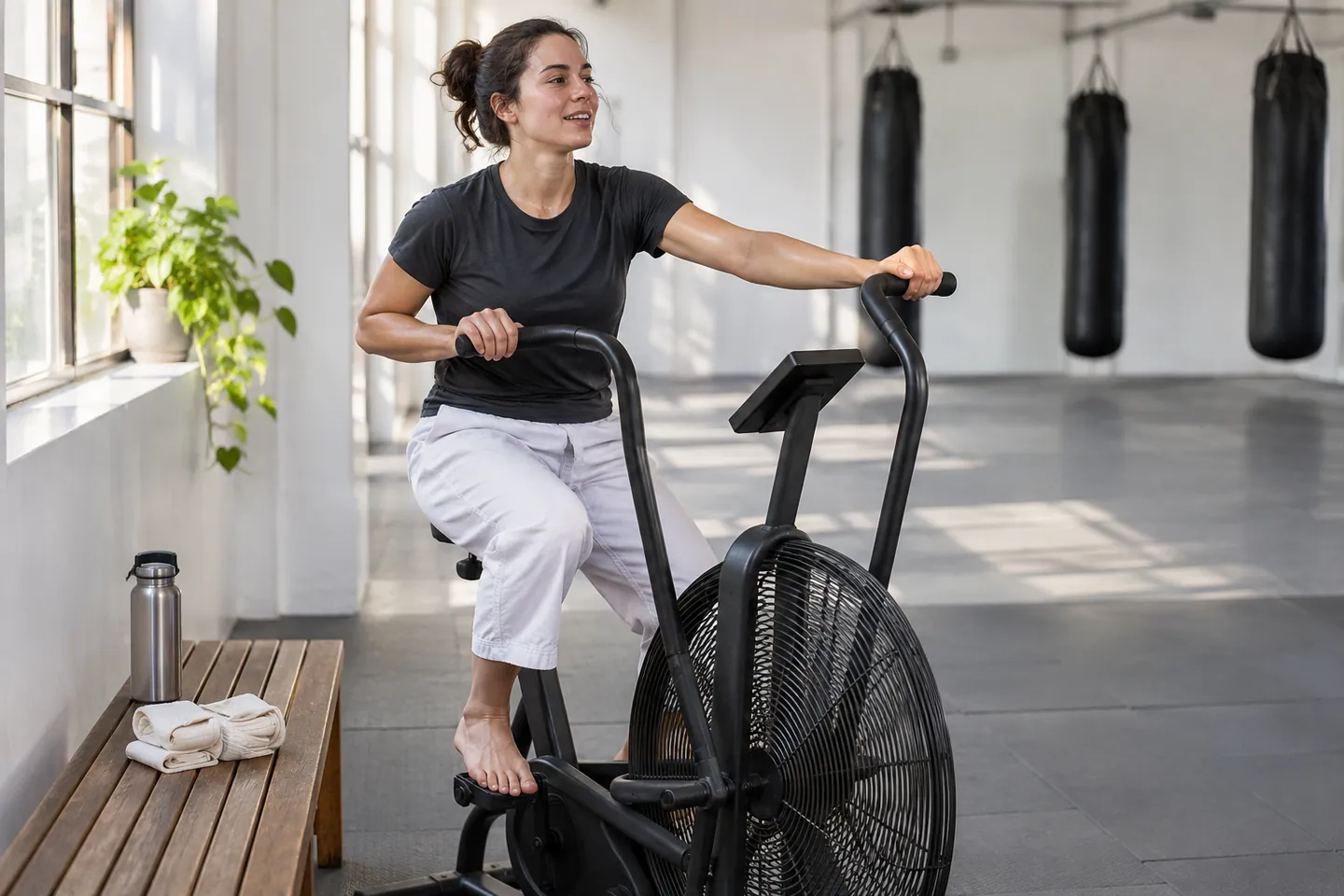
Why slow, steady cardio helps boxers, Muay Thai students and grapplers in Mississauga recover between rounds, plus simple ways to add it to a busy training week.
Ask most people what fighters do for cardio and they will picture something brutal: sprints until someone sits down, burpees between rounds, skipping until the calves give out. Hard conditioning has its place, but a surprising amount of the engine behind a good round of sparring is built at a pace that feels almost too easy. You can breathe through your nose. You could hold a conversation. Nothing about it looks dramatic.
That slow, steady work is what this post is about. If you train boxing, Muay Thai, kickboxing, jiu-jitsu or MMA in Mississauga, low-intensity cardio can help you recover between rounds, come back fresher for the next class, and handle a heavier training week without feeling flattened. It is also one of the friendliest forms of conditioning for beginners, because it is hard to do it badly as long as you keep the effort genuinely low.
What follows is a practical guide rather than a scientific lecture. We will look at what “low intensity” actually means, why it fits combat sports, how to fit it around classes and a commute, and where people usually go wrong. If you have a heart condition, are returning from illness, or have any medical concerns about exercise, check with your doctor before adding new cardio to your week.
What “low intensity” really means
Low-intensity cardio is sustained movement at an effort you could keep up for a long time. On a simple one-to-ten scale of how hard something feels, it usually sits around a three or four. Your breathing is deeper than at rest, you feel warm, but you are not gasping, and you could speak in full sentences if someone asked you a question.
A common rule of thumb is the talk test. If you can say a few sentences comfortably, you are probably in the right zone. If you can only manage a word or two between breaths, you have drifted into moderate or hard work. Some people like to use a heart rate monitor, and that is fine, but the talk test costs nothing and works on the bike, the trail or the treadmill.
The trap is that easy feels unproductive to people who love hard training. Many fighters start a “light” session and slowly push the pace until it becomes a medium-hard grind. That middle zone has its uses, but it is not what we are describing here, and it tends to leave you more tired than you planned for the next class.
Why combat athletes benefit from slow work
A round of boxing or Muay Thai is a mix of bursts and pauses. You throw a combination, you move, you reset, you defend, you throw again. Between the bursts, your body needs to settle your breathing and get ready for the next exchange. Rolling in jiu-jitsu is similar: scrambles and transitions, followed by long stretches of grip fighting and positional pressure.
Steady aerobic work supports that recovery side of the equation. In general terms, it trains your body to deliver oxygen and clear fatigue more efficiently at lower effort levels. When that base is stronger, the “easy” moments in a round feel easier, and you get more back between rounds and between drills. Many coaches describe it as building the floor that your harder conditioning stands on.
There is also a simpler benefit: it lets you train more without breaking down. Combat sports are demanding on joints, skin and the nervous system. Adding another hard session can leave you sore and flat. Adding an easy session usually leaves you feeling looser and more prepared, which means you show up to your next technical class with better focus.
Where it fits in a beginner’s week
If you are new and training two or three classes a week, your classes are already doing most of the conditioning work. You do not need a complex plan. One or two easy cardio sessions of twenty to forty minutes on non-class days is plenty to start. Some people prefer a short easy session on the same day as class, either earlier in the day or as a cool-down.
For someone training four or more times a week, low-intensity work becomes more about recovery. A gentle bike ride or walk the day after a hard sparring or rolling session can help you feel less stiff. It also gives you a structured way to move on days when you want to do something but know your body needs a break from impact.
Try not to stack it in a way that crowds out sleep or makes your schedule fragile. If you have a long drive along Hwy 401 or 403 and a family at home, a forty-minute ride on top of three classes may be the thing that tips the week into exhaustion. Short and consistent beats long and occasional.
Choosing your method
The best form of easy cardio is the one you will actually do. A stationary bike is popular because it is low impact and easy to control. A rowing machine works well if your technique is reasonable and your back tolerates it. Brisk walking, especially on a slight incline, is underrated and needs no equipment at all.
Light skipping can work for boxers who are already comfortable with the rope, but many people find it hard to keep skipping truly easy. If your calves or Achilles are sensitive, save the rope for technical warm-ups and choose something gentler for longer sessions. Swimming at a relaxed pace is another option if you enjoy it and have pool access nearby.
Outdoors, the trails along the Credit River and the waterfront paths around Port Credit make for pleasant easy walks or rides when the weather cooperates. In a Mississauga winter, when sidewalks are icy and daylight disappears early, indoor equipment is usually the safer and more reliable choice.
Shadowboxing and flow drills as easy cardio
You do not have to leave your sport behind to do low-intensity work. Light shadowboxing, done slowly and continuously, can be an excellent easy session. Move around the floor, throw relaxed punches and kicks, work on your footwork, and keep the effort at a level where you could chat. It is aerobic work and technical rehearsal at the same time.
Jiu-jitsu students can do something similar with solo movement drills: shrimping, technical stand-ups, hip switches and bridging, strung together at a calm, continuous pace. The key is to keep moving without letting it become a hard circuit. If you are breathing hard after two minutes, slow down.
This kind of practice has a nice side effect. Because you are not tired, you can pay attention to details your coach has mentioned in class. Many students find their footwork and guard improve when they practise them in a relaxed state, rather than only under pressure.
Keeping easy sessions honest
The biggest mistake with low-intensity cardio is letting it creep upward. You start at a comfortable pace, a song comes on, you feel good, and fifteen minutes later you are pushing hard. It feels productive, but it changes the purpose of the session and adds fatigue you did not plan for.
A few habits help. Decide on your intensity before you start and check it every five minutes using the talk test or your breathing. Breathe through your nose if you can; when nose breathing becomes difficult, that is a useful signal to ease off. If you use a heart rate monitor, ask a coach or qualified professional for general guidance on a sensible range for you rather than relying on generic formulas.
It can also help to remove competitive cues. Avoid racing the person on the next bike or chasing a distance score. Treat the session like brushing your teeth: something you do regularly without needing it to be impressive.
How long and how often
For most recreational combat sports students, twenty to forty-five minutes per easy session is a reasonable range. Beginners can start at the lower end, even fifteen minutes, and build gradually. There is no prize for the longest session; the goal is to repeat it across weeks and months without it interfering with your classes.
Frequency depends on your overall training load. One session a week is better than none. Two or three is a solid amount for someone training regularly. If you notice that your easy sessions are making you more tired rather than less, reduce the duration or frequency and look at your sleep and nutrition before adding more.
Progress tends to show up quietly. You may notice that the same bike resistance feels easier at the same heart rate, or that you recover a little faster between rounds in class. These changes take weeks, not days, so patience matters.
Balancing easy work with hard conditioning
Low-intensity cardio is not a replacement for every other form of conditioning. Combat sports also demand short, intense efforts, and your classes and any interval work your coach prescribes will develop that side. The easy work supports the hard work by improving recovery and making your overall training more sustainable.
A simple way to think about it is that most of your extra conditioning should be easy, with hard efforts used deliberately rather than daily. For many recreational students, classes already provide plenty of intensity. Adding more hard sessions on top often leads to lingering soreness, poor sleep and dull technique.
If you want a more structured plan that blends easy aerobic work, intervals and strength training around your class schedule, a coach in a strength and conditioning program or a personal trainer can help you build one that respects your recovery and your available time.
Listening to your body
Easy cardio should leave you feeling the same or better than when you started. If it consistently leaves you drained, something is off. You might be going too hard, sleeping too little, or simply training too much overall. That is useful information, not a failure.
Pay attention to how your joints feel, especially if you have a history of knee, hip or back discomfort. Switch methods if one aggravates things; the bike may suit you better than walking, or vice versa. Persistent pain is a reason to speak with a qualified professional such as a physiotherapist rather than to push through. Konga Fitness offers physiotherapy services for members who want assessment and guidance.
On days when you feel unusually tired, a short easy session can still be valuable. Ten minutes of gentle movement is often enough to loosen up without adding stress. On days when you are ill, rest is the better choice.
A sample week for a busy student
Here is one example, not a prescription. Imagine someone in Meadowvale training Muay Thai on Monday and Thursday evenings and a jiu-jitsu class on Saturday morning. They might add a thirty-minute easy bike ride on Tuesday, a twenty-minute brisk walk on Wednesday at lunch, and some light shadowboxing on Sunday afternoon.
None of these additions are hard. They fill the gaps between classes with movement that supports recovery and builds a base, without stealing energy from the sessions that matter most. If the week gets busy, the walk or the shadowboxing can be dropped without guilt.
Adjust based on how you feel. Some weeks you may do all three; others, only one. Over a few months, that steady accumulation tends to make a noticeable difference in how you handle rounds.
Bringing it back to the mat and the ring
The purpose of all this is to make your actual training better. When your aerobic base improves, you may find that the third round feels less desperate, that you can think more clearly during drills, and that your technique holds together longer before fatigue takes over. That is when classes become more enjoyable and more productive.
If you are new to combat sports in Mississauga and want to see how conditioning fits into real classes, book a free trial at Konga Fitness and try a session in boxing, Muay Thai or jiu-jitsu. Ask the coach how you might support your training with easy cardio between classes; they can help you find a pace and plan that suits your schedule and your goals.
Filed under
Keep exploring
More training insights await.