
A thoughtful look at how martial arts classes in Mississauga can help children build confidence, boundaries and calm, alongside support from parents and schools.
Parents rarely start looking at martial arts because of a schedule gap or a sudden interest in belts. Often, the conversation begins after something has happened at school: a child comes home quieter than usual, mentions being teased on the bus, or stops wanting to go to recess. The natural instinct is to look for something that will help them feel stronger.
Martial arts can be part of that support, but it is worth being clear from the outset about what it can and cannot do. Classes do not make bullying go away, and they are not a substitute for involving the school, talking with your child, or seeking professional help when a situation is serious. What a good program can offer is a steady place to build confidence, body awareness, emotional regulation and a sense of belonging. For many kids in Mississauga, those qualities make difficult social situations a little easier to face.
This article looks at how martial arts training may support children dealing with bullying, what a responsible kids’ program emphasises, and how parents can work alongside coaches and schools.
Start with the adults around the child
Before anything else, if your child is being bullied, the most important step is communication with the adults who can intervene. Teachers, principals and school staff in Mississauga schools have processes for dealing with bullying, and they need to know what is happening to act on it. Keep notes of what your child tells you and when, and share them calmly with the school.
Talk with your child about what they are experiencing, without pressure. Some children open up in the car, at bedtime, or while doing something side by side rather than face to face. Listen more than you advise. Let them know it is not their fault and that you will help.
If your child shows signs of significant distress, such as changes in sleep, appetite, mood or a reluctance to leave the house, consider speaking with your family doctor or a children’s mental health professional. Martial arts can be a positive addition to a child’s life, but it is not a treatment for anxiety or trauma.
What confidence looks like in practice
Confidence is often imagined as loudness or toughness, but in children it tends to show up in quieter ways. It is standing up straight, making eye contact, using a clear voice, walking into a room without shrinking, and knowing that they can try something difficult and survive the effort. These are learnable behaviours.
A good martial arts class practises them constantly. Children bow in and out, answer coaches with a clear “yes, coach”, line up with good posture, demonstrate techniques in front of others, and attempt drills that are a little challenging. Each small success adds a brick to a foundation of self-belief.
Over months, many parents notice changes outside the gym: a child who speaks up more in class, tries a new activity without as much fear, or handles a frustrating moment with more patience. These changes are gradual and vary from child to child, but they are often what families value most.
Body language and boundaries
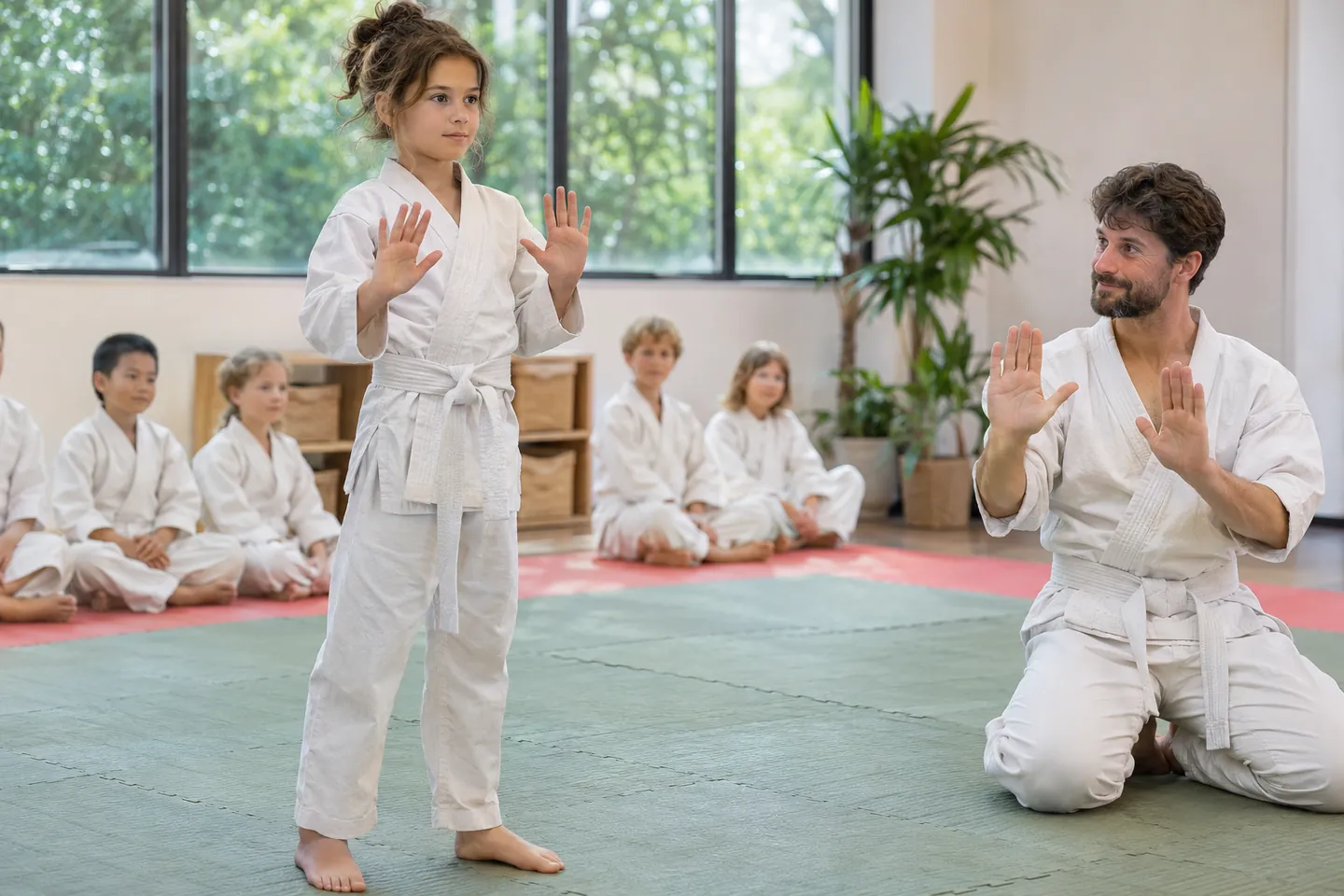
Many kids’ programs teach a simple boundary posture: standing tall, feet balanced, hands open and raised in front at chest height, with a firm voice saying something like “stop” or “back off”. It is non-threatening, clear and easy to remember. Coaches practise it in drills so it becomes familiar.
The point is not to start a fight but to communicate a boundary clearly. Children learn that they are allowed to say no, to step away, and to look for an adult. Practising these words and postures out loud, in a safe setting, can make them feel more natural if a real situation arises.
Coaches also teach awareness: noticing when a situation feels uncomfortable, keeping some distance, and moving toward a teacher, a group of friends, or a safe space. Avoiding a problem is generally considered a success in children’s self-defence teaching, not a failure.
Emotional regulation on the mats
A lot of what children learn in martial arts is about managing their own reactions. They practise waiting their turn, listening while excited, losing a game gracefully, and trying again after a mistake. When a coach calls “freeze” in the middle of an energetic drill, children practise stopping their bodies instantly. Those small moments add up to self-control.
That regulation matters in bullying situations, where children may feel tempted to react with tears or anger that escalates the situation. A child who has practised taking a breath and thinking before acting has an extra option available. It will not always work, and children are still children, but the practice helps.
Coaches in a responsible program model calm responses themselves. They correct behaviour without shouting, explain rules clearly, and help children reset when emotions run high. Kids learn as much from watching adults handle pressure as from any formal lesson.
Physical skills, taught responsibly
Martial arts does involve learning physical techniques: stances, strikes on pads, falling safely, and, depending on the style, basic grappling. In a children’s program, these skills are taught in a structured, supervised way, with controlled contact or no contact at all, and with constant emphasis on safety and respect.
A responsible coach is explicit that these techniques are for practice and for genuine emergencies only. Children learn that using martial arts to hurt someone, show off or retaliate is not acceptable. Many programs teach a clear ladder: walk away, use your words, get an adult, and only protect yourself physically when there is no other option and you are in danger.
Parents should feel comfortable asking how a program teaches self-defence, how contact is managed, and what values are emphasised. If the answers focus on fighting back aggressively, it may not be the right fit. Our kids martial arts program prioritises respect, control and safety at every stage.
Belonging and friendship
One of the less obvious benefits of a martial arts class is simple belonging. Children who are struggling socially at school can find a separate group where they are welcomed, known by name and part of a shared effort. That community does not depend on school cliques or neighbourhood friendships.
Training partners often become friends, and coaches become trusted adults outside the family. Having a place where they feel competent and accepted can give children a sense of stability, especially during a hard term. It reminds them that school is not the whole world.
Parents can support this by keeping attendance consistent where possible, helping children arrive on time, and celebrating effort rather than only results. A familiar routine, such as class every Tuesday and Thursday after school, gives kids something predictable to look forward to.
Effort, progress and visible milestones
Many martial arts programs use belts, stripes or other markers to show progress. For a child who feels unsuccessful at school or socially, earning a new stripe through steady effort can be meaningful. It is concrete evidence that practice leads to improvement.
The key is that those milestones should reward genuine effort and learning, not just attendance or talent. Children who see that persistence pays off are more likely to apply the same attitude elsewhere, whether that is in a hard math unit or a difficult friendship.
Keep expectations realistic, though. Progress in martial arts is not always linear, and a child may feel stuck at times. Talk about effort, enjoyment and improvement rather than speed. Comparing your child with others in the class is rarely helpful.
Choosing the right class for your child
Different children suit different formats. A shy child may do best in a smaller class with a patient coach. An energetic child may enjoy a lively session with lots of games. Some families prefer striking-based classes; others are drawn to grappling. Our kids boxing classes, for example, focus on fitness, coordination and controlled pad work, while broader martial arts classes may include more variety.
Visit a class before committing. Watch how coaches speak to children, how they handle mistakes and behaviour, and whether the room feels welcoming. Ask about class sizes, how new students are introduced and how safety is managed. Trust your instinct as a parent.
Let your child have a say as well. If they feel some ownership over the decision, they are more likely to engage. It is fine if the first choice does not suit them; trying a different format is a normal part of finding the right fit.
Talking about class at home
The conversation after class can reinforce what children learn. Ask open questions: what did you practise, what was hard, what did you enjoy? If they mention a lesson about respect or boundaries, connect it gently to everyday life without lecturing.
You can practise boundary words at home too, as a light game rather than a heavy discussion. Role-play a situation with a stuffed toy or a sibling, using the posture and voice from class. Keep it playful so it does not feel like a test.
Stay in touch with the coach. Let them know, if you feel comfortable, that your child is going through a hard time at school. Coaches can offer extra encouragement, pair your child with kind partners, and keep an eye on how they are doing.
Supporting your child at Konga Fitness
Martial arts will not solve bullying on its own, and any program that promises that should be viewed with caution. What it can provide is a consistent, encouraging environment where children practise confidence, self-control, respectful boundaries and resilience, alongside the essential support of parents, schools and, when needed, professionals.
If you think martial arts might help your child, take a look at our kids martial arts program and the kids schedule, then book a free trial so your child can experience a class in Mississauga before you make any decisions.
Filed under
Keep exploring
More training insights await.