
An honest look at beginner MMA classes for adults in Mississauga: how striking, wrestling and grappling fit together, safety, sparring, and a sensible start.
“I’m not trying to fight anyone. I just want to learn.” That sentence, or something close to it, is how a lot of adults describe their interest in mixed martial arts. They are curious about striking and grappling, they like the idea of a complete skill set, and they want challenging training. What holds them back is an image of MMA as something reserved for young, aggressive athletes preparing for a cage.
That image does not match how most beginner MMA classes for adults actually run. In a well-run gym in Mississauga or anywhere else, beginner MMA is a structured class where people learn fundamentals from several disciplines and practise them with cooperative partners. Many students never compete. They train because it is interesting, physically demanding, and surprisingly sociable.
If you are an adult wondering whether MMA is a reasonable choice, this article explains what you can expect, what is usually not expected, and how to start in a way that is sustainable.
What “mixed” really means in a beginner class
Mixed martial arts brings together techniques from striking arts, such as boxing, Muay Thai, and kickboxing, and from grappling arts, such as wrestling and Brazilian jiu-jitsu. The sport is built around how those pieces connect: moving from striking range into a clinch, from a clinch to the ground, and back up again.
For a beginner, that can sound overwhelming. In practice, classes usually focus on one area at a time. One session might cover basic punches and footwork. Another might focus on takedown defence or getting back to your feet from the ground. Over weeks, the pieces start to link together.
This is also why some people choose to take classes in the individual disciplines alongside MMA, or even before it. A boxing or jiu-jitsu class can deepen the fundamentals, while the MMA class shows how they work in combination. Neither path is wrong. A coach can help you decide based on your goals and schedule.
A typical session structure
Many MMA classes follow a recognisable pattern. A warm-up gets the body moving, often with a mix of light cardio, mobility, and movement drills drawn from both striking and grappling, such as shadowboxing, sprawls, and hip escapes.
The technical portion usually comes next. The coach demonstrates a technique or short sequence, and students practise in pairs. This might be a simple punch combination followed by a level change, a way to defend a takedown, or a method of standing up safely against a wall or from the mat. Partners take turns and work at a controlled pace.
Some classes finish with a conditioning segment or with situational drills, where partners start in a specific position and work toward a limited goal. In beginner classes, those drills are usually done at moderate intensity, with clear rules and close supervision.
The striking foundation
Striking in MMA shares much with boxing and kickboxing. You will learn a stance, basic footwork, straight punches, hooks, and usually some kicks and knees. However, the MMA stance often differs slightly because you also need to be ready to defend takedowns. Coaches may teach you to keep your weight balanced so you can react to a level change.
Beginner striking work typically happens on pads and bags first. You learn to throw techniques with good form and return to a defensive position. Accuracy and control are emphasised over power, because you will soon be working with partners and need to respect their safety.
The open-finger gloves used in MMA offer less padding than boxing gloves. For that reason, many gyms use larger, more padded gloves for partner drills and sparring, and smaller gloves mostly for bag work or grappling-heavy drills. Ask your coach what is appropriate before buying anything.
Wrestling and the clinch
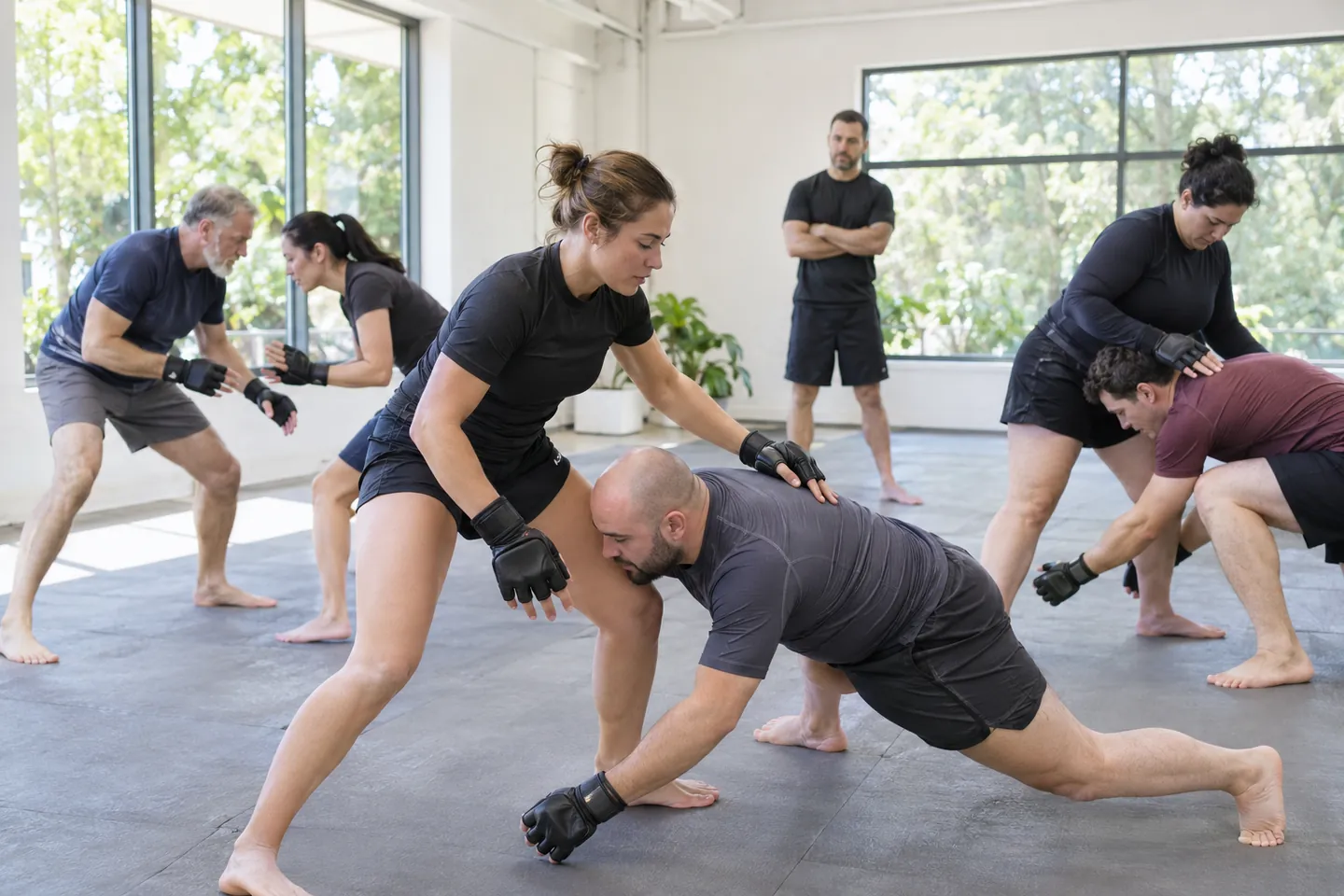
Wrestling skills are a major part of MMA, and they can be the most unfamiliar area for adult beginners. You may learn how to change levels, how to sprawl to defend a takedown, how to control an opponent’s arms and head in the clinch, and how to stay on your feet when someone tries to bring you down.
These drills are physically demanding. They involve a lot of hip movement, posture, and core strength. Many beginners find their legs and lower back working in new ways. That is normal, but it is also a reason to scale intensity sensibly in your first weeks and to tell your coach about any back, knee, or shoulder concerns.
Takedowns themselves are often introduced carefully, with emphasis on safe falling and controlled landings for your partner. Learning to fall, sometimes called breakfalling, is a basic skill that protects you during training. Take it seriously, even if it feels repetitive.
Ground work and getting back up
Once a fight reaches the ground in MMA, positions and goals change. Beginner ground work often draws from Brazilian jiu-jitsu and wrestling: holding positions, escaping from underneath, protecting yourself, and getting back to your feet.
One distinctive element of MMA ground work is that striking is part of the sport, which changes how positions are used. In beginner classes, striking on the ground is typically limited to light, controlled drilling with padded equipment, if it is included at all. Coaches introduce it gradually and only with clear rules.
Getting up from the ground is a skill that receives a lot of attention in MMA. Learning how to stand safely, create space, and return to your stance is useful for the sport and arguably for general self-protection awareness. It is also an excellent workout.
Sparring: when, how, and whether
The question beginners ask most often is whether they will have to spar. In most reputable gyms, the answer is no, not right away, and not without your agreement. Sparring is generally introduced after you have developed basic skills, and it comes with protective equipment, coach supervision, and agreed-upon intensity.
There are also different kinds of sparring. Positional sparring in grappling, light technical sparring in striking, and controlled situational drills are all ways to apply technique against resistance without the risks of hard contact. Many adults train for years doing these forms of practice and never engage in hard sparring at all.
If you have goals around competition, talk to the coaching staff about what that path looks like and what readiness involves. If your goals are fitness and skill development, say so. A good coach will respect both, and will match your partners and intensity accordingly.
Safety, health, and honesty with your coach
MMA involves contact, so safety is a shared responsibility. Before your first class, tell the coach about any injuries, surgeries, or medical conditions. If you have been inactive for a while or have health concerns, it is wise to speak with a doctor before starting a demanding new program.
During training, communicate. Tap early in grappling. Tell a partner if they are going harder than you are comfortable with. Step out of a drill if something feels wrong. The best training environments are ones where speaking up is normal and respected.
Protective equipment matters as well. A mouthguard is commonly required for many partner drills, and groin protection is often recommended. Shin guards and appropriate gloves may be used for striking drills. Your gym will tell you what is required at each stage.
Fitness expectations for adults
You do not need to be fit to begin an MMA class. You will become fitter by training. That said, MMA classes can be intense, and the mix of striking, grappling, and conditioning challenges almost everyone at first.
Scaling is part of smart training. Take breaks when you need them, reduce repetitions during conditioning, and treat the first month as an adjustment period. Some adults choose to supplement MMA with strength work or yoga to support recovery and resilience. Others start with two classes a week and add more once their body adapts.
Age is not a barrier in itself. Adults in their thirties, forties, and beyond take up MMA, often with goals that look very different from a competitor’s. Recovery may take longer, and that is something to plan around, but it is not a reason to avoid starting.
Etiquette and the culture of a good MMA room
A good MMA gym feels collaborative rather than aggressive. Partners help each other learn, experienced students look after beginners, and coaches set the tone. Ego tends to be discouraged because it leads to injuries and makes training worse for everyone.
Basic etiquette includes arriving on time, practising good hygiene, keeping nails short, wearing clean gear, and following the coach’s instructions closely. Treat your partners as people helping you improve, not opponents to defeat. Thank them after each round. These small habits make the room a place people want to return to.
If you ever feel uncomfortable with the intensity or behaviour of a partner, speak to a coach. A healthy gym takes those concerns seriously and adjusts pairings or reminds students of expectations.
Fitting MMA into adult life
Adult beginners in Mississauga are juggling jobs, commutes, families, and everything else. MMA can fit into that life, but it helps to be realistic. Two or three sessions a week is a common starting point. Rest days and sleep become important because the training is demanding.
Think about logistics too. If you commute along the 403 or deal with traffic around Square One after work, choose class times you can reliably attend. Pack your bag the night before. Keep a spare mouthguard in the car. These small arrangements remove friction and help you stay consistent.
Consistency matters more than intensity. A student who attends steadily for a year will usually learn more than someone who trains five times a week for a month and then stops because of fatigue or injury.
Getting started with MMA at Konga Fitness
Beginner MMA for adults is about learning a broad set of fundamentals, building fitness, and training safely with supportive partners. It does not require prior experience, a competitive goal, or a particular body type.
If you are curious, read more about our MMA classes, look at related programs such as Brazilian jiu-jitsu and Muay Thai, and book a free trial to try a session in Mississauga and talk with a coach about your goals.
Filed under
Keep exploring
More training insights await.