
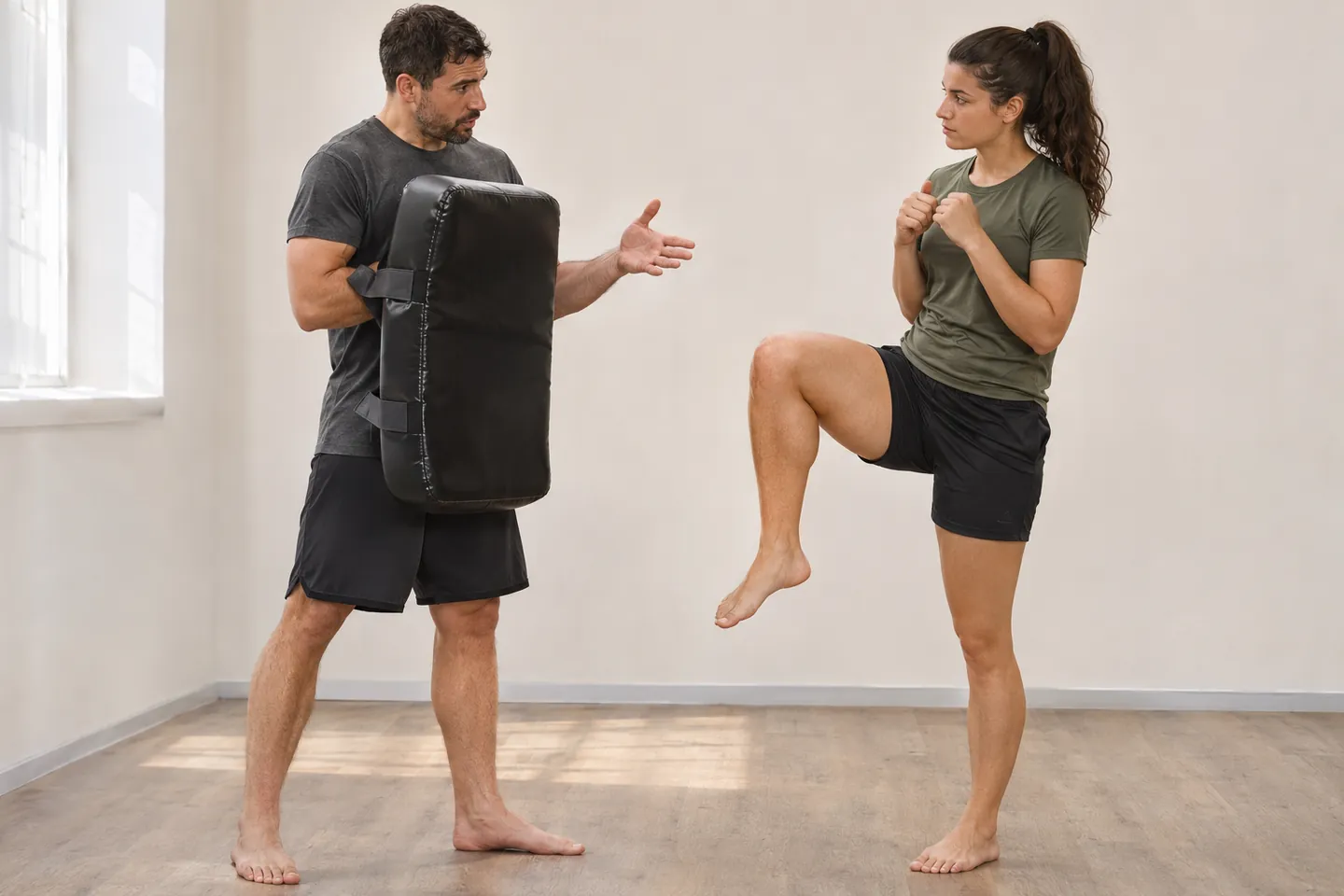
Understand how to approach Muay Thai knee pad drills in Mississauga with clear setup questions, respectful partner communication, and coach-led progression.
Knee drills can be unfamiliar even to someone who has tried other forms of exercise. The action may look compact, yet the lesson involves more than lifting a leg toward a pad. There is equipment to understand, a starting distance to establish, a partner to coordinate with, and a clear way to finish. For a beginner, those details deserve time.
If you are exploring Muay Thai knee pad drills in Mississauga, approach them as a coached learning task. The purpose of this guide is to help you ask better questions and participate responsibly, not to replace a live demonstration. A coach who can see your position and the equipment is the right person to choose the technical progression.
Clarify what the drill includes
The word “knees” can describe more than one class activity. Before starting, ask what the current exercise involves and which elements are deliberately excluded. A stationary pad drill, a sequence that includes movement, and a partner exercise with additional positioning are not automatically the same task. Understanding the scope prevents accidental improvisation.
Listen for the assigned beginning, the action, and the reset. Some beginners remember the striking part but miss the instruction about what happens immediately afterward. Ask the coach to show the whole repetition at a manageable pace. You should know how to stop in the intended position as clearly as you know how to begin.
If you have seen more complex examples online, leave them out of the beginner exercise unless the coach introduces them. Pulling, turning, or adding another strike can change the activity substantially. A shared drill works because both people know what is coming. Familiarity with a video is not permission to expand the task.
Put equipment questions first
Ask which equipment the coach wants used and how the holder should manage it. Pads and shields have different shapes and handling requirements. The person holding them needs instruction, not just a handover. If you are unsure about a strap, grip, or position, resolve that uncertainty before the striker begins.
Do not substitute an available object because it seems close enough. A spare cushion, folded mat, or piece of household equipment is not automatically an appropriate target. In class, follow the equipment selection made by the coach. Outside class, avoid recreating impact drills with improvised targets or untrained family members.
If equipment shifts during the exercise, stop and reset. The pad holder should not have to adjust silently while the striker continues. A clear pause gives both people time to understand the change. Restart only after the equipment and the assigned position are ready again, with the coach’s help when needed.
Establish the starting distance with guidance
Distance is difficult to judge when a movement is new. Standing where you think you should stand may leave you reaching, crowding the pad, or needing an unexpected step. Ask the coach to position the pair for the specific drill. Pay attention to that arrangement rather than relying on what looked correct from the side.
If you feel that you must lean or chase the target, describe the sensation. You do not need to decide the technical cause yourself. The coach can observe the next attempt and adjust the setup or movement. Useful feedback often begins with an ordinary description of what feels awkward.
Avoid correcting distance by moving the pad unexpectedly toward or away from your partner. The striker may already be following the previous setup. Stop first, discuss the issue, and ask the coach when the adjustment is unclear. Consistency helps a beginner understand which part of the movement is changing.
Keep the assigned intensity clear
A new drill can create nervous energy. Some students become overly tentative; others try to prove that they can strike hard. Neither response should determine the exercise. Ask the coach what level of effort is appropriate, then confirm that your partner understands the same expectation.
If the task is controlled learning, impact is not the main score. You may be concentrating on recognizing the setup, following a cue, or returning to the starting position. A louder repetition does not necessarily show improvement in any of those areas. Let the coach explain what a useful attempt looks like.
The pad holder can request a stop or adjustment at any time. Respond immediately. Do not treat their comfort as a challenge or suggest that a different partner would tolerate more. Respectful training depends on the person holding the equipment being able to communicate freely while the round is happening.
Learn the reset as a separate skill
After the action, notice whether you can return to the position the coach asked for. A beginner may focus so strongly on reaching the target that the finish becomes an unplanned step or a hurried retreat. The reset is worth practicing deliberately because it determines how clearly the next repetition can begin.
Ask whether the coach wants a pause between attempts. If so, use it. A pause can provide time to check the stance, hear feedback, and confirm the pad holder is ready. Removing it to make the exercise look continuous may erase the part of the lesson that helps you understand the movement.
When several actions are eventually linked, keep the same attention to the finish. The final repetition is not an invitation to collapse the position or turn away while the partner is still engaged. Wait for the agreed end of the drill, then relax and prepare for the next instruction.
Keep partner boundaries explicit
A pad drill does not automatically include holding, pulling, or moving another person’s body. Follow the exact contact rules explained by the coach. If an exercise includes a new form of partner contact, both people should understand it before starting. Ask how beginners are introduced to that element and what alternatives are available.
You can say that you need clarification or are not comfortable with an activity. A clear statement helps the coach respond. Do not rely on a nervous laugh or silence to communicate a boundary. Equally, when a partner expresses uncertainty, stop and involve the instructor rather than persuading them to continue.
Keep this distinction clear outside the gym as well. Learning a technique does not make it appropriate to demonstrate it on a friend, sibling, or coworker. If someone asks what you practiced, explain the lesson or show the equipment without making them an improvised target. The coached setting provides structure that casual demonstrations lack.
Ask for feedback in manageable pieces
A whole-body movement can attract many corrections, and beginners may struggle to remember them all. Ask the coach which point matters most for the next few attempts. That request organizes attention. You are not asking to ignore the other details; you are asking where to begin improving them.
Use the next repetition to test the chosen cue, then check whether the change was appropriate. Beginners sometimes exaggerate an instruction because they are eager to comply. A brief confirmation helps prevent a small correction from becoming a new misunderstanding. The coach can refine the cue based on what actually happens.
Your partner can support this process by staying consistent with the assigned role. They should not introduce a separate list of technical corrections while the coach is working on a specific point. Practical communication is welcome, but competing instructions can make it harder to recognize the adjustment you are supposed to practice.
Notice when the task needs a break
During a round, pay attention to whether you can still follow the drill and communicate clearly. If you are losing the sequence or the finish is becoming uncontrolled, tell the coach. A shorter practice block or simpler version may be more useful than continuing the same task with decreasing attention.
Pain or feeling unwell calls for stopping and communicating, not an argument about determination. Describe what happened and seek appropriate help. A martial arts lesson should not become an informal attempt to diagnose a symptom. Decisions about a medical concern may require someone with the relevant healthcare expertise.
Use planned breaks to reset equipment and hear the next instruction. You do not need to fill every pause with extra repetitions. Recovery time also creates a moment to ask the one question that has been bothering you. Returning with a clearer understanding can make the following round more productive.
Review the lesson without recreating impact at home
After class, jot down the drill’s name if the coach used one, the equipment involved, and the main cue. A short note preserves context for the next visit. Avoid writing a detailed technical manual from memory; it is easy to record an interpretation that the coach did not intend.
If you want home practice, ask specifically for a noncontact activity suitable for your space. It may be a simple position review rather than any striking motion. Do not ask a family member to hold a cushion so you can repeat the class. Their willingness does not replace training in the holder’s role.
At the next session, tell the coach what you remembered and where you were uncertain. This creates continuity without pretending that one lesson settled everything. Progress may appear as a calmer setup, a clearer stop signal, or a more deliberate reset. Each makes the exercise easier to teach and repeat.
Konga’s Muay Thai program offers a starting point for discussing coached practice. Through the free trial page, you can ask which session suits your experience and how beginner padwork is introduced. Arrive interested in the whole exercise, including the communication and setup. Those quieter details give the striking movement a useful structure.
Filed under
Keep exploring
More training insights await.