
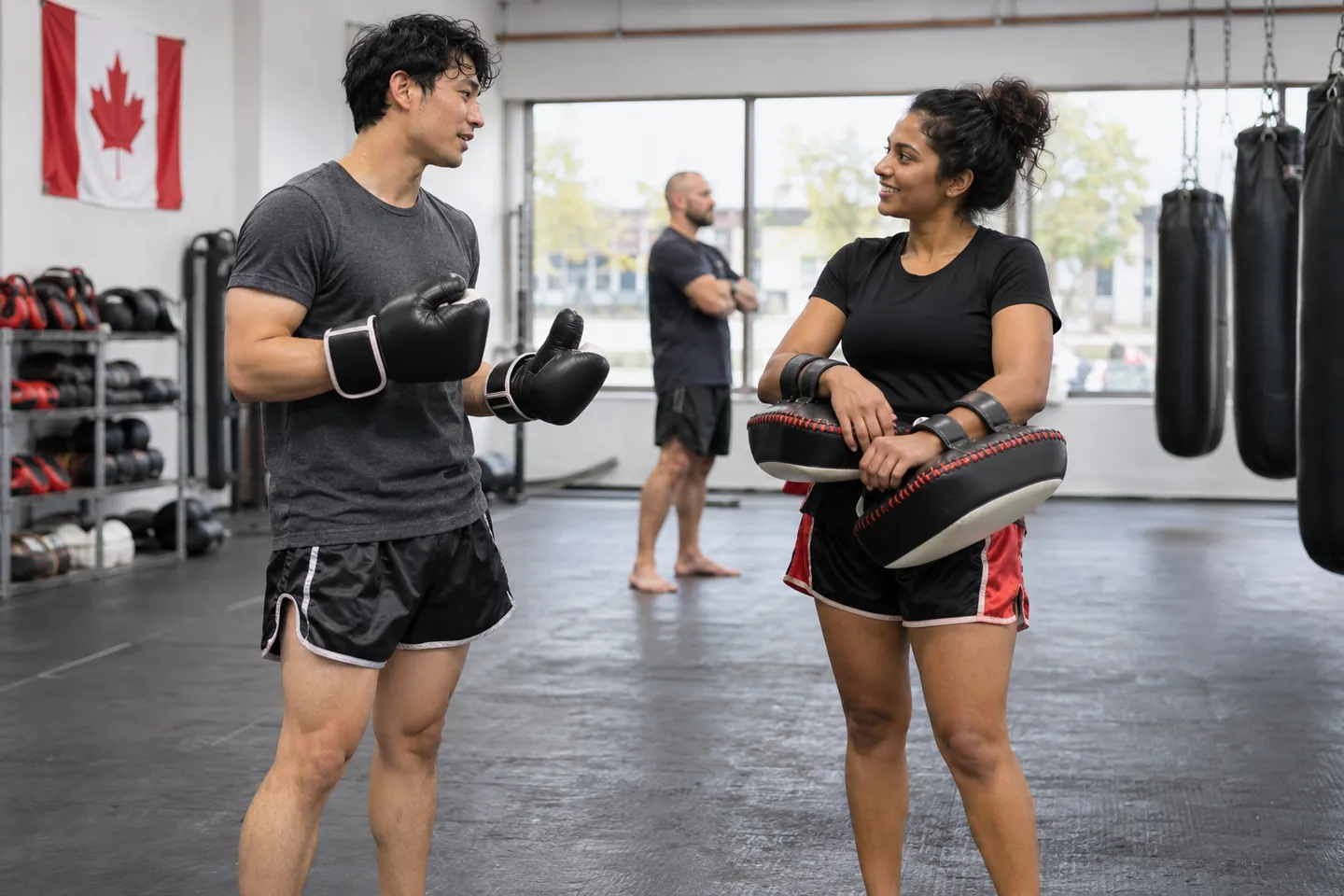
Make Muay Thai padwork in Mississauga clearer with practical ways to agree on drills, ask for adjustments, share feedback, and support a training partner.
A padwork round can go wrong without either partner making a dramatic technical mistake. One person expects a two-part combination while the other expects three. The pad holder starts moving before the striker is ready. A beginner feels uncomfortable but tries to be polite by saying nothing. These are communication problems, and they can interrupt learning just as quickly as a forgotten movement.
Good Muay Thai padwork in Mississauga begins before the first strike. Partners need to understand the exercise, the pace, their roles, and how to stop. None of this requires a long negotiation. A few clear words, supported by the coach’s instructions, make the round easier to follow. Communication is part of the skill being practiced, not an interruption to serious training.
Introductions carry useful information
When working with someone for the first time, introduce yourself and share relevant experience briefly. “This is my second class” gives a partner helpful context. So does “I have done the striking part, but I am new to holding these pads.” There is no need to recount your entire exercise history. Explain what affects the task in front of you.
Do not assume that a confident appearance means someone understands every role. A student can be comfortable wearing gloves and inexperienced as a pad holder. Likewise, a quiet partner may know the drill well but need a moment to hear it. Ask simple questions rather than assigning ability based on age, size, clothing, or confidence.
If you have a practical limitation that changes the drill, tell the coach first and confirm the agreed adjustment with your partner. Keep the description relevant. The partner needs to know what the pair will do, not private details you do not wish to share. Clear boundaries can coexist with a friendly, cooperative atmosphere.
Repeat the assignment in plain language
After the coach demonstrates, confirm the sequence together. Saying “We are doing the two actions, then resetting” may be enough if both people know what those actions are. If not, ask the coach to show the sequence again. Repeating uncertain terminology without understanding it does not create a shared plan.
Check whether the pad holder stays in place or moves, whether the sequence begins on a signal, and when the partners change roles. These details are easy to miss while concentrating on the striking technique. Yet they shape the entire round. A short clarification at the beginning prevents repeated interruptions later.
Avoid adding extra movements because they seem to fit. Your partner may be following the exact demonstration and will not know your private variation. A padwork drill is a shared task with agreed expectations. Creativity belongs where the coach invites it, after both partners understand the change.
Ask for pad-holding instruction
Holding pads is an active responsibility. If you do not know how the equipment should be positioned or secured, ask the coach before beginning. Do not infer the method from how another pair looks across the room. You may miss details about the particular equipment, the assigned movement, or the way the holder is meant to respond.
Explain uncertainty immediately. “I am not sure this strap is secure” or “I do not understand where this pad goes” gives the coach a specific issue to resolve. Trying to conceal the problem to avoid slowing the class can create more confusion for your partner. A brief pause is an ordinary part of learning a new role.
During the round, remain within the responsibilities the coach gave you. Holding pads does not automatically make you the other student’s technical coach. You can communicate what you need and report what happened, but major corrections should come from the instructor. This keeps feedback consistent and reduces conflicting advice.
Agree on effort before the round starts
The coach’s assigned intensity should guide the drill. Confirm that both partners understand it. If the task is controlled technique, neither person should quietly turn it into a power test. The striker’s excitement and the holder’s willingness to tolerate discomfort are not reliable substitutes for a clear instruction.
Use direct, ordinary language when an adjustment is needed. “Please slow that down” is clearer than laughing nervously and hoping the other person notices. “I need to stop and reset the pad” tells the partner exactly what to do next. You are not required to make a concern sound entertaining or apologetic to deserve attention.
The response matters as much as the request. If a partner asks to slow or stop, do so immediately and without argument. The pair can then ask the coach what should change. Debating whether the person ought to be comfortable wastes time and undermines the cooperation needed for the exercise.
Make stopping predictable
Ask the coach how the class signals a stop. Both partners should understand the signal before working. A clear verbal stop should be respected immediately; do not insist that a partner finish a combination first. Equipment can shift, attention can lapse, and a person can notice a problem midway through an action.
Once stopped, keep the conversation simple. Identify the immediate issue, make the agreed adjustment, and confirm readiness before restarting. If either person is uncertain, involve the coach. There is no benefit in restarting while the underlying confusion remains. The purpose of a pause is to restore a shared understanding.
Do not treat stopping as a failed round. A pair that recognizes a problem and responds calmly is practicing an important habit. The alternative is often a series of increasingly confused repetitions. A clean reset protects the learning task and shows that both people can trust the agreement they made at the start.
Give feedback that describes something observable
If the coach asks partners to offer feedback, keep it narrow. Describe what you saw or felt within your assigned role. “We started before I had the pads ready” is more useful than “Your timing is bad.” The first statement points to a specific event; the second gives a broad judgement without an obvious next action.
Limit the number of comments. A beginner receiving five suggestions after every attempt may become more confused than before. Choose the relevant point, then let the coach decide what should receive technical attention. The goal is to help the partner complete the exercise, not demonstrate how much terminology you know.
Positive feedback can also be specific. “That reset gave me time to get ready” tells the partner what worked. General encouragement has its place, but a clear observation helps someone repeat a useful behaviour. Keep the tone respectful and ordinary rather than turning every exchange into a performance review.
Receive corrections without defending every repetition
When a partner reports a practical problem, listen before explaining your intention. You may have meant to follow the signal, but they may still have been unprepared. The useful question is what the pair needs to change now. Long explanations about why the previous repetition should have worked rarely improve the next one.
If you disagree about the instruction, ask the coach together. Avoid competing demonstrations or arguments about what someone saw online. The instructor can clarify the current task and watch the pair attempt it. A shared demonstration is often faster than trying to settle a technical disagreement verbally.
You can acknowledge a correction without criticizing yourself. “Understood; let’s reset” is enough. Repeated apologies can make the partner responsible for reassuring you instead of practicing. Taking the feedback calmly keeps attention on the movement and shows that adjustment is a normal part of training.
Protect attention when the room gets busy
A training space can contain music, timers, movement, and several conversations. Face your partner when confirming instructions and speak clearly enough to be heard. If you cannot hear, ask for repetition rather than nodding automatically. Agreement only helps when both people actually understand what has been said.
Pause your own conversation when the coach addresses the class. A partner should not have to choose between listening to you and hearing the next instruction. Afterward, check any detail that affects your pair. Missing a change in roles or pace can undo an otherwise smooth round.
If language differences make the drill harder to understand, ask for a demonstration and use concise phrases. Avoid speaking faster or adding more jargon. The coach may be able to simplify the instruction or show the sequence in smaller parts. Patience is more productive than assuming someone is inattentive because they need another explanation.
Finish the round with a useful handover
When roles change, stop fully before exchanging equipment. Check that the next holder understands the setup and that the striker is ready. A rushed handover can carry confusion into the new round. Treat the transition as part of the exercise rather than empty time between the interesting parts.
At the end, thank your partner and share one useful observation if appropriate. Perhaps the pace worked well or the start signal became clearer. You do not need to deliver a detailed critique. A cooperative finish makes it easier to work together again and reinforces the habits that helped both people learn.
For adults exploring Muay Thai at Konga, partner communication is a practical subject to ask about during a first visit. Learn how the coach introduces pad holding, signals changes, and supports beginners. Clear words will not replace technique, but they create the conditions in which technique can be taught and practiced with mutual attention.
Filed under
Keep exploring
More training insights await.