
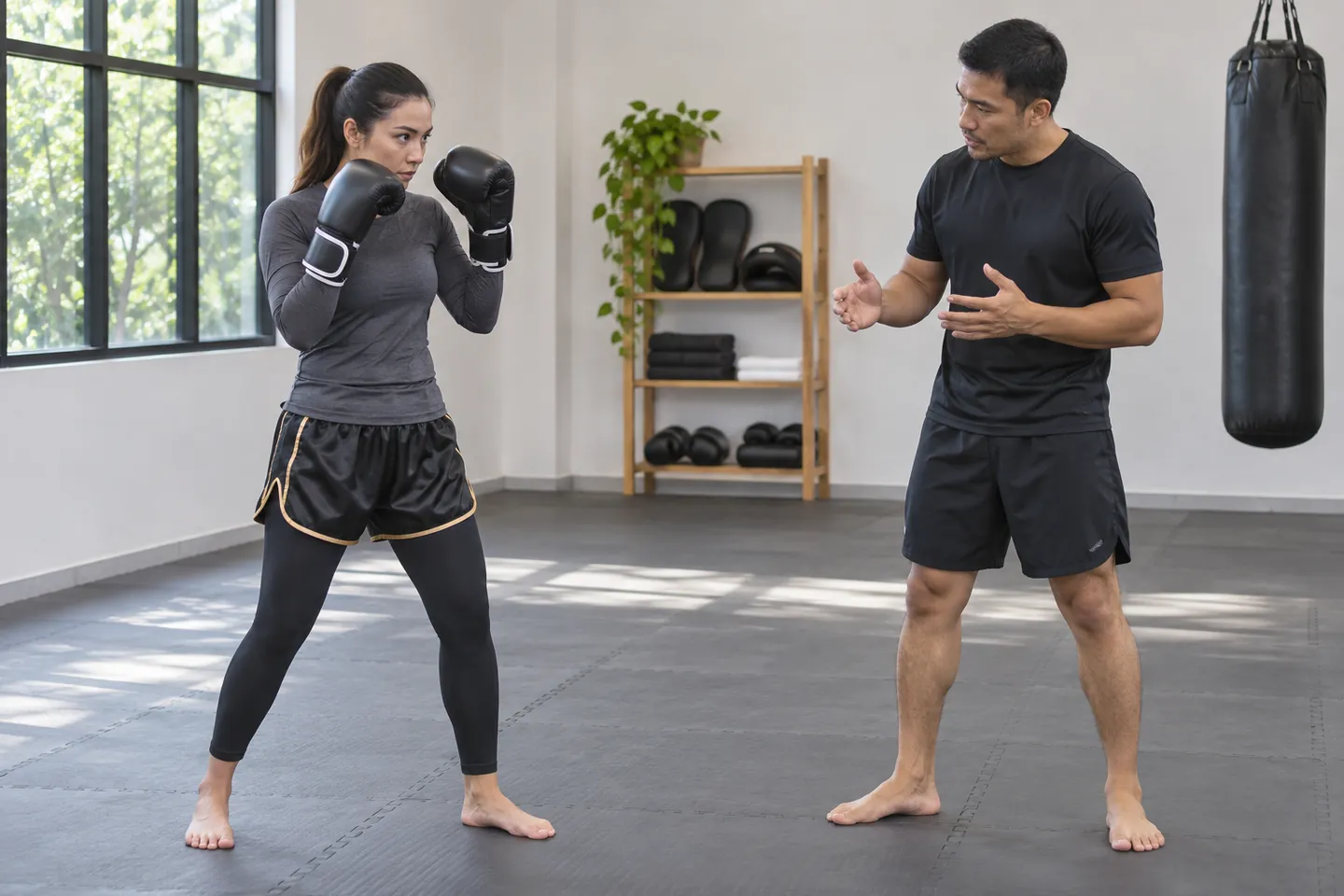
Build a thoughtful approach to Muay Thai stance and guard in Mississauga, with coach-led practice, useful questions, and simple ways to notice progress.
A stance looks simple until you try to keep it while doing something else. Standing where a coach places your feet is one task. Remembering that position after a step, a punch, or a moment of distraction is another. For beginners learning Muay Thai in Mississauga, stance and guard are useful early subjects because they connect almost everything that follows.
They also invite overthinking. Online images can make a beginner believe there is one perfect pose that must be copied exactly. In a real class, the coach is teaching a position for a particular person and exercise. Your job is to understand that instruction, practice returning to it, and notice when the movement becomes difficult. A still photograph cannot replace that process.
Start with the purpose of the position
Ask your coach what the stance is meant to help you do during the current drill. The answer might concern moving comfortably, returning after a strike, or being ready for the next instruction. A clear purpose turns foot placement into a practical task. You are less likely to freeze into an exaggerated pose when you understand that you will need to move again.
Guard has a similar purpose. It is not simply a pair of gloves placed somewhere near your face for a photograph. It is part of the position you are learning to maintain and recover during the exercise. The precise details belong with the coach, who can see your shoulders, elbows, hands, and overall posture together.
Avoid deciding that a stance is wrong because it differs from a clip featuring an experienced athlete. Different activities, coaching approaches, and situations can produce different appearances. In a beginner class, first learn the version being taught. If you notice a difference elsewhere, bring it up as a question rather than silently replacing the instruction.
Let the coach establish your starting point
Tell the coach which hand you normally use for writing and whether you have trained in another striking sport. Do not assume that you should choose a stance solely from an online quiz. Previous habits and the immediate exercise may influence what the coach wants you to practice. A short conversation saves you from repeatedly changing sides on your own.
Once you have a starting position, learn how to find it without looking down for a long time. You may initially need visual confirmation, and that is understandable. Ask for a simple cue that helps you reset. A cue should make the position easier to recognize, not add a paragraph of instructions to every repetition.
Treat comfort as useful feedback, while remembering that unfamiliar does not automatically mean unsuitable. If you feel pain, stop and explain it. If you merely feel unsure where your weight belongs, ask for clarification. Those are different problems and should not receive the same response. Clear descriptions help the coach decide what needs changing.
Work on one relationship at a time
A beginner can hear a list of corrections and try to obey all of them simultaneously. The result is often a rigid body and a busy mind. Instead, ask which detail deserves attention first. Perhaps the feet keep narrowing after a step, or the hands drop whenever a movement ends. Choose the coach’s priority and make that the focus of a short practice period.
This approach does not mean other details are unimportant. It means attention is being organized. When the chosen correction begins to make sense, the coach can add another layer. A good training note might say, “Reset before the next repetition.” It does not need to catalogue every joint position you were asked to consider that evening.
Be precise when explaining what is confusing. “I lose the stance when I step backward” is a useful observation. It tells the coach when the issue appears and suggests a movement to watch. “My stance is bad” offers a judgement without much information. Learning improves when the conversation describes an action rather than assigning a label.
Connect the hands and feet gradually
It is common to maintain a guard while standing and forget it as soon as the feet move. The opposite can also happen: concentrating on the hands may leave the feet wandering into an uncomfortable position. This is a coordination problem to work through, not proof that you lack ability. Reduce the complexity until both parts can receive attention.
For example, the coach might have you practice a single step and return before adding a strike. Follow the assigned progression. If a combination is introduced, pay attention to the finish as well as the beginning. The last movement should not become an excuse to abandon the position and wait loosely for the next command.
Do not accelerate just because a few repetitions feel better. First see whether you can repeat the same task several times without losing its purpose. Speed can make a movement feel more fluent while hiding a detail you have not yet learned. Your coach can decide when the exercise is ready for an additional challenge.
Use mirrors and video carefully
A mirror can help you notice a large change in position, but it can also encourage you to stare at your reflection instead of following the drill. Ask whether mirror work is appropriate for the exercise. If it is, use it to check one visible point, then return your attention to the movement and the coach’s instructions.
Video can be useful when the gym permits recording and everyone who appears has agreed. A short clip of your own practice may reveal a habit you did not feel. However, filming should not interrupt the class or capture other students without permission. The purpose is learning, not gathering a highlight reel from a shared training space.
When reviewing a clip, compare it with the specific coaching cue you received. Avoid treating every difference from a professional athlete as a fault. An experienced practitioner may be responding to circumstances that are absent from your drill. Ask your coach to interpret what you see before rebuilding your stance around a single camera angle.
Notice the return after each action
Beginners naturally focus on the exciting part of a technique. The punch or kick feels like the event, while the return seems like empty space. Yet the return is where you can check whether the original position is still available. Ask yourself whether you can comfortably stop, listen, and begin the next movement as instructed.
If you finish off balance or with your hands elsewhere, do not rush into the following repetition to hide it. Pause and reset. That pause creates an opportunity to notice what happened. The coach may reduce the range, simplify the movement, or change the way you are approaching it. Accept that adjustment as part of learning.
A useful partner can also remind you of the agreed focus, provided the coach has invited that kind of feedback. Keep it descriptive and brief. “You finished with your feet together” is easier to act on than a stream of competing instructions. Partners should not turn a beginner drill into an unsolicited technical seminar.
Recognize when effort is becoming tension
Trying hard can lead to gripping everything tightly, lifting the shoulders, or holding an exaggerated posture. A beginner may interpret that sensation as seriousness. Ask your coach what level of relaxation is appropriate between actions and what should remain organized. The answer will depend on the task, so avoid universal rules drawn from an isolated tip.
Take the rest periods provided and use them to reset. If you can no longer follow the assigned movement or maintain control, communicate that rather than forcing more repetitions. Quality practice requires enough attention to understand what you are doing. Fatigue does not make every mistake meaningful or every additional repetition useful.
Pain deserves a different response from ordinary uncertainty. Stop a movement that hurts and explain the location and circumstances without trying to diagnose yourself. A class coach can modify an exercise but cannot settle every health concern on the mats. Seek appropriate professional guidance when needed before deciding how to continue training.
Practice between classes without inventing a syllabus
Ask for one simple, noncontact task you can safely repeat at home if you want extra practice. It might involve finding the starting position or rehearsing a slow reset in a clear space. Use the exact version the coach approved. Furniture, slippery floors, and other people can make a living room a poor place for energetic striking drills.
Keep the practice short enough that you remain attentive. A few careful attempts followed by a note about your question can be more useful than repeating a confusing movement for a long time. If something feels different at home, do not force it to match your memory. Bring the uncertainty back to class for a demonstration.
You do not need to turn every free moment into training. Consistent attendance gives the coach opportunities to observe and adjust your work. Between sessions, preparing your equipment and making the next visit easy are legitimate contributions to progress. Skill development needs a repeatable setting as well as personal enthusiasm.
Measure familiarity, not perfection
Early progress might mean finding your stance more quickly, remembering the guard after one particular movement, or noticing a reset before the coach reminds you. Those changes are small but useful. They show that an instruction is becoming something you can recognize and apply rather than merely repeat aloud.
The Muay Thai program offers a place to explore these fundamentals with coaching. If you are considering a first visit, use the free trial page to ask about an appropriate session. Arrive ready to learn a starting position, ask a focused question, and return to the basics whenever the exercise becomes complicated. A reliable stance develops through that ordinary, patient work.
Filed under
Keep exploring
More training insights await.