
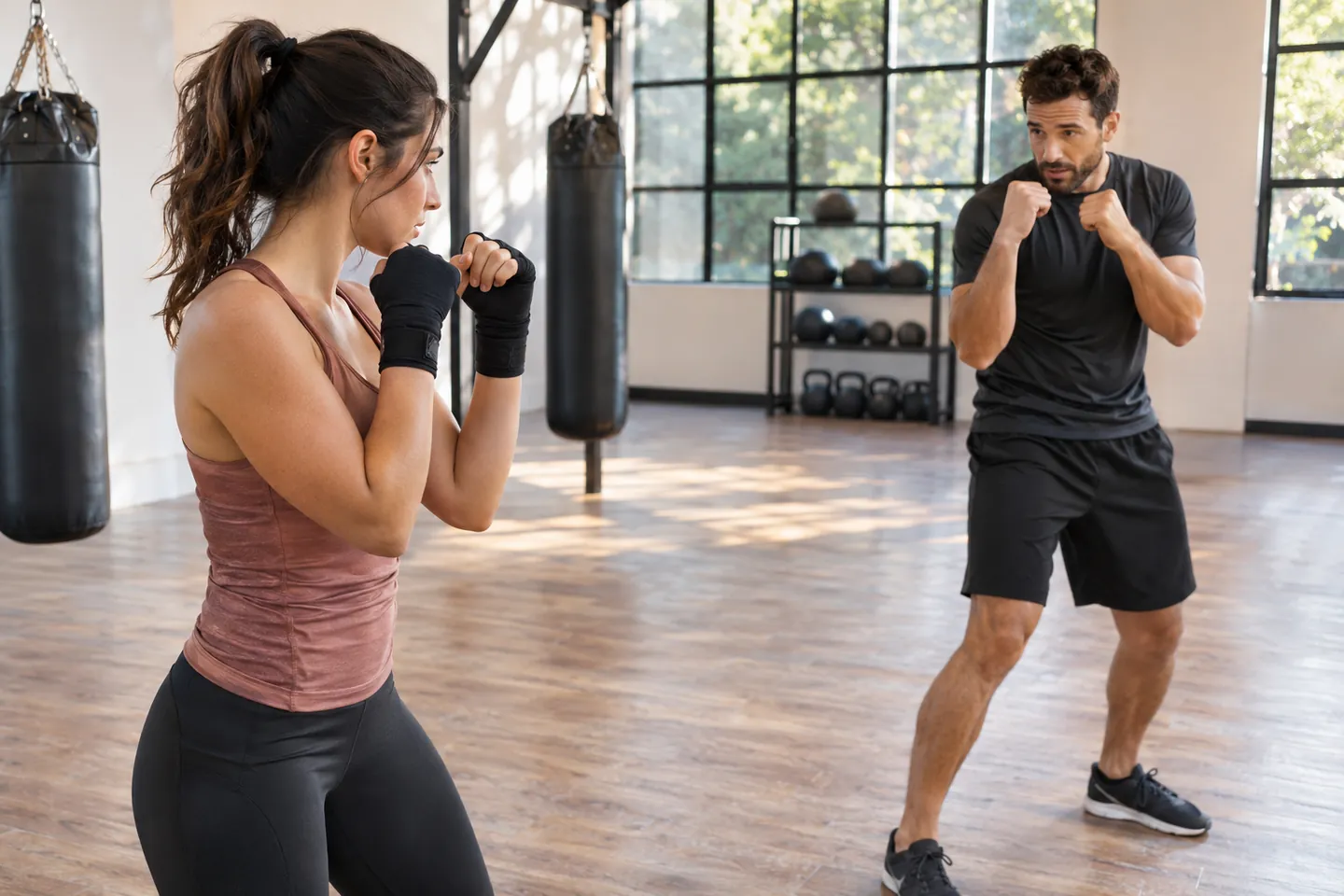
Explore noncontact boxing defence in Mississauga through coached guard practice, movement awareness, clear drill boundaries, and realistic learning expectations.
Learning boxing does not have to begin with someone throwing punches at you. A coach can introduce guard position, movement, and awareness through noncontact tasks that make the basic ideas easier to understand. For adults who want to explore the skill without partner contact, this distinction matters. You can ask about the learning content and the boundaries at the same time.
Noncontact boxing defence in Mississauga should be discussed in clear terms. A drill may teach a movement associated with defence, but rehearsing that movement alone is not the same as testing it against an opponent. Understanding that difference helps you set useful goals. You can value the lesson without making claims about fighting ability or assuming that a fitness session prepares you for real-world confrontation.
Define what noncontact means in the session
The word noncontact can be used loosely, so ask the coach what will happen in the actual drill. Will you practise alone? Will a partner stand nearby and provide a visual cue? Will equipment move toward you? Are participants expected to touch each other at any point? Clear answers allow you to decide which activities fit your preferences.
State your boundary before the exercise begins. You can say that you want to practise movements without strikes directed at you or without any partner contact. The coach can then explain suitable options and any limits of the class format. You do not need to justify a noncontact preference with a personal story.
If the task changes, revisit the agreement. A drill that starts with solo movement should not quietly become a contact exercise because the group is progressing. Ask what the next version includes and choose participation based on the new information. Consent to one activity is not a blanket agreement to every variation.
Start with the position you return to
A guard is often introduced as a hand position, but beginners also need to understand the stance and attention that accompany it. Ask the coach to demonstrate the starting arrangement and explain what you should recognise when you return to it after moving.
Practise finding that position without rushing. You may initially need to check your feet, bring your hands into place, and look forward deliberately. That sequence can become more familiar over time. There is no need to pretend it is automatic before you have learned it.
The aim is a usable reference, not a frozen pose. Ask how to maintain the intended arrangement while taking a small step or performing a familiar punch. Returning to a clear position after an action is a practical beginner lesson that can be explored without another person striking at you.
Understand the purpose of each movement
Defensive terminology can sound more advanced than the task actually is. If a coach introduces a movement such as a slip or a step away, ask what you are meant to learn from the noncontact version. The answer may concern direction, body organisation, or returning to stance rather than responding to a live punch.
Watch a slow demonstration and pay attention to the amount of movement. Beginners may make actions much larger than intended because they want the movement to feel obvious. Ask the coach to show the beginning and ending positions, then rehearse within the instructed range.
Avoid teaching yourself dramatic head or torso movements from short clips. A movement performed by an experienced boxer in a particular situation may not translate into an appropriate beginner exercise. Direct coaching helps keep the practice matched to your current understanding and the class’s purpose.
Use visual cues that everyone understands
A coach may use a simple visual or verbal signal to prompt a movement. The cue should be clear enough that you know what response is expected. If the signal is ambiguous, ask for it to be simplified before increasing the pace.
For example, a direction cue can be used to practise a short step and reset without anyone aiming a strike at you. The learning task is recognising the cue and organising the response. It does not need to imitate a full exchange to be useful at this stage.
If a partner provides the cue, confirm their role too. They should not add unexpected movements or try to surprise you unless that is an explicitly explained and agreed part of an appropriate drill. Predictable practice creates room to learn the basic response before more complexity is considered.
Keep movement small enough to examine
A large movement can feel convincing while making it difficult to return to the starting position. During introductory practice, follow the coach’s requested range and notice how easily you can reset. The ending matters because it shows whether you remain organised for the next instruction.
Move slowly enough that the instructor can observe the action and you can understand the correction. If you lose the stance or need several extra steps to recover, pause and ask which part to adjust. The issue may be the distance travelled, the starting position, or a misunderstanding of the cue.
Do not force a position that feels uncomfortable. Stop and discuss the problem, and seek appropriate individual advice when needed. General technique descriptions cannot determine why a movement causes symptoms or whether it suits your circumstances.
Separate awareness from anticipation
When a drill is predictable, beginners sometimes begin moving before the cue appears. That may help them finish quickly, but it changes the exercise if the purpose is to observe and respond. Ask the coach whether you should wait for the signal or rehearse a known sequence.
This distinction is not about catching you out. It helps define what you are practising. A memorised movement pattern and a response to a cue are different learning tasks. Both can be useful, but you should know which one the coach intends.
If you find yourself guessing, slow the drill and restore a clear pause between attempts. Give yourself time to look, understand, and act. The goal is not to prove that you can react faster than your partner. It is to make the relationship between cue and movement clear.
Connect defence-themed movement to a familiar reset
Once an individual movement is understood, the coach may connect it to a simple action you already know. You might move, return to stance, and then perform a familiar noncontact punch. The connection should be taught gradually so that you understand where each part begins.
Keep the sequence short. Adding several movements at once can turn the drill into a memory challenge and obscure the original lesson. If the first action leaves you in an unfamiliar position, address that before making the sequence longer.
Ask what the ending should look like. Are you returning to the original spot, facing a different direction, or waiting for another cue? A defined finish gives the practice a complete shape and makes it easier for the coach to provide specific feedback.
Avoid treating rehearsal as proof of protection
Being comfortable with a movement in a noncontact drill does not establish how you would respond under pressure or in a real confrontation. Keep the claims about your progress close to what you have actually practised. You may be learning a stance, recognising a cue, or organising a step more clearly.
This realistic framing does not diminish the value of the class. A skill can be interesting and worthwhile without carrying a promise about personal safety. If your goal is self-defence, discuss that explicitly with a suitably qualified provider and ask what their instruction includes. Do not assume that any boxing-themed fitness drill serves the same purpose.
Likewise, noncontact defence practice is not a substitute for competitive preparation. The environments and demands differ. Your current goal can remain recreational learning, movement practice, or participation in a noncontact class without needing to borrow the claims of another setting.
Make the group environment work for you
In a class, tell the coach when a demonstration is difficult to see or when you are unsure of the boundaries. Standing where you can observe the instructor clearly may solve confusion before it becomes repeated movement errors. Ask whether a side view would help.
Choose a partner arrangement that the coach considers appropriate and communicate plainly. If your partner begins changing the drill, stop and ask the instructor to clarify. You do not need to negotiate technical progression alone or continue because you worry that pausing will seem unfriendly.
Respect other participants’ preferences as well. Do not pressure someone to try contact, dismiss their questions, or assume that experience removes the need for agreement. A good learning partnership depends on both people understanding the same task.
Review what you actually learned
After the session, describe progress in concrete terms. Perhaps you can find your guard more readily, return after a small movement, or follow a visual cue without guessing. Those observations identify real learning without exaggerating its scope.
Write down any boundary or format question for the next visit. If the class is not a good match for your noncontact preference, ask about other suitable options rather than trying to ignore the mismatch. The right routine needs to fit both your learning goals and your participation choices.
When enquiring about boxing instruction, ask directly how noncontact beginners learn stance, movement, and defence-related concepts. Clear answers make it easier to choose a class thoughtfully. You can learn meaningful parts of boxing while keeping the task, the limits, and the next step understandable.
Filed under
Keep exploring
More training insights await.