
How teen athletes in Mississauga can use the off-season for supervised strength and conditioning, with sensible priorities, recovery, and realistic expectations.
For a lot of teenage athletes, the year is a blur of practices, games, tournaments, and school. Hockey runs into spring, soccer runs through summer, basketball fills the winter, and some teens play two or three sports in overlapping seasons. When a break finally arrives, it is tempting either to do nothing at all or to try to make up for lost time with a punishing training plan.
Neither extreme tends to serve young athletes well. The off-season is a chance to rest from the specific demands of one sport while building general qualities like strength, movement control, and conditioning that support everything else. For teens in Mississauga, where club sports and school teams keep many families busy year-round, a sensible off-season plan can be one of the more useful things a young athlete does.
This article is written for teens and the parents who drive them around. It looks at what off-season training is for, what good supervision looks like, and how to keep the focus on long-term development rather than quick results.
What the off-season is actually for
The term “off-season” can be misleading. It does not have to mean no activity, and it does not mean training as hard as possible in a different setting. It is better thought of as a change of emphasis.
During the competitive season, most of an athlete’s energy goes into practices, games, and recovering between them. There is little room to work on general strength or to address movement habits that might be holding them back. The off-season frees up some of that time and energy.
Done well, off-season work can help a teen return to their sport with a stronger base, more confidence in how their body moves, and a better understanding of how to train. Done poorly, it can lead to burnout, nagging aches, or a teen who arrives at preseason already tired. The difference often comes down to planning and supervision.
Rest comes first
Before any structured training, many athletes benefit from a period of genuine rest after a long season. That might be a week or two of lighter activity: swimming, cycling, walks along the Credit River trails, casual pickup games, or simply more sleep and time with friends.
This break matters physically and mentally. Teens who move straight from a demanding season into an intense training block can carry fatigue forward, and the enthusiasm they need for the next season can fade. Coaches and parents sometimes underestimate how much the mental side of a season takes out of young people.
If a teen has been dealing with pain or an injury during the season, the off-season is a sensible time to have it assessed by a qualified healthcare professional, such as a physiotherapist or physician, before starting new training. Building strength around an unaddressed problem is not a good plan.
Why supervision matters for teens
Strength training can be appropriate for teenagers when it is well designed and properly supervised. The concerns people sometimes raise usually come down to poor technique, excessive loads, or unsupervised attempts to copy programs meant for adult athletes.
A qualified coach does several things a teen cannot easily do alone. They assess how the athlete moves, choose exercises that suit their current ability, teach technique carefully, and decide when it is appropriate to add load. They also notice signs of fatigue, frustration, or discomfort that a young person might ignore in order to keep up.
Parents can reasonably ask a prospective coach how they work with teens, how they progress training, and what they do when an athlete reports pain. Clear, thoughtful answers are a good sign. Vague promises about rapid gains are not.
Building a general foundation before sport-specific work
There is a temptation to make every exercise look like the sport. A hockey player wants to train like a hockey player, and a basketball player wants to jump all the time. Some sport-specific work has its place, but the off-season is often the best time to build general athleticism that the in-season schedule leaves little room for.
A general foundation usually includes basic movement patterns: squatting, hinging at the hips, pushing, pulling, lunging, and carrying. It also includes trunk control, balance, and the ability to land and change direction safely. These are the building blocks that make sport-specific training more effective later.
Teens who play one sport year-round may have particular gaps or imbalances. A soccer player might have strong legs but limited upper-body strength. A swimmer might move well in the water but lack experience with landing and cutting. A good coach will look at the whole athlete, not just the sport they play.
Technique before load
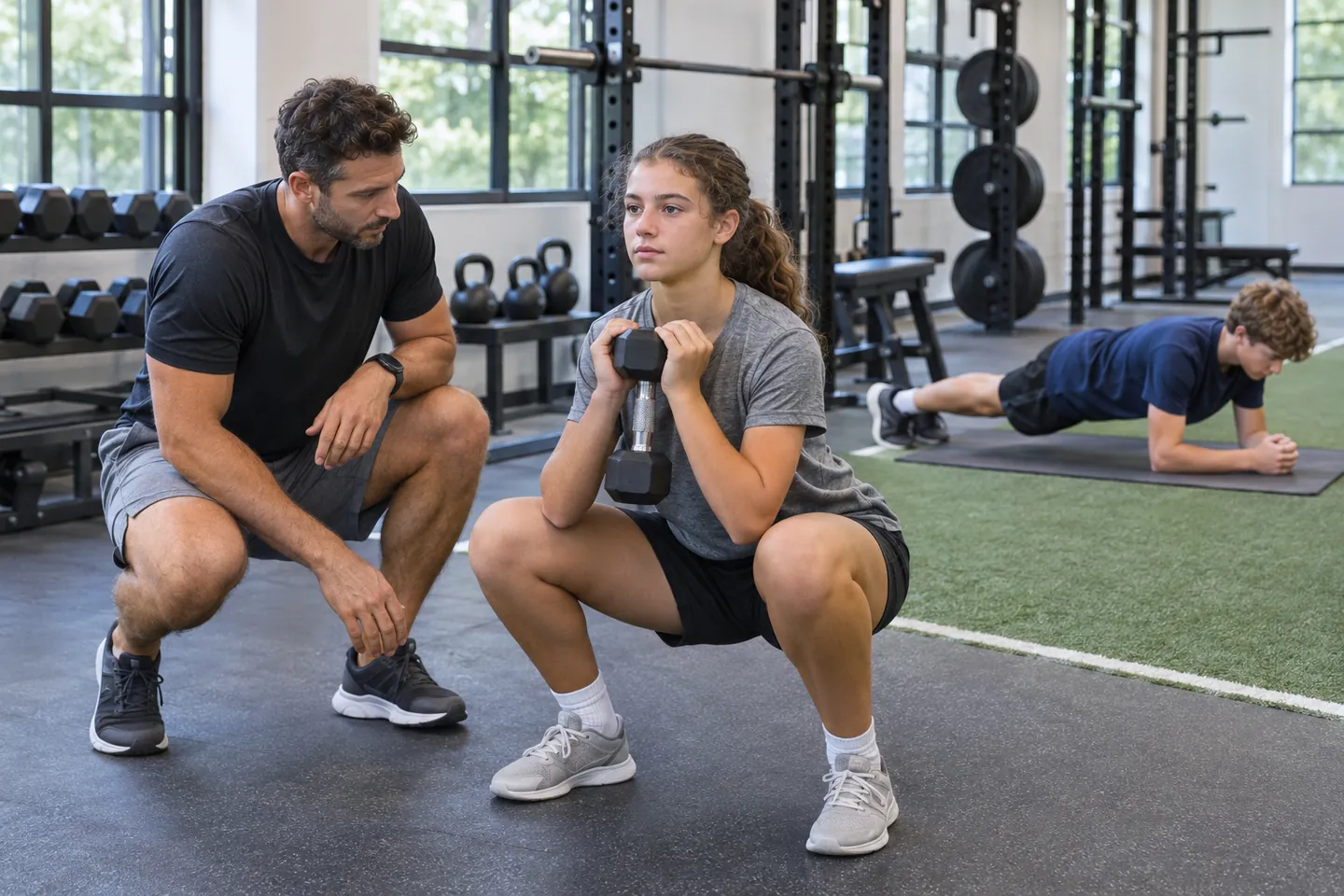
The most important rule in teen strength training is simple: learn the movement well before making it heavy. A squat with a light dumbbell or even just body weight, performed with good control, teaches more than a heavy squat performed poorly.
Coaches often begin with body-weight versions, then progress to light implements like dumbbells, kettlebells, or a light bar. Load increases gradually, and only when technique holds up across multiple sessions. Some teens find this frustrating, especially when they see older athletes lifting more. It helps to remember that the goal is years of healthy training, not one impressive lift.
Teens should feel comfortable stopping a set if something feels wrong. Pain, sharp discomfort, or a sense of losing control are all reasons to pause and talk to the coach. Pushing through those signals is not toughness. It is a missed opportunity to learn.
Conditioning without burning out
Conditioning is the part of off-season training that teens sometimes dread, often because they associate it with punishment drills. It does not have to be like that. Good conditioning builds the capacity to work hard, recover between efforts, and keep technique together when tired.
A variety of methods can help: intervals on a bike or rower, circuits with moderate effort, skipping, sled pushes, and sport-related drills performed at controlled intensity. The mix should reflect the athlete’s sport and current fitness. A teen who plays a stop-and-start sport like basketball may need different conditioning from a long-distance runner.
The key is to build gradually. A conditioning session that leaves a teen exhausted for days is not productive. Coaches typically increase volume and intensity across weeks, with lighter sessions built in, so the athlete adapts rather than simply surviving.
Combat sports as off-season cross-training
Some teens use the off-season to try something completely different. Martial arts like boxing, kickboxing, Muay Thai, and Brazilian jiu-jitsu can offer conditioning, coordination, and a new kind of challenge, along with a mental break from their main sport.
These activities can complement strength work well. Boxing and kickboxing build footwork, rhythm, and upper-body endurance. Jiu-jitsu develops grip strength, body awareness, and the ability to stay calm under pressure. Many teen athletes find that learning a new skill restores some of the enjoyment that a long season can wear down.
It is worth being thoughtful about load, though. Adding several martial arts classes on top of strength training and summer jobs can quickly become too much. Start with one or two classes a week and see how the body responds.
Recovery, sleep, and food
Teenagers are still growing, and their bodies have a lot going on. Training adds to that load. Recovery is not a bonus. It is part of the program.
Sleep is the most obvious and most neglected factor. Many teens stay up late, especially in summer, and then train early. Consistent sleep supports both training and general well-being. Parents can help by encouraging a reasonable routine without turning it into a battle.
Food matters too. Active teens generally need regular meals and snacks to fuel training and growth. Restrictive diets aimed at changing weight or appearance are not appropriate for most young athletes without guidance from a registered dietitian or physician. If a teen has questions about nutrition, those professionals are the right people to answer them.
Balancing training with summer life
Summer in Mississauga brings its own schedule: part-time jobs, family trips, summer school, volunteer hours, and plenty of social plans. An off-season program that ignores all of this is unlikely to last.
Two or three supervised sessions a week, combined with some general activity, is a realistic structure for many teens. That leaves room for rest, other commitments, and simply enjoying the break. If a family vacation interrupts a few weeks, that is fine. Training can resume afterward without much lost.
Teens should have a say in their off-season plans. When they understand why they are doing something and have some ownership over it, they are more likely to stay engaged. A plan imposed entirely by adults can feel like another obligation in an already busy year.
Tracking progress the right way
It is natural to want to see improvement. Rather than focusing only on numbers like maximum lifts, it can be more helpful to track things like technique quality, consistency of attendance, how a session feels compared to a month earlier, and whether movements that used to be awkward now feel comfortable.
A coach might periodically reassess certain movements or simple fitness markers, but those should serve the athlete’s development rather than become a source of pressure. Teens are often already dealing with performance anxiety in their sport. Off-season training can be a place where progress feels steady and personal.
Parents can help by praising effort, consistency, and learning, rather than only outcomes. A teen who has shown up reliably and learned to squat well has had a successful off-season, regardless of any number on a bar.
Preparing for the return to sport
As the competitive season approaches, training typically shifts. General strength work may reduce slightly, and more sport-specific preparation, including skills, speed, and conditioning that resemble game demands, may increase. Coaches from the athlete’s sport and the strength coach ideally stay in communication so the transition is smooth.
The goal is for the athlete to arrive at preseason feeling prepared rather than worn out. If a teen is showing signs of persistent fatigue, low motivation, or recurring aches as the season approaches, it is worth scaling back and talking with the coach or a healthcare professional.
Getting started in Mississauga
If your teen is looking for a structured, supervised way to use their off-season, our strength and conditioning program focuses on technique, gradual progression, and individual attention. Some families prefer one-on-one personal training for a more tailored start. To see how a session feels before committing, you can book a free trial and talk with a coach about your athlete’s sport and schedule.
Filed under
Keep exploring
More training insights await.