
Plan a steadier approach to beginner Muay Thai rounds in Mississauga with clear effort expectations, useful breaks, partner communication, and class reflection.
The opening minute of a class can be misleading. You feel fresh, the room has energy, and the first drill seems manageable. A new student may respond by doing every action as quickly and forcefully as possible. Later, when the coach adds a technical detail, there is little attention left to absorb it. The class becomes an exercise in getting through the timer rather than learning the task.
Pacing Muay Thai rounds in Mississauga starts with understanding what each round is meant to accomplish. A technical drill, a partner exercise, and a conditioning activity may call for different approaches. You do not need to guess at the hardest possible version. Ask the coach what effort fits the assignment and learn to communicate when the quality of your work changes.
Replace the idea of one permanent intensity
Beginners sometimes arrive with a simple rule: if exercise is useful, harder must be better. That rule does not account for learning a movement or coordinating with a partner. A controlled round can be demanding in a different way from a fast one. It asks you to listen, remember, and repeat a specific action rather than produce the most visible effort.
Before the round, identify the task. Are you rehearsing a new combination, practicing a known sequence, or following a separate conditioning instruction? Ask if the distinction is unclear. Once the purpose is understood, effort becomes something chosen to support it rather than a measure of how seriously you take the class.
Do not assume the same approach should continue throughout the session. The coach may change the focus or ask the group to slow down for a demonstration. Respond to the current instruction. Carrying the intensity of one activity into the next can make an otherwise manageable drill unnecessarily confusing.
Begin with room to listen
During a new exercise, leave enough attention available to hear corrections and notice your partner. If you are immediately so occupied with effort that you cannot follow the sequence, tell the coach. The starting pace may need adjustment. The aim is to understand the movement while practicing it, not to postpone understanding until after the class.
A useful early question is whether you can still identify the beginning and finish of each repetition. If the sequence has become a blur, you may be moving beyond the pace that currently supports learning. Slow or simplify as directed. This gives the instructor a clearer view of what needs correction.
Resist copying the pace of an experienced student nearby. They may be practicing familiar movements or following a different instruction. You cannot see their entire training history from the next station. Your assignment should determine your effort, and your coach can help you understand how that assignment changes over time.
Agree on the round with your partner
A pair needs a shared expectation before padwork begins. Confirm the sequence and the requested level of effort. If one person expects controlled practice and the other expects a hard round, both are likely to feel frustrated. A short conversation at the beginning prevents the disagreement from being expressed through the equipment.
Use straightforward language during the round. “Can we slow the sequence?” or “I need a reset before the next one” tells the partner what to change. You do not need to justify every request with a long explanation. If the adjustment is unclear or affects the drill’s purpose, bring the coach into the conversation.
When your partner asks for a change, respond promptly and without comparison. Their request is information about the shared task. It is not an invitation to discuss who is fitter or who worked harder in a previous class. Cooperation makes the round repeatable for both people and keeps the coach’s instruction central.
Treat breaks as part of the session
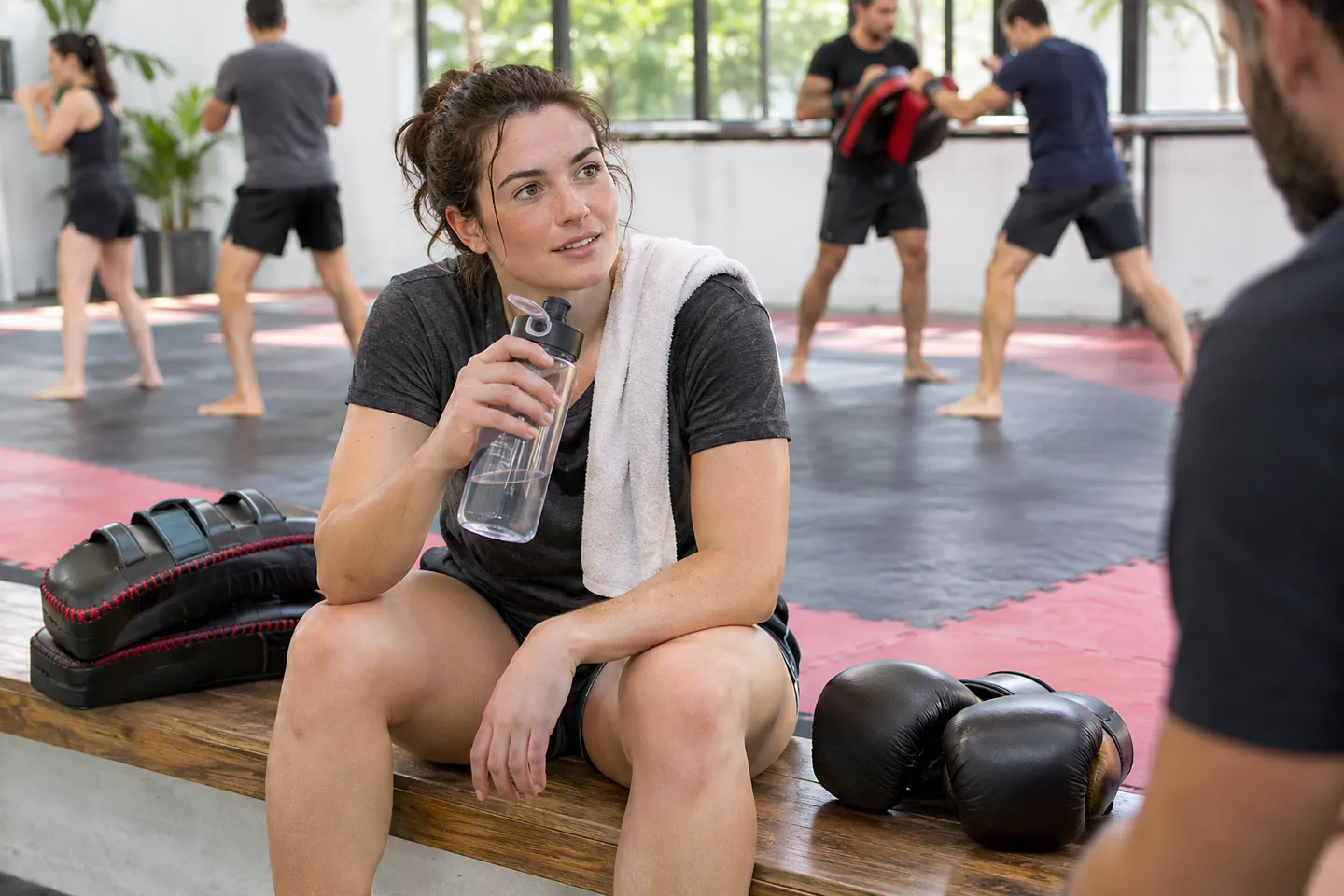
A planned break is not missing training time. It creates space to recover, drink when appropriate, reset equipment, and hear the next instruction. Use it deliberately. If you spend the entire break doing extra repetitions, you may miss the change that makes the following round different.
Keep your equipment organized so that the transition does not become a scramble. Place the bottle where the gym permits, check straps when needed, and be ready to listen. These small habits make the class feel calmer. They also reduce the temptation to rush into the next round while still adjusting something important.
If the provided break is not enough for you to continue the assigned task comfortably, tell the coach. They can discuss a modification or additional pause. Do not assume that requesting an adjustment is a failure. The useful question is what allows you to participate appropriately in the current lesson.
Notice technique changes without self-criticism
As a round continues, you may begin forgetting the return, taking extra steps, or losing the order of a combination. Describe the change rather than turning it into a judgement about toughness. “I am rushing the last action now” gives the coach a practical observation to work with.
The response may be a simpler sequence, a slower pace, or a pause. Follow the recommendation and see whether the movement becomes recognizable again. This is an opportunity to learn how effort affects your execution. The lesson is not limited to the moments when everything feels smooth.
Avoid using sloppy repetitions as evidence that you should work even harder immediately. More effort can be the wrong answer to a task that needs more clarity. Let the coach decide which adjustment fits the situation. Their view of the movement provides information that your internal sense of effort cannot supply alone.
Keep discomfort categories separate
Being challenged by an unfamiliar exercise is different from experiencing pain or feeling unwell. Do not place every sensation under the heading of “pushing through.” If something hurts or you become unwell, stop and communicate clearly. Describe what happened without trying to diagnose the cause on the training floor.
A coach can manage the exercise and help you stop safely, but personal medical questions may require appropriate healthcare support. Do not rely on another student’s experience to decide that your situation is the same. The immediate priority is to understand the concern before returning to the activity.
For ordinary uncertainty about effort, ask before it becomes a silent struggle. You might not know whether you should be moving faster or taking more time between actions. That is a coaching question. Clear guidance can remove the pressure of trying to infer expectations from the loudest or busiest person in the room.
Account for the day you actually had
A class after a demanding workday may feel different from a session on a quiet weekend. Travel across Mississauga, family responsibilities, and a rushed arrival can affect how prepared you feel. Tell the coach if there is relevant context, and approach the class you are attending rather than the ideal class you imagined earlier.
This does not require turning every ordinary fluctuation into a major problem. It means avoiding a rigid promise that you must perform identically every time. A sustainable routine leaves room to adjust the task while staying engaged with the lesson. Consistency is easier when one imperfect day does not become a reason to abandon the week.
Practical preparation helps. Pack your equipment before the rush, confirm the current class time, and leave enough room for the journey. Arriving with a few minutes to orient yourself makes it easier to hear the opening instruction. Pacing begins partly in how you organize the transition into training.
Review the session with better questions
After class, do not judge the experience only by how exhausted you feel. Ask whether you understood the assigned movements, communicated with your partner, and maintained attention through the main lesson. A session can be valuable without leaving you completely spent. The purpose of training includes learning, not merely proving that effort occurred.
Identify one point where your pace worked and one point where it became less useful. Perhaps you began too quickly but adjusted after speaking with the coach. That is a meaningful observation. It gives you a specific change to try next time without requiring a complicated tracking system.
If you keep notes, make them brief. Record the type of round, the adjustment, and whether it helped. Avoid inventing precise performance scores that do not reflect the class’s purpose. A clear sentence about the task may be more useful than a page of numbers disconnected from the coach’s instruction.
Build a routine you can repeat
The goal is not to make every class feel easy. It is to participate in a way that supports learning and leaves you willing to return. Choose an attendance pattern that fits your actual week, and ask the coach how to progress as the movements become more familiar. The appropriate challenge can change with experience.
If you are beginning Muay Thai at Konga, use the free trial page to discuss your starting point. Mention that you would like guidance on effort and pacing. A thoughtful first session can teach you when to work, when to listen, and when to ask for an adjustment. Those decisions are part of becoming a capable training partner and student.
Filed under
Keep exploring
More training insights await.