
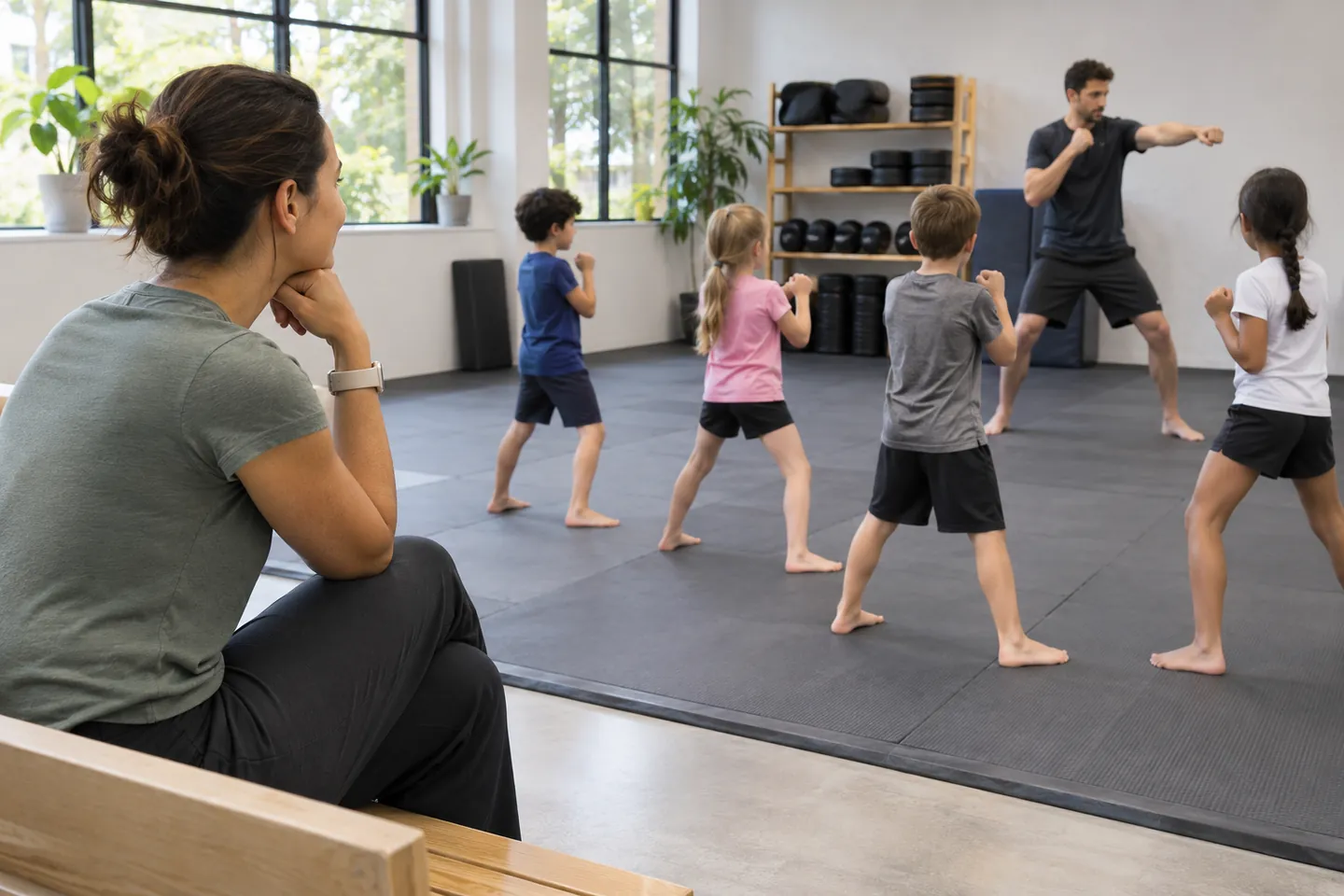
Support your child's martial arts classes in Mississauga with thoughtful sideline habits, clear coach communication, respectful observation, and calm car rides.
Watching your child learn can create an unexpected urge to coach. You see the missed instruction, the wandering attention, or the moment they forget which foot moves first. The correction feels obvious from the sideline. Calling it out seems helpful, especially when you want your child to make the most of the class. Yet the extra instruction may add another voice at exactly the moment they are learning to follow one.
Helpful parent sideline habits for martial arts in Mississauga begin with a clear role. The coach leads the lesson; the parent supports the conditions around it and communicates concerns appropriately. That role is active and valuable without requiring a running commentary. Your presence can make the experience steadier when it gives the child room to learn, make ordinary mistakes, and ask the instructor for help.
Learn the observation policy first
Ask where parents are expected to wait and whether observation is available during the session. Different spaces have different arrangements. Follow the current policy rather than assuming that a seat near the mat is open to everyone. The arrangement may reflect room layout, class flow, or the needs of the group.
Find out how the coach wants parents to raise an immediate concern and when longer questions should be discussed. Knowing the channel prevents you from having to choose between interrupting the lesson and staying silent about something important. A clear process supports both the class and the family’s communication needs.
Explain the arrangement to your child before the session. Tell them where you will be and that the coach will give the activity instructions. Avoid promising to direct them from your seat whenever they look over. A shared understanding makes it easier for the child to know whose guidance applies during the lesson.
Notice the difference between support and instruction
Support can mean arriving on time, preparing the required items, and helping the child understand the routine. Instruction means telling them how to perform the activity in the moment. During class, that second responsibility belongs with the coach unless the instructor specifically invites parent participation.
Even a correct sideline reminder can create confusion. Your child may turn toward you and miss the next demonstration. They may also hear a different phrase from the coach and wonder which version to follow. The issue is not whether your intention is good; it is whether the added voice helps the current learning task.
If you notice a repeated technical difficulty, make a brief note and ask the coach about it later. They may already be addressing it, or they may be prioritizing a different detail first. A private conversation gives you context that is not visible from the seating area and avoids putting the child on display.
Let ordinary mistakes remain ordinary
A child will sometimes forget a sequence, look at another group, or need to be shown where to stand. These moments do not automatically mean they are wasting the class. Learning a new routine includes mistakes and corrections. Watch how the coach helps the child rejoin the task before deciding that you need to intervene.
Try not to react dramatically to every error. A visible sigh, a pointed gesture, or an exaggerated look can turn a small mistake into a social event. The child may begin checking your response instead of listening to the instruction. A calm presence leaves more room for the coach’s feedback to do its work.
This does not mean ignoring a concern. If a pattern persists or something seems inappropriate, discuss it. The distinction is between useful communication and immediate commentary on every imperfect attempt. One thoughtful question after class can be more effective than ten corrections from across the room.
Use encouragement that does not add pressure
When encouragement is appropriate, keep it simple and aligned with the class atmosphere. Follow the coach’s expectations about talking or cheering during activities. Some moments call for quiet attention. Others may welcome group encouragement. Observe the setting rather than assuming a louder response is always more supportive.
After class, describe a specific effort you noticed. “You waited until the coach finished explaining” or “You asked for another demonstration” gives the child an action they can recognize. Avoid praise that depends on being the best, never making a mistake, or appearing fearless throughout the session.
Do not compare your child with a sibling or another student. The comparison may overlook differences in experience, instructions, or comfort with the setting. It also changes the focus from learning to ranking. Your child’s useful reference point is their own understanding and the next task the coach has identified.
Protect other families’ privacy
Ask about the gym’s photography and recording rules before using a camera. Even if you are filming your own child, other children may appear in the frame. Their families have not automatically agreed to recording or online sharing. Follow the program’s permission process and respect any limits without treating them as an inconvenience.
Do not post identifiable images of other children without the required consent. A proud family moment can still involve someone else’s privacy. If recording is permitted, keep it brief and avoid interrupting the lesson to obtain a better angle or repeat an action for the camera.
Be thoughtful about conversation as well. The seating area is not a place to discuss another child’s behaviour, ability, or family circumstances. You may be seeing only a small part of the situation. Keep concerns directed to staff through the appropriate channel rather than turning them into sideline commentary.
Give the coach time to teach
A coach managing a group may not be able to answer a detailed parent question immediately. Ask when there is an appropriate time to talk. A scheduled conversation can provide more attention than trying to catch the instructor while they are starting another class or returning equipment.
Prepare the question in descriptive terms. “I noticed my child often misses the transition between these activities; how can we help them understand it?” is more useful than a broad accusation that they are not being watched. The first invites a comparison of observations and a practical response.
Listen to the explanation before deciding what should change. The coach may be using a progression that is not obvious from the sideline. Equally, you may have relevant information about your child that the instructor has not received. A productive conversation allows both perspectives to inform the next step.
Handle a difficult moment calmly
If your child becomes upset or needs help, follow the coach’s established process. Avoid rushing onto the training area without coordination unless there is an urgent situation requiring immediate action. The instructor needs to manage the group and the individual child, and clear communication helps both happen.
When you speak with your child, focus first on understanding what occurred. They may be frustrated by a task, confused about an instruction, or concerned about a partner interaction. Those situations need different responses. Do not assume the cause from your distant view or insist that finishing the activity is the only acceptable outcome.
If the concern involves pain, feeling unwell, or a significant issue beyond class instruction, seek appropriate help. A coach can support the immediate setting but should not be expected to resolve every health or emotional concern. The family’s response should fit the actual problem, not a general rule about always pushing through.
Make the car ride a transition, not a review meeting
A child may need a little space after class before discussing it. Start with a simple invitation rather than a list of corrections. “What part do you remember most?” allows them to choose the topic. You may learn more from their account than from immediately presenting your own observations.
If you have a concern to discuss, keep it focused and respectful. Avoid replaying every mistake or asking why they were not like another student. The class already involved instruction and correction. The journey home does not need to become a second lesson delivered by someone who was not leading the first.
You can share one positive observation and one practical plan for next time. Perhaps the equipment needs to be packed earlier, or the child wants to ask the coach a question. That keeps the conversation useful. It also shows that the family routine can improve without making the child responsible for every difficulty.
Review your own habits occasionally
Ask yourself whether watching has become enjoyable support or a source of constant tension. If you find yourself correcting every movement mentally, consider how to step back within the gym’s arrangements. You may benefit from focusing on the overall lesson rather than tracking your child every second.
Notice what your child seems to need from you around the class. It may be predictable transport, a calm arrival, or a chance to talk afterward. Those contributions are substantial. Parenting support does not become less valuable because it happens before and after the technical instruction rather than during it.
For families exploring kids martial arts at Konga, use the free trial page to ask about current observation and communication arrangements. A helpful sideline role is clear, respectful, and steady. It gives the coach room to teach and the child room to learn, while keeping the parent involved through practical preparation and thoughtful conversation.
Filed under
Keep exploring
More training insights await.