
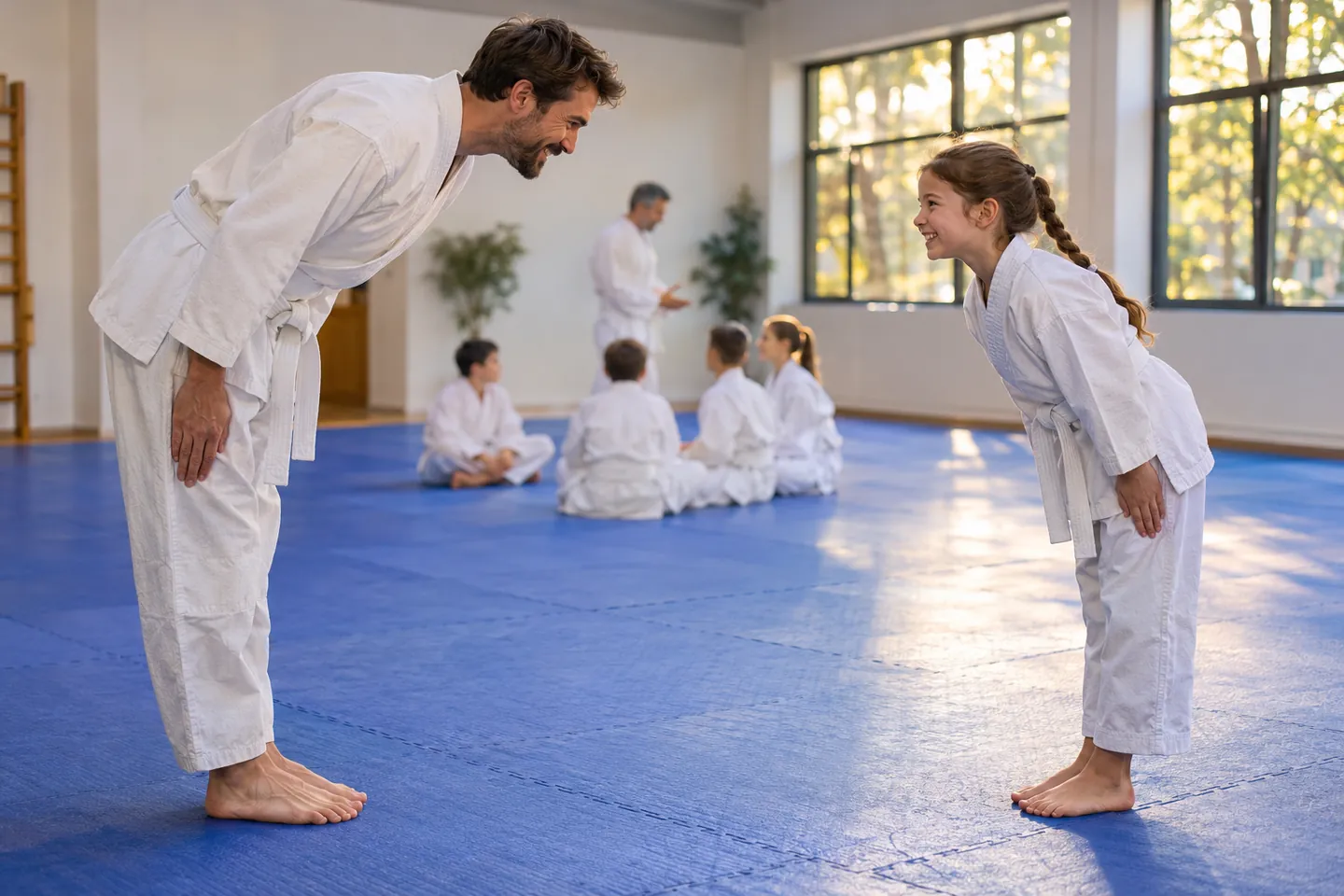
How Mississauga families can make parent and child training at one gym work, from scheduling and car rides to boundaries, motivation and shared goals at home.
For a lot of families, it starts on the bench. A parent drops off a child for kids’ martial arts, sits along the wall for forty-five minutes week after week, and slowly realises they would rather be on the mats than scrolling on their phone. A few weeks later, they are signed up for an adult class at the same gym, and the family’s weekly routine looks very different.
Parents and kids training at the same gym in Mississauga has become more common, partly because it solves a practical problem. When everyone trains at one location, there is one drive, one schedule to coordinate, and one community to belong to. But the benefits go beyond logistics. Children see their parents learning, struggling and improving, and parents gain a much clearer understanding of what their kids are going through.
This post looks at how families can make shared training work well, what to watch out for, and how to keep it enjoyable for everyone. It is written mostly for parents, since you will be the ones organising the calendar, but there are ideas here for helping kids feel ownership over their own training too.
Why it works for many families
The most obvious benefit is time. Families in Mississauga already juggle school, work, homework, extracurriculars and often long commutes. If a parent’s class runs before or after their child’s, or at the same time in a different area, the family can fit fitness into an evening without needing two separate trips across the city.
There is also a cultural benefit. Children are strongly influenced by what adults do, not just what they say. When a child sees a parent showing up regularly, listening to a coach, and getting back up after a tough round, it reinforces the values the kids’ program is trying to teach. Discipline and effort stop being lectures and become family habits.
Shared training also gives you something to talk about. Car rides home can turn into conversations about what each person learned, which drills were hard, and what felt good. For some families, especially with older kids who are becoming less chatty, that shared language is valuable.
Separate classes, shared environment
In most gyms, including ours, children and adults train in separate classes designed for their age and needs. Kids’ programs focus on movement skills, focus, coordination and safe technique, delivered in a way that suits their attention spans. Adult classes move at a different pace and include more physical intensity.
That separation is a good thing. Children need space to learn without feeling watched by their parents every second, and adults need space to work hard without worrying about their kids. You are training under the same roof, not necessarily side by side.
Some families like to arrange schedules so that classes overlap, letting everyone train at once. Others prefer back-to-back sessions so one parent can watch the child’s class and then train afterward. Look at the kids schedule and adult schedule together to see which arrangement suits your household.
Choosing programs for each person
Parents and children do not need to train the same discipline. A child might love kids martial arts while a parent prefers boxing or yoga. In fact, choosing based on individual interests often leads to better long-term attendance than forcing a match.
That said, some families enjoy training the same art. A parent and child both learning Brazilian jiu-jitsu, for instance, can practise simple drills together at home and share the excitement of promotions. If you go this route, be careful not to turn every home moment into extra coaching. Children usually respond better to encouragement than correction from a parent.
For younger kids, it can help to let them try a couple of options before committing. For parents, think about what you want: fitness, stress relief, self-defence skills, or a new challenge. Each of those may point toward a different class.
Managing the logistics
A good routine is predictable. Pick class times you can realistically maintain through the school year, accounting for homework, other activities and seasonal changes. Winter driving on Mississauga roads can turn a fifteen-minute trip into forty minutes, so give yourself buffer time from December through March.
Pack bags the night before. Kids’ uniforms, belts, water bottles, mouthguards and adult gear add up quickly, and nothing derails a training night faster than a missing belt discovered at the door. Some families keep a dedicated gym bin by the front door so everything returns to the same place.
Plan for food. Training on an empty stomach after school is hard for many children, and adults coming straight from work may be in the same situation. A light snack in the car, such as fruit or a small sandwich, can make the difference between an energetic class and a cranky one.
Letting your child have their own space
One risk of training at the same gym is that a child may feel they never get a break from their parent. Kids benefit from having places where they are known on their own terms, by their own coaches and friends. Try to respect that.
If you are not training during your child’s class, consider whether watching from the side is helping. Some children love having a parent watch. Others become self-conscious or start performing for you rather than listening to the coach. Ask your child what they prefer, and ask the coach what they observe.
Avoid coaching from the sidelines. Calling out instructions or corrections can confuse a child who is trying to follow their instructor. Save your praise for afterward and focus on effort rather than outcomes: “I saw you keep trying that roll” means more than “You should have done it like this.”
Being a beginner in front of your kids
For parents, one of the most powerful parts of shared training is letting your children see you as a beginner. Adults often avoid situations where they look awkward or uncertain. Stepping onto the mats and visibly learning something hard sends a strong message about courage and growth.
Talk openly about your experience. Tell your child when a class was difficult, when you made a mistake, or when something finally clicked. This normalises struggle and shows that improvement takes time for everyone, not just children.
Be honest about frustration too. If you had a rough session, you can say so without being negative: “That was hard tonight, but I’m going back on Thursday.” Kids absorb that kind of resilience more deeply than any motivational speech.
Keeping it positive at home
Shared training can create wonderful moments at home, such as practising a drill together in the living room or stretching side by side before bed. It can also create friction if it turns competitive or critical. Keep things light.
Let your child teach you something they learned. Children often love being the expert, and explaining a technique helps them understand it better. You may be surprised by how much detail they remember.
Be careful with roughhousing. Martial arts practice at home should stay gentle and controlled, with clear rules and plenty of space. Coaches teach safety for a reason, and those rules apply in the basement too. If there are younger siblings around, keep practice to movement and balance drills rather than partner techniques.
When motivation dips
Every family will hit periods when someone does not want to go. It might be the child after a tough week at school, or the parent after a long shift. Having multiple people in the household training can help, because one person’s enthusiasm can carry the others.
It is also worth distinguishing between a temporary dip and a real problem. If a child consistently dreads class, talk to them and to the coach. There may be a social issue, a skill they are struggling with, or simply a need for a different program. Forcing attendance rarely builds a lasting love of training.
For parents, remember that your own attendance matters. If you skip regularly while insisting your child goes, the message is mixed. That said, life happens, and occasional missed sessions are normal for everyone.
Shared milestones
Belt promotions, first sparring sessions, or completing a challenging class are worth celebrating. When parents and kids train at the same gym, these milestones become family events. Children can cheer for their parents’ achievements, and parents can be fully present for their kids'.
Keep celebrations proportionate. A favourite dinner or a small outing works well. The aim is to recognise effort and persistence, not just results. Avoid comparing family members’ progress; each person is on their own path at their own pace.
Some families keep a simple training journal or calendar on the fridge, marking each class attended. Watching the marks accumulate over months is satisfying for kids and adults alike.
Health and recovery for busy parents
Parents often put themselves last. Training at the same gym as your kids is a chance to change that, but it is important to look after your own body as you start. Ease into classes, especially if you have been inactive for a while, and tell coaches about any injuries or health concerns.
Recovery matters more as we age. Prioritise sleep, stay hydrated, and consider mobility work or a yoga session to balance more intense training. If something hurts beyond normal soreness, speak with a qualified professional. Our on-site physiotherapy and massage services are available to members who want support.
Taking care of yourself also sets an example. Children learn that rest and recovery are part of training, not signs of weakness.
Getting started as a family
If you have been watching from the bench and wondering whether you should join in, the answer is probably yes. Training at the same gym as your kids can make your week simpler, your family more connected, and your own health a higher priority.
Start by booking a free trial for yourself, and talk with our team about how your class could fit around your child’s. If your child has not started yet, look at our kids martial arts program and see whether there is a time that works for everyone in your household.
Filed under
Keep exploring
More training insights await.