
Partner workout ideas for couples in Mississauga: you-go-I-go circuits, pad drills, shared goals, scaling for different fitness levels, and keeping it enjoyable.
For a lot of couples, the week is a relay race. One person drops the kids at school while the other heads to work early. Someone covers dinner while the other picks up groceries. By the time the household quiets down, there is little energy left for each other, let alone for exercise. Training together can solve two problems at once: it puts movement back into the week and turns it into shared time.
Partner workouts are not only for couples who are already fit or already sporty. They work for people at very different levels, people who have never set foot in a gym together, and people who simply want a regular activity that is not another chore on the calendar. Couples in Mississauga use them to build fitness, stay connected and keep each other accountable through busy seasons.
This article covers the benefits of training as a couple, how to handle differences in fitness and experience, and a set of practical partner workout formats you can use at the gym or at home.
Why training together helps
Accountability is one of the most obvious advantages. It is much easier to skip a workout when you are the only one who knows about it. When your partner is waiting by the door with their gym bag, the decision is made for you. Couples often find their attendance becomes more consistent once they plan sessions together.
Shared training also creates a new kind of time together. It is active rather than passive, and it involves teamwork, encouragement and the occasional bit of friendly teasing. For couples whose time together usually involves screens or logistics, this can feel refreshing.
There is also something valuable about seeing each other work hard. Watching your partner push through a tough round, learn a new skill or reach a goal can build respect and appreciation. Many couples say that training together gives them a shared language and a set of experiences that they would not have otherwise.
Handling different fitness levels
Very few couples start at exactly the same level. One partner may have played sports for years while the other is new to exercise. One may enjoy running while the other prefers lifting. These differences are normal, and they do not prevent you from training together effectively.
The key is to focus on effort rather than output. In most partner formats, each person works at their own intensity. A beginner might do push-ups against a bench while an experienced partner does them from the floor. One person might use a lighter kettlebell, or row at a gentler pace. Both are working hard relative to their own ability.
Avoid comparing numbers. It is easy to slip into competition, especially if one person is naturally competitive. Instead, celebrate personal progress. Notice when your partner manages a new weight, completes an extra round, or looks more confident with a movement. Encouragement builds momentum; comparison often erodes it.
You-go-I-go circuits
One of the simplest partner formats is the “you go, I go” structure. One person works while the other rests, then you switch. This naturally builds rest into the session and keeps both partners engaged.
For example, one partner performs a set of goblet squats while the other rests. When the first partner finishes, the second performs their set. Move through a series of exercises such as squats, push-ups, rows, lunges and planks. Each person chooses a weight and variation that suits them.
This format works well for couples with different fitness levels because each person sets their own pace. The rest periods also provide moments to chat, offer encouragement or give a quick reminder about form. Aim for three to five rounds, depending on time and energy.
Shared-rep challenges
Another popular format involves sharing a total number of repetitions. Choose a target, such as one hundred kettlebell swings or two hundred bodyweight squats, and split the work however you like. One partner works while the other rests, switching whenever the active partner needs a break.
This structure encourages communication and teamwork. Partners decide together how to divide the work, and it is easy to adjust if one person is tiring faster. It also creates a sense of shared achievement when the target is reached.
Be mindful of form throughout. In the push to finish, it can be tempting to rush. Keep movements controlled, and take breaks whenever form starts to slip. The goal is to work together effectively, not to race through sloppy repetitions.
Synchronized movements
Some exercises are fun to perform at the same time. Partner squats, where you face each other and squat in unison, or synchronized lunges, where you both step forward together, can create a sense of rhythm and connection. Matching pace requires attention and communication.
Medicine ball passes are another option. Stand a short distance apart and pass a ball back and forth with chest passes, overhead throws or side tosses. Choose a ball weight that both partners can handle comfortably, and keep throws controlled to avoid dropped balls or accidental impacts.
Plank high-fives are a playful core exercise. Facing each other in a high plank, you take turns lifting one hand to tap your partner’s hand while keeping your hips steady. It challenges core stability and usually generates a few laughs along the way.
Pad work and striking drills
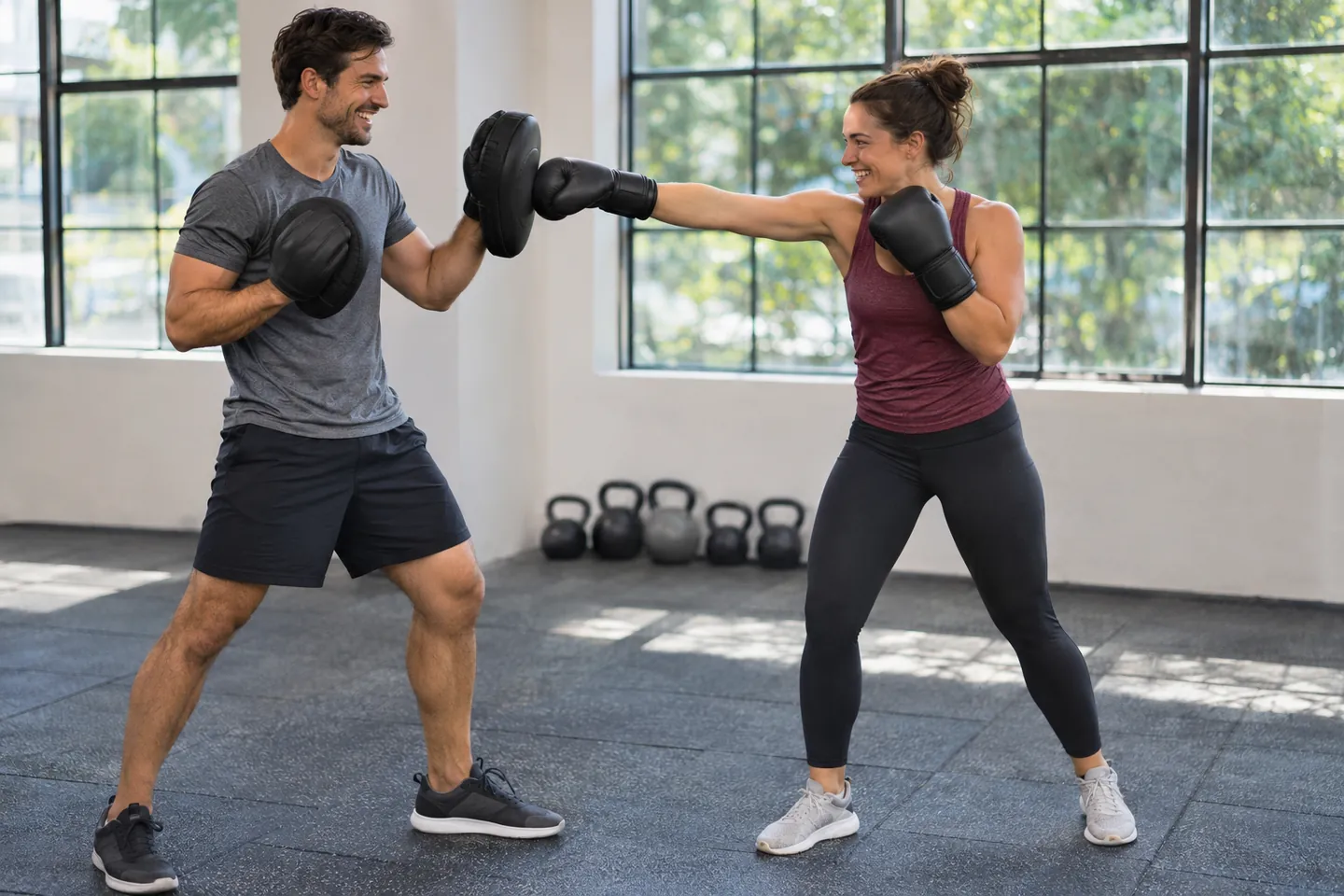
Combat sports offer some of the most engaging partner workouts. Holding pads for your partner while they practise punches and kicks combines fitness with skill and requires focus from both people. Many couples find it surprisingly enjoyable.
If neither of you has experience, take a class first. Learning how to throw punches and hold pads safely from a qualified coach prevents bad habits and injuries. Boxing and kickboxing classes often include partner drills, so you can practise together under supervision.
Once you have the basics, pad rounds can become a regular part of your sessions. Start with simple combinations, keep power moderate, and switch roles every round. Communicate about pace and comfort. The person holding pads should feel safe, and the person striking should feel supported.
Training together at home
Not every partner workout needs a gym. Bodyweight circuits at home can be just as effective, especially on busy weeknights or when weather in Mississauga makes travel unappealing. A small open space, a timer and a bit of creativity are enough.
Try a simple circuit of forty seconds work and twenty seconds rest, rotating through exercises such as squats, push-ups, reverse lunges, mountain climbers and glute bridges. Partners can perform the exercises together or alternate. Repeat three or four times.
Walking and hiking also count. A brisk evening walk through your neighbourhood or a weekend outing along a trail by the Credit River gives you time to talk while staying active. These lower-intensity sessions balance harder workouts and are a pleasant way to spend time together.
Safety when you train as a pair
Partner exercises add a few safety considerations that solo training does not. Space matters more, because two people moving at once take up more room than one. Before starting, check that there is enough clearance around you for lunges, ball passes and any kicks or punches.
Agree on simple signals. A word such as “stop” should mean both people pause immediately, no questions asked. This is especially important during pad work and medicine ball drills, where one person’s fatigue or loss of focus can affect the other. Keep the tone relaxed, but take the signal seriously.
Be honest about aches, old injuries and energy levels. Partners sometimes push through discomfort to avoid letting the other person down, which is exactly the wrong instinct. If either of you has a health concern, speak with a qualified professional before trying more demanding sessions, and scale the workout so both of you can finish feeling good rather than battered.
Setting goals as a team
Shared goals can make training more meaningful. You might aim to complete a certain number of workouts each month, try a new class together, or prepare for an event such as a charity walk or a hiking trip. Having something to work toward gives sessions a sense of purpose.
Individual goals still matter. One partner might want to build strength while the other focuses on endurance or flexibility. Talk openly about what each of you hopes to achieve, and look for ways to support each other’s goals within your shared sessions.
Revisit goals periodically. Life changes, and goals may need adjusting. A busy period at work or a new family commitment might mean scaling back temporarily. The point is to keep training together in a way that fits your current situation.
Keeping it enjoyable
The best partner workouts are ones you both look forward to. If one partner dreads the sessions, consistency will suffer. Pay attention to what each of you enjoys and build sessions around those preferences.
Variety helps. Alternate between gym sessions, home workouts, classes and outdoor activities. Try something new every few weeks, such as a yoga class, a strength session or a martial arts trial. Novelty keeps things interesting and can reveal new shared interests.
Be patient and kind with each other. Some days one of you will feel tired, unmotivated or frustrated. Offer encouragement rather than criticism, and be willing to adjust the plan. A short, easy session is still better than no session, and it keeps the habit alive.
When to train separately
Training together is valuable, but it is fine to train separately as well. Each partner may have activities they enjoy alone or with other friends. Separate sessions allow you to pursue individual goals and bring new energy back to your shared workouts.
Some couples find a balance where they train together once or twice a week and independently on other days. Others prefer to do the same class but focus on their own work rather than partnering up. There is no single right approach.
Respect each other’s need for space. If one partner wants to focus on a sport or program that the other does not enjoy, support that choice. Shared training should add to the relationship, not create pressure.
Taking the next step together
If you want guidance, structure and a fun environment, consider joining classes together. Group classes offer a mix of fitness and skill training, and you can ask the team whether personal training options could work for the two of you.
Konga Fitness welcomes couples looking to train together in Mississauga. Complete beginners and people returning after a long break are both common in classes, so you can book a free trial and find out which classes suit you both.
Filed under
Keep exploring
More training insights await.