
How older adults in Mississauga can use one-on-one personal training to build strength, balance and confidence at a sensible pace, with medical guidance.
Getting up from a low couch without pushing off your knees. Carrying groceries from the car to the kitchen in one trip. Stepping off a curb on a slushy February morning without that small moment of hesitation. For many older adults, these are the kinds of goals that matter most, and they are exactly the kinds of goals that thoughtful strength training can support.
Personal training for older adults in Mississauga isn’t about chasing the routines you see younger people doing on social media. It is about building and keeping the capacity to do the things you value, on your own terms, for as long as possible. One-on-one coaching can be a practical way to do that, especially if you are new to exercise, coming back after a long break, or managing a health condition that calls for a careful approach.
This guide explains what a good training relationship can look like later in life, what to discuss before starting, and how sessions are typically structured so they feel challenging but manageable.
Start with a conversation, not a workout
The first meeting with a personal trainer should feel more like an interview than a workout. A good trainer will want to know about your health history, any medications that affect exercise, previous injuries, joint replacements, and what an ordinary week looks like for you. They will also want to hear what you’d like to be able to do, whether that’s playing with grandchildren, walking the Credit River trails, or simply feeling steadier on stairs.
It is wise to check with your family doctor before beginning a new exercise program, particularly if you have heart, lung or blood pressure concerns, osteoporosis, diabetes or a recent surgery. Your doctor may have specific guidance, and sharing that with your trainer helps them plan appropriately. A trainer is not a substitute for medical advice, and a responsible one will say so.
Bring your questions to this first conversation. Ask how the trainer adapts sessions for older clients, how they monitor effort, and what they’d do if something felt uncomfortable during a session. The answers will tell you a lot about their approach.
Why strength still matters
People sometimes assume that walking and light activity are enough as they age, and these are certainly valuable. Strength training adds something different. Muscles that are challenged regularly tend to stay more capable, and capable muscles help with balance, getting up from chairs and floors, and handling everyday loads.
Strength training for older adults doesn’t have to mean heavy barbells. It can involve resistance bands, light dumbbells, cable machines, body weight or a sturdy step. What matters is that the muscles are asked to do a bit more than they are used to, in a controlled way, and that the challenge increases gradually over time.
A trainer helps by choosing exercises that match your current ability and by watching your form closely. They can also judge when you’re ready for a slightly heavier weight or one more repetition, which is often hard to judge on your own.
Balance deserves its own attention
Balance is a skill, and like other skills, it can be practised. Many training sessions for older adults include balance work alongside strength exercises. This might mean standing with feet closer together, shifting weight from one foot to the other, stepping in different directions or standing on one leg with support nearby.
The key is safety. Balance exercises should be done next to a wall, rail or sturdy surface, with the trainer close by. Progress is gradual. You might start holding onto a support with both hands, then one hand, then just fingertips, over a period of weeks.
Improved balance can make a noticeable difference in daily life, especially in Mississauga winters when sidewalks and parking lots can be unpredictable. Feeling more stable on your feet often brings a quiet boost in confidence that encourages you to stay active outdoors.
What a typical session might look like
Sessions vary, but a common structure begins with a gentle warm-up: walking, marching in place, arm circles, or easy mobility movements to prepare the joints. This might take several minutes, longer on cold mornings or if you’ve been sitting for a while.
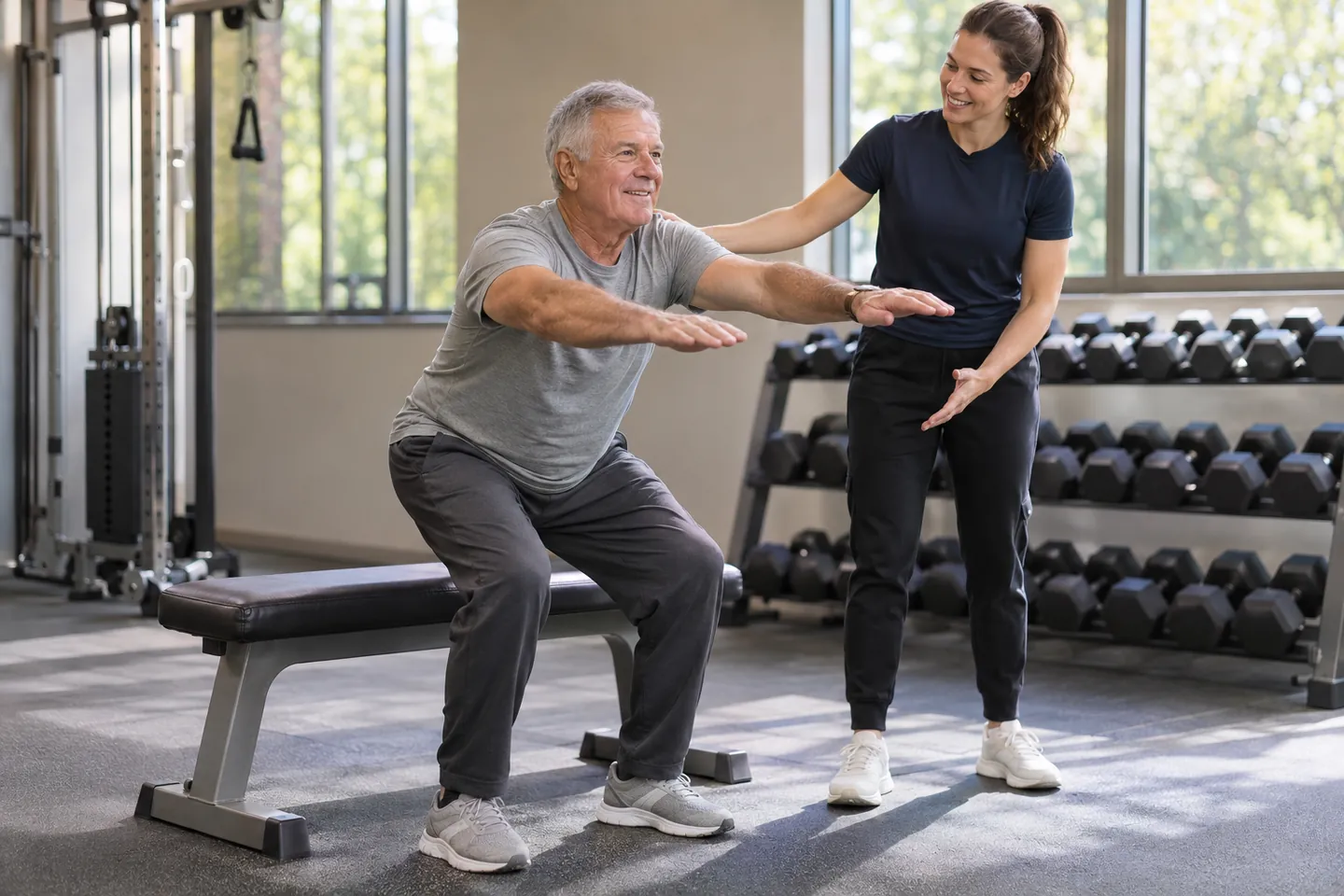
The main part of the session usually includes a handful of strength exercises that cover the major movement patterns: pushing, pulling, squatting or sitting down and standing up, hinging at the hips, and carrying. Each exercise is chosen and adjusted for you. A squat might be a sit-to-stand from a bench. A push might be against a wall rather than the floor.
Balance and mobility work often fit in between strength exercises or at the end. Sessions usually finish with a cool-down and a brief chat about how things felt. Your trainer may suggest one or two simple movements to practise at home between sessions.
Managing effort sensibly
One of the trainer’s most important jobs is helping you find the right effort level. Too easy, and the body has little reason to adapt. Too hard, and you might feel unwell, become discouraged, or risk injury. The sweet spot is usually challenging but comfortable enough that you could still hold a conversation.
Trainers often use a simple scale where you rate how hard an exercise feels. This helps both of you track effort over time and adjust on days when you’re feeling tired, stiff or under the weather. Some days will be better than others, and a good trainer adapts without making you feel you’ve failed.
Speak up if anything feels wrong: dizziness, chest discomfort, unusual shortness of breath or sharp pain are signals to stop and, if needed, seek medical attention. Ordinary muscle tiredness is expected. Pain that feels different from that should never be ignored.
Working around joints and past injuries
Many older adults have a history of joint issues, from knee or hip arthritis to old shoulder injuries or replaced joints. These don’t necessarily rule out strength training, but they do shape it. A trainer can choose exercises that work around sensitive areas, adjust ranges of motion, and select equipment that feels comfortable.
If you’re under the care of a physiotherapist or other healthcare provider, it can help to share their recommendations with your trainer. Coordination between the two means your training supports your rehabilitation rather than working against it. At our gym, clients can also access physiotherapy and massage services, which some people find useful alongside their training.
Never feel that you need to push through joint pain to prove yourself. Modifications aren’t a lesser version of the workout. They’re the workout that’s right for you.
Bone health and impact
Bone health is a common concern later in life, particularly for women after menopause and for anyone diagnosed with low bone density. Strength training and certain types of weight-bearing activity are often recommended as part of an overall approach, but the specifics depend on individual circumstances.
If you’ve been diagnosed with osteoporosis or osteopenia, ask your doctor which movements to avoid and which are encouraged. Some exercises, such as deep forward bending or heavy twisting under load, may need to be modified or skipped. A trainer can follow those guidelines and build a plan around them.
This is one area where professional guidance is particularly valuable. General information online can be contradictory, and your own situation may be different from what a generic article describes.
Consistency over intensity
The most effective training plan is one you can actually keep doing. For many older adults, two or three sessions a week, whether with a trainer or partly on your own, is a sustainable rhythm. Some people prefer early weekday sessions before errands, while others like midday when the roads are quieter after the morning rush on the 401.
Missing a week because of a cold, a family visit or a trip doesn’t undo all your progress. When you return, your trainer may scale things back slightly before building up again. The long-term pattern matters far more than any single session.
Keeping a simple log can help. Note the exercises, the weights or bands used, and how you felt. Looking back after a few months can be genuinely encouraging, especially on days when progress seems slow.
The social and mental side
Training with the same person regularly builds a relationship, and that relationship can be motivating. Knowing someone is expecting you makes it easier to show up on grey days. Many older clients also mention that sessions give them structure and something to look forward to during the week.
Some people eventually enjoy adding a group class or a gentle yoga session for variety and social connection. Others prefer to keep training one-on-one. There’s no wrong choice. What matters is finding a combination that keeps you active and engaged.
Exercise is also commonly associated with better mood and sleep. Those effects vary from person to person and aren’t a substitute for professional care if you’re struggling, but many people notice they simply feel better on days they move.
Questions worth asking a trainer
Before committing, consider asking a prospective trainer how often they work with older adults, how they adjust programs for health conditions, and how they communicate with other healthcare providers if needed. Ask what a first month typically looks like and how they measure progress.
You might also ask about the training environment. Is the space accessible? Is there seating nearby for rests? Is parking easy? These practical details make a real difference to whether training feels sustainable.
A good trainer will welcome these questions. They show that you’re taking your health seriously and want a partnership that works.
Taking the first step
Starting a training program later in life can feel like a big decision, but the first step is usually a simple conversation. You don’t need to be fit to begin, and you don’t need to know anything about exercise. That’s what a trainer is for.
If you’d like to explore personal training at our Mississauga gym, feel free to contact us to ask questions or arrange an initial meeting. We’ll talk through your goals, your health considerations and what a realistic, enjoyable plan might look like for you.
Filed under
Keep exploring
More training insights await.